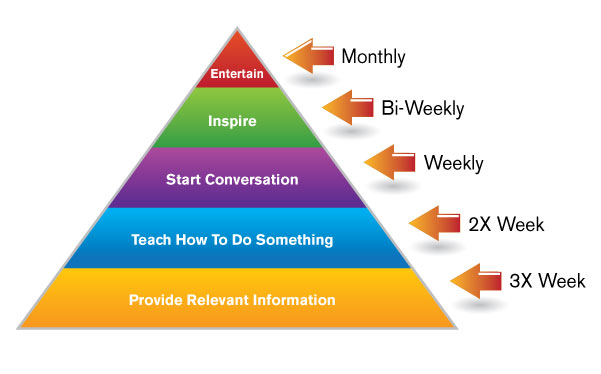
The content Marketing Institute created that nice little image up there that shows what a content mix might be.
This image has been bandied about on various websites as THE correct mix. It isn’t THE correct mix but it’s a good starter to make you think. It might make you think you are entertaining your potential clients too much or it might make you think you are being a bit boring talking about kitchen worksurfaces a little too much.
Click To Read More Interior Design Articles
For a start it’s saying that you should blog 6 times a week or at least create content 6 times a week. For small businesses that just ain’t gonna happen in the real world.
However it certainly DOES give you ideas about what to write next.
Provide relevant information: Perhaps contribute to a thread somewhere telling people about some of the great things you learnt with a particular product on your last project.
Teach: Show you really know what you are talking about. Share some knowledge in an authoritative way on how you do your job.
Start a conversation: Perhaps on a LinkedIn group or your Facebook business page.
Inspire: others to do better. This could be on a forum or your could write something.
I’ve posted the same question and a link to this (evolving) article on LinkedIn. You can take the question literally if you wish. As a reward I will link back to you from this page for any noteworthy (good or bad!) answers that I might paraphrase for the sake of brevity. The more ‘sensibly’ creative your answer the more likely I will include you and your answer. Go create.
Designcouncil.org.uk describes interior design as “Interior design isn’t just about home decoration. It is concerned with creating functional and beautiful to look at interior spaces in all sorts of places including houses, public buildings and commercial properties such as shops, restaurants, leisure venues and offices. Interior design can also be applied to temporary environments, whether that’s pop-up shops that are in existence for just a few months at a time, or show homes and exhibition stands that may simply last days. Anything that has an interior can be designed, redesigned or refurbished.”
Whereas Wikipedia suggests: “… a group of various yet related projects that involve turning an interior space into an ‘effective setting for the range of human activities’ that are to take place there”
Rebecca at RHA Interiors: “[if all else]…fails I always go for the football analogy, ‘why choose red over blue?’”
Terry Maurer makes interesting comments noting that kids are increasingly influencers in the interior design purchasing and commissioning process in families.
Mark Randall at 1901 Design would ask the boy to learn what interior design means by “doing” And the boy would be asked to create his perfect den. Sharon Kaper suggests a similar “show-and-tell” approach.
Mike Major suggests it should be no different to explaining it to a potential client.
Many Interior Designers have Pinterest accounts and quite a few of us use them. Here are my thoughts on whether or not interior designers should use Pinterest and HOW they should best use Pinterest.
https://pinterest.com/paulaovallev/color/
Here, for example is Paula Ovalle Vicuña’s beautiful pinboard of colors. Now, this and similar boards are great sources of imagery for colours for interior designers and of course there are other pins showing styles and colour themes and so on. If you had a board like this you could show your clients on your iPAD as part of your presentations.
Click To Read More Interior Design Articles
BUT think carefully about how you are going to use this as a tool to win more business. How are your potential clients going to be driven to you and/or your web site. Why is your potential client going to be looking on pinterest for work by interior designers. They MIGHT be using it as a means of selecting designers but IMHO I doubt that many potential customers will be doing that – some, for sure, but not many.
Now, your competitors may be using it to get some inspiration. So you’ve done a bit of work to help your competitors. That’s all well and good as others will reciprocate and you will benefit from that potentially. But that hasn’t got you any more sales has it?
If you are going to use pinterest for collecting and presenting images then it may be great as a productivity tool.
You have the option with pinterest of creating secret/hidden boards – that may be a good way forwards for those of you conscious NOT to help out your competitors!
So you have to answer this question: “Do my clients hang out on Pinterest so making them more likely to find out about my interior design skills from my Pinterest account?”.
IF you can answer that question positively then read on…
Effective Pinterest Marketing
1. Fill-in the Form! Setup You Account Properly – Gets the Basics Sorted Out
Your name (first and last), username, logo, About, Location and Website information should all be properly included. PLEASE if you can make sure that, for example, you use the same name as you do across all media – printed and electronic. It’s good for your ‘branding’. Verify your website and put your blog address in your ‘About’ section.
2. Be a digital stalker! Follow People – You build a following, which looks good to potential new followers, if you follow people. They often reciprocate. It’s a bit like Twitter in that respect. Perhaps look for people or boards with certain of your keywords on them and then follow those people.
3. In the Digital World, Content is King! Get content. Regularly seek out and add new relevant content. To be truly amazing you will, of course, add your own original content. Content may be the king but creativity rules the Empire of Design.
More?
Create a board and use it (link to it) on facebook or twitter to invite your other followers to discuss it.
When you blog you always add at least one great image right? Well make a collection of those great images on pinterest. That way you save a little time by using one piece of content twice.
Focus on the right content. Think always about your target customer. Only post what they are going to be interested in.
Put a url in your comments on pins to link back to the original content (your blog), Ibelieve I am right in saying that this URL is made clickable by pinterest.
English: Selection of Danish Modern chairs at the Danish Design Center, Copenhagen (Photo credit: Wikipedia)
Modern vs Contemporary: Contemporary is usually something that is modern or recent looking yet which takes something ‘good’ from the past such as, for example, GOOD traditional materials. Modern may sometimes (and probably incorrectly) infer a degree of futuristic design.
Vintage vs Retro vs Reproduction: Something vintage is from its original period. Retro is something that has been recently made in the style of an older piece or period. Reproduction is a copy of an item some time after its original period has finished. A fake is a reproduction that is specifically designed to be passed off as an original.
Selective indulgence: You probably haven’t got the budget to have a fully indulgent design. So instead you choose to be indulgent on certain concept or focus pieces that make a statement.
Organic – This can mean ‘eco’ in modern parlance. But you should also be aware that others use it to mean natural in a very broad sense – for example to how your entire scheme works together and fits to the space.
Energy: This is more about emotions and feelings than the vividness of colours or eye-catchingness of objects.
Re-purpose – this means more than just to re-use something. Yes you re-use it but you re-use it for a different purpose.
Diversified Portfolio: You have more than just taupe in the photos of your past work 😉 Your portfolio will show different types of projects, say, a classic villa and a contemporary restaurant
Collaborative spaces – allow spaces for group work but also allow such spaces to be able to be used and re-used for different functions or groups.
English: JC Hryb, interior designer/owner of Style de Vie and Twenty Gauge, promotional photo (Photo credit: Wikipedia)
What can I write about?
Anything you want to of course. Although it is clearly best for you to write things that your target audience will be most interested in, the things that will make them come back to your blog again and again and again. In old marketing speak that raises your brand awareness (and the interest in it).
It’s also best to write the words that NEW potential clients are most likely to type into google.
However, I suspect that you have come to this post as you have run out of ideas. Don’t worry it happens to us all.
Use these tools to find alternative ways or approaches to subjects you have already written about:
Who is the best interior designer in the world? blimey that’s a question and a half.
I’m writing this post in wordpress and I use this thing called Zemanta which suggests images and articles to do with the subject, with suggestions changing as I compose the article. So the first designer that appears will get put in the picture on the right and that will be the person you are looking at now!
I’ll probably not know the person that is suggested (we’ll see it still hasn’t appeared yet!)
Ooops there she is: Tanya Gyani.Congratulations Tanya.
Now of course there probably really is no ‘best interior designer in the world’ that we can all agree on. But the point of my post was to go one of two ways. I was either going to come from the angle of saying that YOU should be the best interior designer in terms of how you market yourself to your target nichesOR that whoever comes up and gets put in my picture isthe best interior designer in the sense that they are the best at getting their image shown against a generic search for “the best interior designer in the world”.
Click To Read More Interior Design Articles
Maybe Tanya will now go on to global fame? Who knows? If she does I certainly hope she will start specifying some of our fabrics on her projects as she hasn’t done so yet! (as far as I know).
No; really YOU should be positioning yourself as the best interior designer at what you do. But rather than saying you are “the best at XYZ” it is probably more appealing and more humble for you to phrase it as “I am the only Interior Designer In XXX who does YYY”. Use that sort of angle A LOT in your client communications (written or verbal) and you give your potential clients A REASON TO CHOOSE YOU and a REASON FOR YOU TO JUSTIFY YOUR PRICING. Make sure it’s true of course. For uniqueness is priceless (well almost!!)
Remember of course that it should not all be about price. Your client wants a great job most of all. Cost might be a factor but so also is the risk of who the client chooses. Find a way of exuding confidence and competence to lower that perceived risk.
Good luck you and good luck Tanya (there she even gets a link to her website).
For our American readers I will leave the explanation of another meaning of ‘a bit on the side’ to your furtive imaginations. This article looks at some of the ways you can make a bit of money (on the side) from your blog – that is ways other thanthat of attracting your target customers to your web site.
Be Warned: This may well distract you from your core business for minimal gains!
There are 2 ways that web sites and blogs can make additional revenue. If you are in the right market writing the right stuff you could make $1,000 a month…just like all those unsolicited emails say you can! Or you could be in the wrong market and invest the same amount of time as the person who makes $1,000 a month but yourself only get $50 a month. So be careful.
The 2 ways are shown here.
Put adverts on your site (google adsense – which is the reverse of Google adwords)
Host blog POSTS that are effectively adverts containing back-links to other sites by:
The advertiser or their agent writes the post and you just put it on your site.
Be Warned: This may impact negatively on the image of your blog or website.
Pre-requisites
To make money in either of these examples you need to have people going to your site. So if your site is currently ‘low-traffic’ then I would stop reading now and get back to your interior designing!
Google, with their adsense, program will be interested in adverts on ANY site, including yours. But *YOU* will only make money out of adsense if you firstly have lots of visitors for your great content AND SECONDLY they click on the adverts that Google put there.
If you have a good site with lots of visitors and a good ‘pagerank’ (>3) then advertising agencies will potentially be interested in your site, especially if your subject matter broadly matches that of their clients. If you also have lots of twitter/pinterest/facebook/linkedin followers then that might be a bonus for the agency/advertiser (but probably not, although it should be).
Simple adwords can go anywhere on your site – be it a web site or a blog. Paid posts could be a new page added to your website but more easily it can be accomplished with a blog which you hopefully already have.
So what do I need to do then?
Cheque from Google AdSense (Photo credit: Wikipedia). It’s on wikipedia so it must be true, right? 🙂
A. Attract Agencies
To attract advertising agencies I would firstly check a bit more closely some of the unsolicited emails you have been deleting. Some of these may well have been from advertising agencies genuinely offering to pay you to put posts (and/or back links) on your site for a fee…honest! Workout a standard response to these emails including why your site is great and how much you charge, save it and use it. We have accepted some adverts from this route and, yes, it is true and genuine and you do get paid (or you remove the post). We worked on the assumption that it was virtually zero effort and the post would soon get buried in the history of our numerous posts – you could even put a one year time frame on the advert after which you would remove it.
Secondly I would be proactive and look for sites that let you register an interest to be a host for these paid-for-blog posts. Sites such as www.socialspark.com let you do this.
Click To Read More Interior Design Articles
If you have a good pagerank (>3) and, say, more than 5000 unique visitors per moth then you should get at least US$/£100 for a single post containing one backlink to an advertier’s client’s site. You may or may not get a few of these a month. Compare this to the next paragraph, AdSense, where you should get a higher frequency of lower value income…
Many of you have your blogs on wordpress. If you let wordpress do all the hosting for your then you will not be able to incorporate ads on your site. This is because wordpress place adverts themselves and make money from your site themselves. You can’t see them doing this if you look at your site from your computer…but they do. Honest.
So you have to move or migrate your blog to somewhere that you control. The company who hosts your website will probably be able to let you install wordpress on your part of their machine and then you can use it and put ads onto your site. This could involve quite a complicated migration and software installation for you or your techy people. Again there will be a cost associated to this. You will then have to set up your blog so that parts of it are able to automatically show Google’s ads and credit your account if they are clicked.
NEVER click the ads yourself nor get friends to do it. Google are very clever.
If you are on a site that is controlled by wordpress (like this one) then look at your wordpress control panel for clicks on your site. You will probably see quite a few clicks to sites that you don’t know about. How did these links get on your site? Well they were the ones that google put there. If you add up your clicks you will get some idea of the number of clicks you might get going forwards by doing AdSense yourself. If you work on a revenue-per-click of 20p to 50p (20 cents to 50 cents) then you can do the maths of a best case scenario and a likely case scenario for an interior designer.
Be Warned: AdSense can theoretically show your direct competitor’s adverts on your site through their AdWords program.
Problems
Sites like socialspark.com allow advertisers to automatically put posts onto your site. Whilst I’m sure the content will be ethical I’m not so sure it will always tie in with the image you hope to portray on your site.
Think how your readers will feel. Will they want to be shown ads on your site and might a post from an advertiser, in a way, trick the loyal reader into reading an advert they were not expecting.
Moving to a site capable of hosting AdSense adverts might be tricky and/or time consuming – depending on your current setup.
That’s about it really. Fairly simple to understand but potentially tricky to implement for uncertain rewards.
As an interior designer you’ve probably been attracted to houzz.com to look at the many high quality interiors images there. And there are literally tens of thousands of high quality images. We’ll come back to those in a minute but first we’ll look at some other benefits for you being in that online space.
Houzz.com *IS* a popular web destination. It is used by your competitors and also possibly by future residential clients of yours. It’s always good to hang out with clients right? You keep telling me networking is important so I guess you are with me so far?
Click To Read More Interior Design Articles
There are lots of discussions initiated by potential residential clients. If you buy into how social media works then you will already know that.
Talking to someone and helping them could possibly lead to a sale (or a waste of time).
Talking to someone digitally leaves a record. Someone in the future could come along with the same problem and decide to talk to you based on your response.
Someone could be doing a bit of research into you and your opinions before deciding to contact you.
Of course if you haven’t bought into social media then you’ll think it’s a load of nonsense and you probably should stop reading this now as I’m surely wasting your time!
You can create “idea books” on Houzz. So you can pull together some of your images and perhaps somebody else’s images. You can then use these as part of a presentation to your client, for example. Or you could get your client to pull together an idea book and review that after they’ve finished. The danger there of course is that the client has control of the ‘digital capital’ and may tout around his/her likes and dislikes to your competitors. One issue with doing this on Houzz is that sometimes images are incorrectly tagged and so sometimes you are presented with the wrong images and/or you can’t find the right ones. Another potential issue with Houzz, which I have not verified, is that some images on Houzz become copyrighted by Houzz (I’m not quite sure how they manage that legally but that’s another issue, just be aware).
Any idea books you create stay on houzz and may be seen and liked by other potential customers or copied by competitors or taken to competitors by less discerning clients.
If you put together a pretty coherent theme then that could be seen as giving away your creative work to other people or it could be seen as you being a confident and competent designer worthy of considering for a client’s next project. So it could get you the chance of winning some business.
There are ways to embed “idea books” back onto your website/blog. This is good in that someone else is managing the hosting and techy stuff behind the display of your images and ideas. HOWEVER, and this is importnat, such embedded bits of digital stuff will encourage people to click back to houzz. So you will inadvertently be encouraging a potential customer (or existing customer) back to houzz and potentially out of the eager creative grasp of your web site or blog.
So I’d think carefully about that.
You can of course use houzz as yet another online directory. It’s probably better than most because of the aesthetics and wealth of quality images.
Why not, go for it! See how it works out? It’s free after all.
On sites that you think MAY turn out to be useful I would always recommend using a special link to your web site on that site directory listing/profile of you. That way you will be able to track the number of hits your site receives from houzz. eg you will have index.htm so create an identical copy of that called index-houzz.htm or index1.htm something like that. I hope that makes sense without gettign too technical. Don’t bother doing this if you are sceptical of houzz.
What i like about houzz is that it draws the user into it. It makes the user (your potential customer) stay there and play around. This is an important thing to bear in mind as most potential cients that go to your site will say there between 10 and 60 seconds (if you are lucky). So anywhere that encourages people to stay is POTENTIALLY a good place for YOU to establish a profile.
If you are a designer who needs a bit of inspiration from time to time then you can get that on houzz. But again you’ll probably just be going there for product inspiration, right? As you would never want to (ahem) match/copy/change-a-bit someone else’s interior design ideas! Would you?
Houzz has the idea of region or metro area. That’s nothing amazing but it does help potential clients find a local designer.
I think the main draw is the huge volume of images with relatively straightforward ways of getting to that information and, importantly, an EASY way to then copy or “cut and paste” those ideas into an idea book. That’s what houzz fundamentally is built upon CONTENT and ORGANIZATION…photo-content, how they are indexed and displayed and how easily you can copy and create custom content.