I’ve just got my new iPAD 3…yeah! Whilst it has obvious limitations and is a tad expensive, it is also ‘obviously’ a great creativity productivity tool for interior designers. You can benefit a lot from all the stuff that’s already built in when you buy it but what about those pesky apps? You know, the ones that are a few pounds/dollars but are rubbish and the ones that are free and awesome…it’s a bit of a minefield sorting through them all to find a useful gem to help you with productivity and creativity at work.
Here’s a bit of help for you with my list of iPAD essential apps for interior designers. Some are specifically useful to designers other more generally useful to your business usage of an iPAD. Please feel free to suggest some more I certainly haven’t used them all.
Houzz: The “Wikipedia of interior and exterior design” by CNN, Houzz has the largest database of home design ideas on the net, with over 200,000 high resolution photos. Watch out tho it can show TRADE PRICES in many places..not great for your client to see. **Free**
AutoCAD WS: View, edit, and share your DWG™ files with anyone, anywhere. AutoCAD WS mobile app enables you to work with AutoCAD® drawings directly: Free
iHome HD: Many free interior pictures. Cost: Free but a more extensive version is available at an additional cost.
Home Interior Ideas HD: the best app in AppStore for discovering home interior designs and decorating ideas. $1.99
Interior 2011 – Sweet Home (HD): find your perfect House Design. With Interior 2012 you can enjoy a wide variety of manufacturers in the area of Home Decoration and Interior Design. $0.99
Dream home HD: integrate the latest interior design trends into your home. Explore the immense variety of decor solutions from professional designers for your entire home, browse through hundreds of real photos and navigate through the extensive menu of colors, styles and room types. From tiny efficient accents to the most sophisticated interiors, Dream Home HD contains a top class collection of ideas for the home of your dream. $4.99
Remodelista: Get your daily deco fix with the new Home Design App from Remodelista, the online sourcebook: $2.99
Phaidon Design Classics: comprehensive collection of general design classics including interiors: $19.99
Sensopia : Create visual instant floor plans – I like it anyway!
Moodboard: Creates a Moodboard! Does what it says. $15.
SktechBook Pro: Capture design ideas no matter where you are. A professional-grade paint and drawing application: $4.99
Color Wheel: An OK but basic application that allows you to experiment with different colour schemes: $0.99
Penultimate: Can’t be bothered to use a pen and paper but want that same look…this is the one. It can also do graph/lined paper…cool $1.99
Peppermint, NCS Color: If you frequently work with color and need an incredibly accurate tool for making choices or purchases, the Peppermint app is one for you: $3.99
Quill: is a vector art drawing program, a bit limited but OK: $0.99
Freeform: is a vector drawing tool for your iPad perhaps worth a bit of research before spending: $9.99
Adobe Ideas: Digital sketchbook that you will probably get if you already use Adobe stuff. Reports of quite a few bugs in this app tho: $5.99
Brushes: A painting app for experimentation and drawing, a snip at $7.99 but is it as good as the INSPIRE app?
PhotoPad: Change the look of a photo for some FREE inspiration.
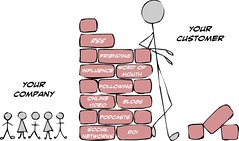
Customers are Ignoring You (Photo credit: ronploof)
Whether you are a new Interior Designer or an accomplished Interior Designer of repute and long standing there is always a need to know who your target customers are. In fact, if you don’t really know your target customers then, unless you are lucky, you will not stay in business long.
Times change. Remember what was a great target market in the boom times might not be if things get tough, you should look at your target markets annually.
There are broadly two types of customer; residential, and commercial. The former would be characterised by an individual or household decision making unit whereas the latter would be characterised as an organisation, potentially an organisation can be very difficult to deal with as it can be more complex with decision makers, buyers, specifiers, influencers and many people involved in the decision making processes.
A potential, residential customer could be a friend, relation, someone down the road, a referral. Essentially someone who wants to ‘do’ their living space.
Click To Read More Interior Design Articles
A potential commercial customer could be a hotel chain, your local restaurant, the office where someone you know works; often it will be a ‘workplace’ of some sorts but it could also include a large property developer/builder building an apartment block or a private aircraft or yacht manufacturer/designer.
What is NOT a target market. Green design is NOT a target market. Kitchen design is NOT a target market. You must always phrase the target market in terms of the customer. So the preceding examples become: People who are environmentally conscious in their interiors purchasing decisions; and People who are replacing their kitchen.
Remember. There are a LOT of people in this world. There are a LOT of workplaces in this world. So you will probably need several criteria to precisely specify your target market.
And here is where it gets tricky.
You can use criteria like: Age; Location; Gender; Income level; Education level; Marital or family status; Occupation; and Ethnic background. But then, really, how meaningful is that for your marketing? If one of your criteria is “educational level” then, for example, ‘graduate’ may well describe all of your previous customers BUT how useful is that criteria in seeking out new customers? Will you really vet everyone that comes to you to see if they have a degree? Will you assume that all graduates are intelligent (very many are not, trust me!)? Will you assume that all graduates are wealthier? In your marketing how exactly can you target graduates? If you use alumni magazines for advertising then I admit that would be a great route to graduates but really alumni magazines!? With the advent of Facebook advertising you CAN specify that adverts are only shown to graduates…so assuming that the Facebook user is telling the truth about themselves then OK I accept that would be reasonable. Think it through, whatever you decide.
So what you are trying to achieve with your target markets is a level of manageable clarity. Clarity in the sense that it becomes clear who your customers are going to (hopefully) be. You can see how your marketing efforts will be focussed towards them. Manageable in the sense that there are enough that you can ‘easily’ target them with the money, time and manpower you have available for marketing.
Do not fall into the trap of saying that your target market is “People who buy my type of service”. That won’t really help you! despite it being obviously true.
Once you properly know your target markets (which might require some research) you will be able to work out how big they are. You will be able to see how easily you can get your message to them. You will be able to assess if they can afford your services. Much of your marketing will ‘fall into place’ relatively straightforwardly once you have figured out what you are selling and who you are selling it to.
Remember that there are LOTS of people out there trying to get the same business that you are. So you have to be smart. The obvious market may well be obvious to 100 other interior designers and your basic design service the same as the one offered by those 100 other designers. Often it is good to aim for a less crowded market with a relatively unique offering that is suited precisely to that market. Easier “said”, than “done”, of course.
Here are some suggestions:
Commercial Interiors
Hospitality & Leisure
Marine
Medical
Aerospace
Residential Interiors
Age
Location
Gender
Income level
Education level
Marital or family status
Occupation
Ethnic background
Eco-buyers
Buy to let
New builders
Renovators
Landlords
Tech savvy
Time poor family
Friends
Networks/ past client networks
If the target user of your service is someone you might not directly contact and you have to go through someone else (usually an organisation). then that organisation becomes your channel to market.
If you have any additions to suggest please add them via a comment below. I will put them into this list.
There are links below to more related and detailed stuff. Here are some of the posts I previously wrote or you can find them all in one go by <clicking here>
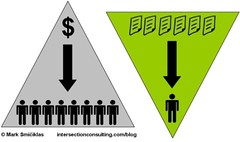
New Target Market (Photo credit: Intersection Consulting)
Interior design professionals, designers with shops, freelance designers, decorators and in-house interior design teams from international architecture practices all share the need to plan all aspects of their businesses. The larger the organisation, the more there is the tendency to do the planning ‘properly’. The larger the organisation, the higher the tendency to stick to plans where possible and the lower the ability to react quickly to unexpected opportunities.
A small design practice might have had several successful years and yet each year did not follow the plan that was set at the start of that year.
A large in-house design team’s manager might bemoan the amount of time s/he has to put aside to planning and budgeting each year.
Click To Read More Interior Design Articles
Focussing initially on marketing, a design graduate might shy away from a financial plan when starting out in business. Only then to realise that the financial plan is really only what the bank is interested in when it comes to taking out a startup loan.
A fledgling business-owner might spend many nights worrying over the financial forecasts of cashflow and sales as those are what pay the mortgage, the salaries and office rent.
So we all come at business planning from a different perspective and we probably all agree that some degree of planning is necessary. You might just be a bit confused about the difference between a marketing strategy/plan and a business strategy/plan – as many people use those terms to mean the same thing.
Essentially what we want to know is how to allocate the resources we have; people, money and time. And then how to measure, monitor and control that allocation.
But what brings you here is probably that you want to know how to allocate your resources SMARTLY. And how others in your industry do it. You might want to just find a plan that someone else has already done that you can follow and copy to save a bit of time.
Well I think I will have a series of textbooks to write to answer all of those questions! And many plans to collate and link to in order to get the right one for all the readers of this.
So before we go any further let me just point out that there are some links to other materials at the end of the article and that the remainder of the article will just touch on a few aspects of marketing and business plans.
Plans and strategies (and goals for that matter).
A business goal is EXACTLY what you want to achieve and when you want to achieve it by. The business strategy is the method by which you want to achieve it. You might also have some longer term aspirational stuff set in missions, visions and values but I’ll leave that alone here.
So:
Goal: 10% growth in sales revenue this year at existing gross profit levels.
Strategy: By organic growth from existing customers.
This higher level stuff is important in the sense that it will determine what happens lower down in the organisation. For example the strategy I have just laid out might well require existing sales people to think of themselves as ACCOUNT MANAGERs and undergo the appropriate training rather than recruiting 10% more sales people. Or it might not! But you get the point hopefully.
So these goals and strategies will filter down to the various parts of your business. They will manifest themselves in various tactics when seen from the MD’s point of view. From within each department (if your business is large enough) your department head will be tasked to achieve these organisation tactics. It’s just that they will instead view them as their GOALS. So their departmental goals then require departmental strategies and tactics and so on, cascading down to the individual level.
What your marketing strategy needs to do is figure out all of this in terms of customers.
So one of the first things you will need to do is to work out who your target customers/markets are. You NEED to do this in terms of groups or types of customers. These groups are called MARKET SEGMENTS. You SEGMENT or divide up your entire market into distinct measurable groups. It’s important that these groups all behave in a similar fashion. This is because when you try to reach each segment you will want to simplify the ways that you appropriately reach (market to) that segment.
You are based in, say, Central London so you will need to narrow your market down by area, say Chelsea and Westminster and Islington or specific postcodes. Presumably also narrow it down by house value as well and so on.
To quantify your market segments you might then soon come to realise that you need to be looking at the website of your local council to look at planning approvals. Free information that will tell you exactly which building work will be started in 1-6 months time by postcode. It will probably also tell you the owner and architect/builder. Or you might decide to drive around your target postcodes and look at the building works already in progress. Usually the architect will have a board outside. Would you try to do show homes? (You might target varying sizes of construction company). Or you might try to tackle it further down the line at the estate agent level knowing that a buyer is going to spend money on interior design fairly immediately after buying a house, rather than in 6+ months time when construction starts? Of course the house buyer may well already have the interior designers/decorators sorted out at this stage or might simply be doing it themselves, it might be prudent to make contacts as early in the process as possible
And of course building firms and architects (and maybe estate agents) probably already have existing Interior Designer contacts or in-house capabilities. I never said this was going to be easy! But then again they may have been let down on the last project and could just be looking for your services.
But the point of all of this is to narrow your thinking down. Then to focus your efforts. The silly but obvious example is that if you had not chosen specific postcode target markets you could be driving around the whole of London for the next two months or spending many evenings trawling through London Borough Council websites. But of course if an ad-hoc opportunity comes your way you grasp it even if it is not in your target market (within reason).
Or you might have jumped straight in to building a web site saying what a great London Interior Designer you are and how good you are and where you were educated and so on. When the reality is that the people you are trying to reach might NEVER even look at the internet for an interior designer. Your target market might just use the internet to check you out after they have received a contact from you from some other (non-digital means.
So; for each target market you then need to think about the 4P’s of marketing: Product, Price, Promotion and Place.
4P is easy to remember but not necessarily helpful so here’s what they are to you:
Product – really the service(s) you offer to EACH target market (they could be different or tailored)
Place – or Distribution – or how you get to your true, end client. what MIDDLE MAN you use. eg the architect or estate agent in the above example. This ‘PLACE’ might not be so important if you are going direct to your customer.
The links below will show you more comprehensively how you can structure a business plan.
If you are not the detailed planning type then another approach is to use the SOSTT 4M mini-planning model. Let’s say you are thinking about how to revamp the marketing you do from your shop or from your web site. You’ve got an idea of something you’d like to try. Normally you’d just go ahead and do it and perhaps not think through all the implications. Is that you? Then if so here, perhaps, is a quick way to checklistise what you are going to do
SOSTT +4m
S – SITAUATION: What is the current state of play. The problems, opportunities, worries. What are you good at in this particular area?
O – OBJECTIVES: Exactly what do you want to achieve? Use a SMART goal (Specific, Measureable, Achievable, Realistic, Time-delimited). eg increase my awareness in a certain targetmarket by 5% by the end of the year, measured by XXX.
S – STRATEGY: How are you going to achieve this? eg By increasing my online presence in social media
T – TACTICS: How are you going to achieve this in a bit more detail? focus on Twitter Restauranters and LinkedIn Restaurant Groups
M – MANPOWER: Who exactly is going to do all the various activities. eg My partner
M – MONEY: What will it cost. Probably very little in terms of cash.
M – MINUTES: How long will it take? 2 days set up and then 2 hours every Sunday night.
M _ MONITOR: How are you going to check how this is all working? You might have a special new web page that is the same as your homepage but called index2.htm. All your twitter activity and LinkedIn activity might point only to this new web page. That way you can track EXACTLY the hits you get from your new activity to see if it is working.
So that’s it. For a marketing plan for a small business, those are the things I would make sure you have covered before devoting a week to a fully detailed plan. If indeed you get that far!
There are links below to more related and detailed stuff.
Here are some of the posts I previously wrote or you can find them all in one go by <clicking here>
Raffia and Tatami are often terms that are used synonymously these days by some interior designers.
Tatami are woven Japanese floor mats. Originally they were made from (rice-) straw but now they are made from a variety of materials with better properties for fire resistance, warmth and general comfort. Typically Tatami mats are made to be twice as long as they are wide and they are usually about 2m long.
Raffia (often Raphia in the USA) refers to fibres made from a tropical tree. Specifically raffia is made from the leaves of a specific palm tree called “Raphia ruffia”, which is usually found in Madagascar and more generally in Africa. A different variety in South America is “Raffia taedigera”.
Raffia that is more suited to top market interior design projects will probably often be made from other materials – one of the particular note would be made from high quality cellulose pulp.
So, often when clients ask for Tatami or Raffia they are really often asking for a straightforward, grass-like, woven fabric similar to that shown in the main image accompanying this article.
Click To Read More Interior Design Articles
Such raffia and tatami fabrics are usually available by the meter and have additional properties making them more superior to traditional variants. For example having high martindale test scores making them suitable for upholstery and coming pre-treated for fire retardancy.
Tatami and Raffia by the meter may also be quite flexible allowing it to be fastened around wooden frames and then used as a textured finish for walls and ceiling.
With Wyzenbeek rubs of 40,000 KOTHEA’s 2011 Raffia (Raphia) are also eminently suitable for a wide range of upholstery uses.
Raffias can usually be fire treated to meet a wide range of contract requirements including hotels and marine installations.
This type of raffia weave has been used for thousands of years perhaps most famously as Japanese Tatami mats. They are of course one of today’s modern day design staples for a clean, modern look.
The interior design world moves on and so does the way your clients use the internet to find you. Sometimes for the better and sometimes not.
Just after we have spent ages (days! weeks! months!…years?!) trying to figure out what search terms our clients might type into Mr Google, and then incorporate that into our online presences(s), we find they are morphing how they search into something new and far more sinister.
Would you believe it? In the design world, a place based on aesthetics, those darned potential customers are using images to find us. How annoying is that? It seems like only yesterday when we ignored images because we knew that google can’t really ‘see’ them and we balanced that by putting all the right words everywhere. We even got the odd first page google listing for some odd convoluted phrase that one client a year might potentially type!!
So now it seems that we have to go back to what we naively thought was right all along. All we have to do is just put lots of pretty pictures onto our site and the whole world will come flocking to our door.
Click To Read More Interior Design Articles
Well, maybe! I’ll backtrack a little and explain where I’m coming from before everyone gets a little too excited!
I’ll come from one simple factoid. One of my interior design industry based web sites has about 500 hits a day. Not bad, I suppose. I looked into some of the stats a bit more last week and found that by far the most number of hits came from google. Fine. About 85% of the hits in fact. Nothing new there then? No.
But; there’s always a “but”.
When I delved deeper I found that 19% of the google hits were coming from the GOOGLE IMAGES part of the google search site. IE the bit where you type in ‘mohair velvet fabric’ (or whatever) and then find you have loads of pages returned to you, so you click on the images bit on the left hand side and it only shows you (in theory) lots of pretty pictures of mohair velvet fabrics. (As well as lots of other junk of course, but on the whole it’s not too bad).
19%. that’s quite a lot.
So I looked at different time frames and, yes, that 19% was pretty consistent over at least the last 6 months. Maybe 17%, maybe 23%, it varied. That’s still enough of a trend for me to believe it and I’m sure it would hold true if I had bothered to look further back in time.
So what’s going on here then?
Well firstly it showed that I am doing some things right. I am putting images alongside my musings. It makes it easier to read, pretty pictures – some perhaps even relevant – just like a magazine. Also for the images to have been recognised by google then I must also have tagged them (the ALT tag if you want to be more precise in HTML terms). So yes I had images in my musing and they were correctly tagged images. That is, the images had a bit of text manually put on them by me. To make matters better I had also called the images the same thing (broadly) as the tags I intended to use.
3. The alt tags you give to the image; and peripherally at
4. The physical colour scale of the image (it can recognise it is mostly green, for example).
The first three of these are very important the 3rd much less so.
So you’ve just done a great design job for one of your better clients. You upload some pics of the rooms to your online portfolio and voila! 100s of people will beat their way to your internet door!…er no.
Let’s say you had this great picture of the main room. So you upload img_1325.jpg to your site and you cleverly ALT-TAG it as “main-room-31-randomstreet-localtown”.
Not good. Assuming it was not a tiny thumbnail image here is something along the lines of what you should have done:
1. Called it “contemporary-modern-home-belgravia.jpg” – or something similarly appropriate; and
2. Tagged it as “contemporary, modern, home, Belgravia” – or something similarly appropriate.
You get the idea? The keywords you have already discovered that work in the text of your writings now also need to be judiciously applied to your images. Get cracking!
Here are some of the posts I previously wrote or you can find them all in one go by <clicking here>
A designer asked: is it acceptable to use a Crib 5 interliner with a Crib 3 fabric in a restaurant?
The short answer is no. In non-residential spaces an interliner does not compensate for a fabric that does not meet the required fire standard. The Crib 5 interliner and Crib 3 fabric combination would not be acceptable in a restaurant or any other public space. The fabric itself must either be inherently Crib 5 or be treated to achieve Crib 5.
This combination might be acceptable in an office environment where Crib 3 is the required standard, but not in a public-facing hospitality environment.
KOTHEA Fabric Picks For A Chilly Winter’s Day
With Verity du Sautoy of KOTHEA.
We love the seasons. All have their beauties and all have touched our senses in memorable ways over the years. Winter is no exception: lower, more balanced light; quietness and chaos with both the shopping and the weather; festive celebrations; the cuddle of a loved one; the hope and expectation of early spring flowers grasping for rare and tiny glimmers of light; and, perhaps, the welcomed warmth of a beautiful fabric.
Some of my best memories are centred on family: a warm fire; a little baby; or a bouncing toddler. Then an old children’s classic on the iPlayer watched on my Mac as it balances precariously on an elegant coffee table. I stroke my children’s hair with one hand and rest my other hand on my sofa. A generous cushion is warm, encapsulating and a bit of fun for the little ones to hide under. The curtains are not yet fully drawn but they smooth the boundary to the cold outside and give us tantalising glimpses of the world beyond – should we venture too close to the sheers that offer the final, soft protection from the elements.
Dominika B Tana Lawn
I work for a fabric company. I love fabric. I can’t pretend that it (fabric) is a be-all and end-all to life and that somehow it will make your life complete. It can’t. But what it clearly can do is complete the sensory experiences in the parts of life that, if you choose, you have control over…the parts of your home. Memories are not just photo-like snapshots in your brain; they are stored, multi-sensory splashes of emotion.
Here are my Winter picks. They are actual ‘picks’ that I’ve recently purchased or are about to purchase.
I talked to a friend a couple of weeks back and she bemoaned the fact that her Design Practice had spent quite a bit of time and money on creating and growing their web site but not much was coming from it in terms of genuine leads and sales in the very particular niche market that she was targeting much of her efforts towards.
So I quizzed her a bit more:
1. Was she creating engaging, frequently updated content for her target market? She said yes. I read her blog and had to agree.
2. Was she using the right keywords? She thought so. And although I’m not an expert in her particular target market I tended to agree.
3. Then she raised the point that Mr Google thought her PAGERANK was quite high. That was strange and surely not part of the problem?
4. We then looked through her Google AdWords campaign. And that too seemed broadly OK.
Click To Read More Interior Design Articles
5. There were quite a few backlinks from other sites to hers, so that wasn’t the problem either.
So what’s the problem? Other than she wasn’t getting any money back from the investment? And, er, that’s pretty important!
To cut a long story and quite a bit of research short, here’s what we thought the problem was (if you want to know what pagerank is there are links at the end of the article).
Well, although her pagerank was OK it wasn’t actually that relevant.
One problem with pagerank is that it just BROADLY shows how often your site is visited/how important your site is/how trusted yoru site is. It does NOT show you how often YOUR target customers visit your site…and that is the stat you really want.
So what was happening was that quite a lot of people were visiting the site from all the good links and good search engine positioning that she had paid for. A few of them read some of the stuff on her blog BUT VERY FEW went on to the next steps for converting them into customers. And that was because they weren’t interested in her services because her services were not RELEVANT to them…they just WERE NOT POTENTIAL CUSTOMERS.
So you could have the most visited website with the best page impressions, page views, clicks and all the rest of it. BUT THAT IS NO GOOD IF THE WRONG PEOPLE ARE VISITING YOUR SITE ! They won’t buy.
Her market was such a small market and relatively technically unsophisticated so, perhaps, blogs and search engines were not the best way to get to them.
Similarly, and a bit simplistically, if she had a pagerank of 8/10 (which would be excellent) it would not mean that she was excellent at targeting her customers…just excellent and targeting the whole population.
And the problem was compounded because the 3rd party, who was commissioned to get clicks and a higher pagerank and higher search engine positioning and all the rest of it, did just as they were asked. They weren’t asked to get leads! And didn’t!
Now it was not a total waste of time of course. Because pagerank IS IMPORTANT for google to give your site weighting when google produces search results.
And really the picture was not as bleak as I painted as she did experience an increase in leads for other services she was offering. Although they were more mass market services with lower levels of profit.
So what did she do?
A: Cut back a bit on 3rd party SEO services, focussing the remainder of the budget on the markets that had been successfully reached. With the marketing budget that she saved, she is now looking again at how best divert funds to more traditionally target the profitable niche market she originally set out to make money from.
We would always recommend 100% Cashmere Wool for luxury throws.
Cashmere wool is made from the fibres of the undercoat of the cashmere goal (capra hircus laniger). The fibres are extremely fine, not exceeding 19 microns. To ensure that the high quality undercoat fibres are used a criterion exists to ensure that 97% of the fibres are below 30 microns.
Cashmere wool thus feels ‘fine’, is lightweight and provides good insulating properties without the weight typified by other wools for the same degree of warmth.
No other commercially available wool offers as high a level of quality as cashmere.
So to ensure the best quality Cashmere Throw it is important to specify 100% Cashmere Wool – neither a blend nor any other wool is as good.
Interior Designers have been moving much of their sales and marketing into the digital world over the last few years. Maybe this was because of great looking Apple products or maybe just because as new, young designers come into larger business they bring in with them the gadget trends of youth. Or maybe because all this digital e-stuff actually can work and can work quite cost effectively if done right.
I’ve written a few articles on this general subject over the years (I’ll reference some of them at the end of this post. However things have moved on in the real world and some of what I’ve PREVIOUSLY written has been superceded or improved.
It’s still mostly true that you will use your web site as your show case for your business. Your blog will be a part of your website and, unless you sell products that require an up-to-date online catalogue, it is your blog that will contain the information that CAN AND SHOULD be regularly updated. (That will boost your google position). Twitter, LinkedIn and Facebook come in as networks you are building. All good stuff.
Click To Read More Interior Design Articles
The problem used to come in how you would simultaneously update all these networks without having to manually re-submit the information. That would obviously be time consuming as would installing and keeping working additional pieces of software that glued all the bits of your marketing together.
Well now it is relatively straightforward to have your wordpress blog update your twitter account, your LinkedIn presence and your facebook business page. Similarly twitter can also update your facebook page automatically. Lots of these automatic links now exist within the main software websites (wordpress, twitter, etc) so you only have to write new information (blog posts or tweets or on your wall) once and then the software you use automates the distribution of that information across lots of different web site and online communities. Sorted, no mystery any more.
This area used to be horrendously complicated and thankfully facebook have now simplified how to create a venity URL. What I mean by this is how do you create and use www.facebook.com/kothea …or of course you would have your business name at the end of that.
Essentially you can now just create a PAGE and give it a name (eg KOTHEA in our case) straight away. Gone are the ridiculous but well intentioned rules about having a certain number of fans.
3. Building networks with Facebook
You probably already know that once you have created you PAGE in facebook then you can use facebook as if YOU are the ‘page’. Rather than the person you really are. So rather than having your facebook activities in the name of ‘Joan Smith’ you make comments as if they are coming instead from your business ‘Smith Interior Design’.
google are also trying to “do a facebook”. This is their Google plus network. You can ignore that for the time being.When was the last time you or your kids used it?
Much better for your branding. Remember to be nice ad say sensible things and don’t get carried away!
4. Gadgets
Especially in the Interior Design and Architecture industry lots of people use Apple iphones and ipads. Of course your clients may well also use these devices but perhaps are also quite likely to use other ‘tablet’ devices and other smart phones like Blackberries.
Like you, your clients lead hectic lives. They are on the go and people are increasingly looking for information on the move. So all the electronic marketing you do needs also to work on these devices so your potential clients can read it and find it.
This is not so hard to achieve. Facebook and Twitter and LinkedIn will automatically do it. WordPress blogs will do it if you check a box in one of the admin features. It might be harder for your web site to do it properly so have a word with your web page designers.
You can use something like https://marketing.grader.com/ to tell you for free some of the more technical things (like working with mobile/cell phones)
Here are some of the posts I previously wrote or you can find them all in one go by <clicking here>



 Raffia and Tatami are often terms that are used synonymously these days by some