How to Clean Mohair Velvet
For a complete guide to fabric care symbols and upholstery cleaning codes including what W, S, WS, and X mean for velvet upholstery, see: Fabric Care Symbols and Cleaning Codes: A Guide for Interior Designers and Specifiers.
How to Maintain and Clean Mohair Velvets
Mohair velvet can be difficult to clean. If you are in any doubt, contact a professional cleaner. The following information is provided as a guide only and is not a formal recommendation by KOTHEA.
As with many fabrics, prevention is the best cure. A regularly cleaned velvet will last longer. Routine care should consist of brushing with a firm clothes brush and regular vacuuming. Expert professional cleaning approximately every five years is advisable as part of a longer-term maintenance regime.
Removing Stains
Serious stains should always be removed by a professional. Never attempt to treat them yourself.
Minor stains can sometimes be removed, but always test any cleaning method on a small inconspicuous area first.
For fresh stains that have not dried, use an absorbent, dampened, lint-free cloth. Do not use a coloured cloth as the dye may transfer into the velvet. If water alone does not work, try a diluted upholstery shampoo applied carefully following the manufacturer’s instructions. Rub very gently, finishing in the direction of the pile. Remove all chemical residue afterwards.
Do not use the fabric again until it is thoroughly dry.
Dealing with Wear and Tear
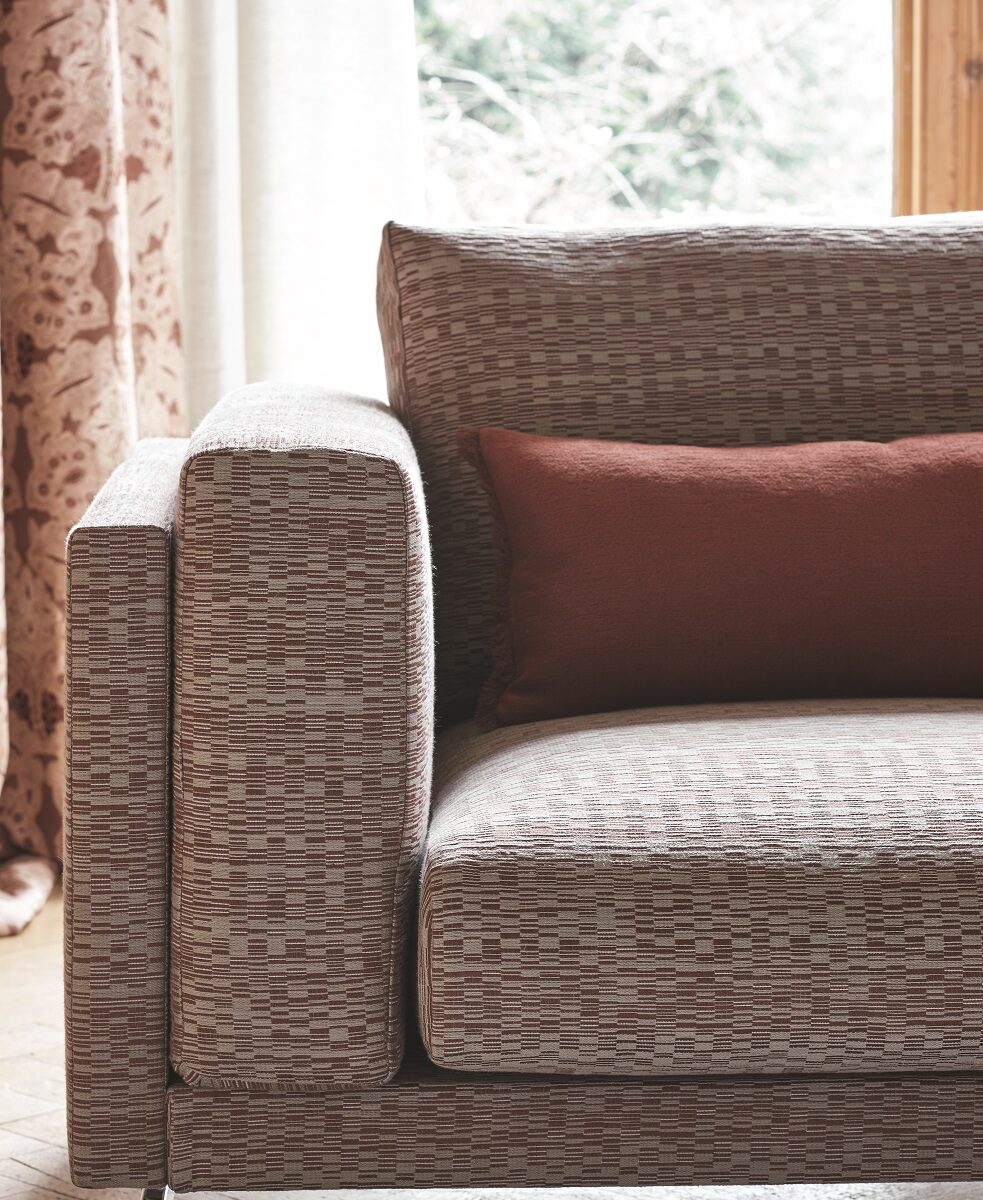
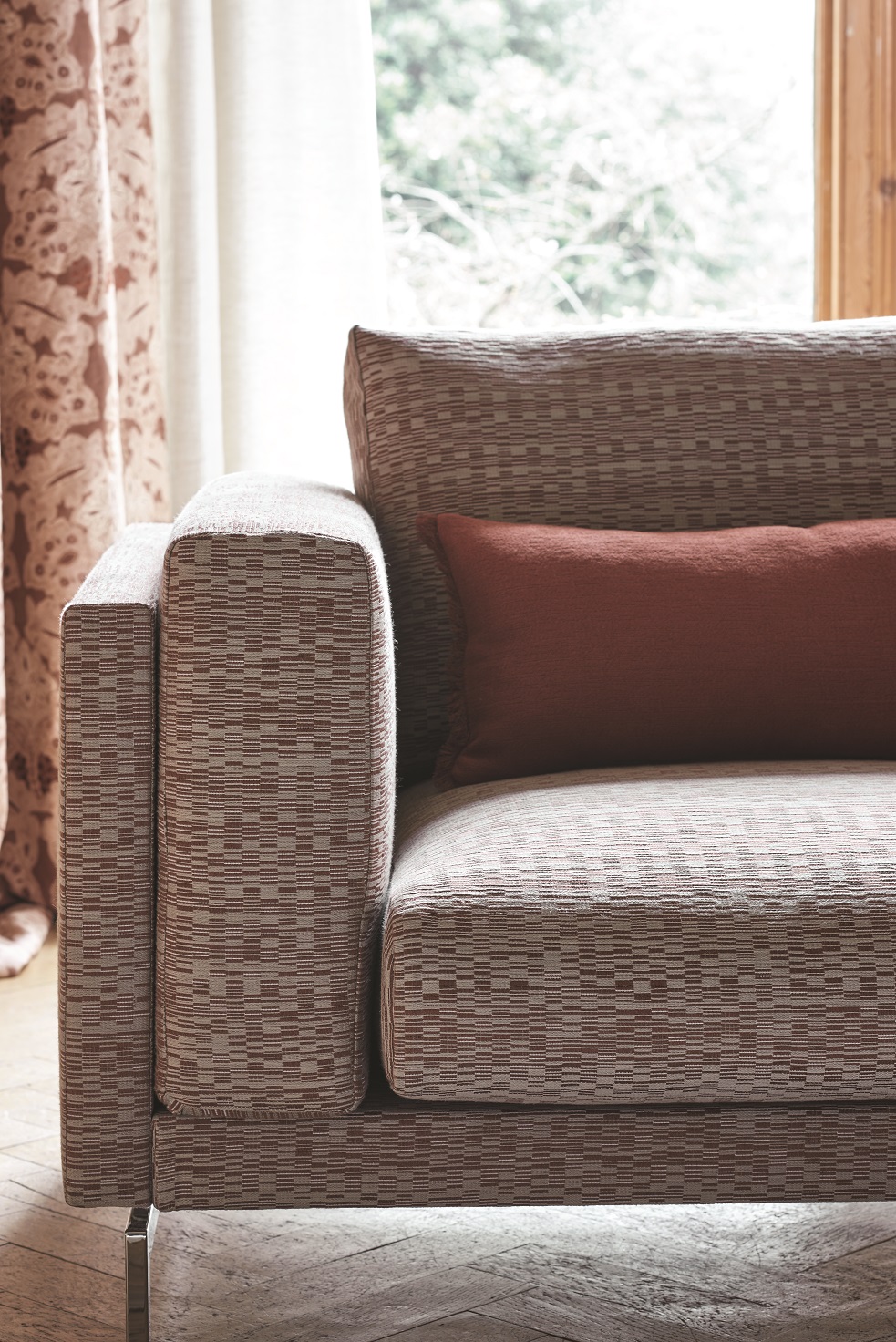
A regular cleaning regime is essential for velvets. Without it, the fabric can show premature wear, most visibly on regularly used areas of sofas and chairs. Frequent movement on velvet pile pushes the pile in different directions, which can eventually cause matting. When pile lies in different directions the shade of the fabric can appear to change. This is a natural property of the fabric and is made worse by excess heat or humidity.
Mohair velvets generally take and hold colour well and typically achieve high Martindale rub test scores, making them among the more durable natural-fibre velvets available for upholstery. For KOTHEA’s contract-grade ranges, see our mohair velvet upholstery page.
On clean fabric only, the following may help restore the pile: apply a clean, lightly dampened cloth and leave for ten hours, then remove and allow the fabric to dry naturally for ten hours in a well-ventilated room. Use only pure or distilled water. Never wet or soak the cloth or the fabric.
Request Samples
Order cutting samples of any fabric from our current collections. Trade accounts only.
Order CuttingsOr call +44 (0)20 8943 4904 or email info@kothea.com
Our Collections
Mohair Velvet Faux Leather Cashmere Throws Silks Linen Textured Upholstery
Specification Guides
Buying Guide by Purpose Crib 5 Fire Guide Martindale Rub Test BS 5867 Curtains Marine Fabric
The Links Between Office Design and Employee Happiness
Offices are an essential area in every organisation since that is where all work is planned, preserved and monitored. Having a good working environment has a significant effect on employee output, so businesses should ensure that their office design boosts the mood of its staff. Workers in an excellently designed office tend to be more productive than those who work in disorganised environments. There are various aspects which ought to be considered while creating an office to enhance production and morale.
Lighting
An office fit out of the highest order should ensure that enough natural light enters the office during the day. The quality and quantity of light in the office area can have an impact on the aesthetic judgement and resulting mood of the employees. The volume of light entering the office should be controlled by those who work there, through the use of blinds and drapery to reduce glare and other brightness related issues.
In the evening, the room should be well illuminated for any employees who might be working late. The bulbs used in the office should be located in positions where they won’t strain the eyes of employees, whilst still providing enough light to make reading and writing comfortable. A well-lit room also plays a significant role in preventing accidents.
An office with dull lighting can make employees feel miserable and demotivated, something that isn’t good for any business.
Redesigning
One discovery from human resource research is that employees become happier when their offices are redesigned. A study on 257 employees, as published in the Journal of Vocational Behaviour, showed that workers experienced a feeling of collaboration and innovation within their company on the back of a redesigned office. Employees who visit the same room for years tend to get bored and do not look forward to reporting to their specific jobs, as compared to those whose offices have been redeveloped and kept fresh over time.
A refurbished office creates a sense of progression and provides employees with a new environment in which they can feel as though they are starting a job or a promotion. In redesigning an office, employees can make their suggestions to the decision makers, giving themselves a sense of purpose in the process.
Furniture and Equipment
The working area should provide employees with enough comfortable furniture for themselves as well as any clients who visit the office. Having comfy chairs and correctly sized tables ensures that employees don’t injure themselves whilst working, which could significantly reduce their productivity. The office furniture should also be arranged in such a way that clients will not interfere with the work of the employees when they come to visit.
Employees should also be provided with up-to-date office equipment such as modern computers and Wi-Fi. An office with the latest state-of-the-art technology boosts the mood of the employees due to their efficiency and speed of production. Such equipment should also provide a sense of trust where employees can control the functionality of their machines without the interference of the support team. They will also be responsible for taking care of expensive and technologically advanced equipment.
Greenery and Space
Small offices can make employees feel confined to their workspace due to the fact that they can seem crowded, whilst big offices can provide a better working area as well as room for expansion. Scientists’ study on lean offices found that green plants incorporated in certain areas can help in counteracting the adverse effect of large unoccupied spaces, which can create a feeling of emptiness. Greenery in lean offices can help increase comfort levels in the room, which increases productivity by up to 15%.
Privacy
An office fit out should provide environments where workers can work independently on their desks without feeling like they are being monitored by their colleagues or managers. Having a private workspace does not necessarily mean isolating employees from each other, but rather it provides employees with the opportunity to work without interference from the colleagues sitting nearby. Having workers in a standard room with independent counters helps to boost their morale and prevent boredom which is caused by working in solitude. This kind of office design also supports easier communication amongst employees.
Painting from Photographs

My selfies are never going to grace the wall of the Museum of Fine Art; nor at Tate Modern for that matter.
However with a little internet wizardry, that even Harry Potter would be proud of, it is now eminently possible to turn your own photographs into works of art. Certainly to a standard where they can grace YOUR living room walls.
Essentially, online services will ask you to upload your image and then to choose an artistic style so that it’s algorithms can manipulate your image according to key features of that artistic style and/or medium. You can see that, above, with the Albert Einstein image rendered as in the style of Vincent van Gogh. Cool!
Services like Portraits on Demand offer a more straightforward and practical service that will render your image to mimic specific media such as oil, pencil, watercolour, charcoal, pastel and acrylic. This is a more cost effective approach, as the more complex manipulations that are made when changing the artistic style (rather than medium) can become quite prohibitive from a cost point of view. Sometimes ranging to the thousands of pounds/dollars.
Contrast those thousands with the cost of printing out and sending a media-mimiced image which will range from a few tens of pounds/dollars to a few hundred pounds/dollars. Mostly those costs are dependent on the size of the canvas and the secure shipping costs for getting the art to your door.
How to Improve the Look of a Work Area While Thinking About Safety
When a team of tradesmen are hired to carry out work on on a commercial building, it’s important to not only think about the design and desired result, but about the health and safety of the employees who will later work in the building too. Whether it’s the look of a car garage, a car park, an office block or a factory that needs improving, there are a number of considerations that need to be factored in…
Fire safety
Fire is a health and safety hazard for every business, which means that fire proofing is essential in a work space. Firstly, you should think about the soft furnishings in your work space: carpets, curtains, fabric blinds and fabric chairs can be highly flammable, so why not try using fire retardant fabric sprays on these materials? Also, fire doors should be fitted in the premises or standard doors should at least be coated with a layer of fire resistant paint.
Smoke detectors, fire extinguishers and fire alarms must be installed to ensure that the work space complies with the government’s health and safety regulations too, and if a sprinkler system is being installed, it will need planning into the refurbishment at the appropriate point.
Finally, a re-designed work space might look the part, but if it doesn’t contain an adequate number of emergency exit points at suitable positions, the design won’t be good enough. Make sure that exit routes are plentiful and properly signposted.
Asbestos
Commercial buildings (particularly those that were built before the year 2000), are likely to contain asbestos in some form. Asbestos is a highly dangerous material for people to work around, and is especially dangerous for tradesmen or contractors who come into contact with: the fibres from asbestos can settle in lungs, causing asbestosis and mesothelioma.
Tradesmen should take care when drilling, removing, cutting or sanding structures in a work space: the materials used for fire protection, insulation or textured coatings often contain asbestos. Contractors should only carry out work involving exposure to asbestos if they’re trained, licensed and insured to handle it.
Flooring
The surface of a work space is a very important consideration too. While a work area can be cleaned using chemically appropriate materials to reduce the risk of slips, it might be better to just repair or replace the floor altogether. Use an anti-slip coating on surfaces to help to minimize the risk of trips and falls, or add a layer of coloured anti-slip paint to brighten up a work area while adding decoration, durability and protection.
Noise and ventilation
In work areas that become excessively noisy (for instance, where cartridge operated tools or heavy machinery is used) it might be necessary to install barriers or protective screens around equipment or areas where noisy processes are carried out. Also, adequate ventilation is essential for work areas such as car garages, factories or warehouses, or anywhere else chemicals and fumes pose a health hazard.
There are many more safety considerations to think about when improving the look of a work area (such as not trailing cables across walkways, ensuring there’s adequate lighting to provide an even lighting level across work areas, and accounting for changes in surface levels using tread markers or other markings), so be sure to work closely with site managers and designers when carrying out refurbishments.
Iconic Furniture by LLI Design
Iconic Furniture was conceived out of an in house side project at LLI Design. Starting initially as a bunch of mid century furniture sketches we were looking at ways to “frame” and present the sketches and get them off paper into a more permanent form.
To progress the initial sketches they were scanned and outlined in Adobe Illustrator, several graphic styles were explored, but we eventually settled on the one used as we felt it struck a good balance between accuracy and playfulness with a nod towards mid century advertising illustration.
After deciding that the project would be published as an interactive website we explored multiple ways to display the illustrations and text; settling on a strong graphic style utilising Lato font in various weights. The bold muted background colour palette was again inspired by period Mid century advertising and posters to complement the furniture.
Finally the parallax effect (vertical scrolling moving panels) was employed to add intrigue as each new illustration is revealed.
Iconic Furniture, was designed and developed in house by LLI Design – https://llidesign.co.uk
Eclectic Living
By Anouska Lancaster, www.noushkadesign.com
To me ‘Eclectic’ is all about freeing yourself from the traditional concept of design and being brave enough to buy the things you want simply because you love them. It’s about breaking the rules and surrounding yourself with things that make you happy and showcase your personal style.
The beauty of eclectic living is that things don’t need to match or be neutral. It’s an open invitation to use colour, be bonkers and have fun with bizarre and crazy objects because that is what makes your space different from everyone else’s; and that’s what makes the World an interesting place.
Getting the correct balance in your eclectic interior is absolute key. It may often look as though items have been radically thrown together in varying proportions by chance, but believe it or not, there is a mathematical formula when it comes to creating a harmonious eclectic interior that is pleasing to the eye. The last thing you want is for your interior to look as though it’s displaying the remnants of a junk yard. To avoid this faux pas, follow my top tips on how to create the perfect eclectic interior that will not only ooze sophistication; but will also showcase your personal style.
- Watch the scale. Getting the scale and proportions correct is especially important in eclectic rooms. Scale matters both in how the pieces relate to one another as well as to the room.
- Play up contrasts. Choose objects that are extremely different in feel, time period, texture and style. For example, team a contemporary glass coffee table with a vintage leather armchair.
- Find a common thread to make the items gel. This is most easily done with colour.
- Make sure nothing matches. Split up any matching furniture and divide these items between rooms.
- The best eclectic interior is one that represents you. It’s a space to showcase your travels, your loves, your stories and your aspirations.
- Experiment and take risks. Remember, there are no rules so have fun adding and removing items until you feel the room is pleasing to the eye.
- Add quirky and odd elements of surprise to create ‘wow factor’ and talking points. This may be a surf board if you love surfing, or hanging polo sticks on the wall if you play polo.
- Source your items from different places over a period of time. This will avoid the ‘catalogue look’ and will enable your interior to tell your story as it grows with you.
- Vary the scale. Oversized objects, particularly when teamed with smaller objects, will add drama and interest to a space. Mix up the scale so that you have varying layers of height and depth.
- Last but certainly not least – add some bling. I always believe in adding a little bit of sparkle or metallic to boost the ‘wow factor’ and add an element of surprise.
Decorative Hats For Interior Design Details

OK it’s a long shot.
Deer antlers were so-2015.
Well, probably more like 2010 when they appeared on many pages in World of Interiors and other similar Interiors magazines
What is going to be the ‘next big thing’ to decorate your hall or room walls?
My money is on hats.
Hats of all shapes, colours and sizes.
A strange choice perhaps but I reckon the versatility of the hat will lend itself to many Interiors as mini-Isles of inspiration.
1. Kitchen
Obviously here it’s going to be a series of 3 of those large, white chef’s’ hats. They might take up a bit of wall space but there’s an obvious fit. They might get a bit splattered from time to time and lose their pristine whiteness but hey practicality never stopped a good interior designer.
2. Kid’s bedroom
Apologies for any ensuing sexist clichés but the Real Madrid-loving daughter in your life will certainly like a selection of 5 Real Madrid Supporters’ Club hats adorning here wall. You’d probably have a different one from each of 5 championship-winning year. Have they won 5 times? No idea! Probably. Why 5? Odd numbers are best.
3. The graffiti-covered teenage chill out room
So we all knew, even back in the ’90s, that street graffiti was going to make its way first to loft-type apartments and then to perhaps less well suited residences.
Anyway, maybe now the teens hang out in front of the video consoles in your street-art room.#
Naturally some form of street-related hat is required here, the obvious choice being the humble baseball cap. If you are not american then it probably makes little difference which club it is. New York Yankees are the perennial favorite.
Spring 2016

New KOTHEA Collections for Spring 2016. Textured upholstery,sumptuous textured weaves, mohair and silk velvets, faux leathers and new colours for our existing Cashmere Throw range. Sampling available on our <home page>.
Spring 2016

New KOTHEA Collections for Spring 2016. Textured upholstery,sumptuous textured weaves, mohair and silk velvets, faux leathers and new colours for our existing Cashmere Throw range. Sampling available on our <home page>.