English: Leather tanning, Fes, Morocco Français : Tannage du cuir, Fès, Maroc (Photo credit: Wikipedia)
Faux leather looks like leather. It is a fabric made out of materials other than leather. Faux is the French for ‘fake’. So it is fake leather. It is cheaper than natural leather and much easier to work with in many cases. As well as a fabric for interiors it is used in many industries: it could be in your car or could make the case covering your iPAD. In the interior design world you would use it for: upholstery and wall-covering but also to cover, doors, table-tops, bar stools, bars, etc.
Types of Faux Leather
There are two main chemical types of faux leather: polyvinyl chloride (PVC) and polyurethane (PU). Both types are used in making clothing, upholstery, and product covers; typically KOTHEA use PVC For our faux leathers. We are able to obtain fine faux leathers with amazing properties as a fabric including extremely high Martindale Rub test scores in excess of 200,000 and extremely accurate animal hide pattern copies.
Compared to Real Leather
Sometimes you can’t tell the difference unless you know what to look for. Most obviously natural leather will not have any kind of repeatable pattern. Faux leather will have a degree of ‘repeat’ but might be sufficiently subtle that you do not notice it. Natural leather has visible and irregular pores and rough edges.
Natural leather tends to have a smoother feel whereas some faux leather may well feel like plastic BUT other faux leathers will feel very similar to the natural leather. The ‘smell’ may be chemically but this could be either the chemicals that have been used to treat the natural leather or the chemicals in the faux leather. A VERY chemically smell that sticks to your hand is probably a faux leather – although most faux leathers will not have this property.
Pros and Cons
Faux leather can generally be made to have very good consistency of colour across batches and in theory can be made to any required colour (in sufficient quantity). Similarly texture and pattern can be varied and/or reproduced much more easily than with a natural product.
Care and maintenance of faux leather is greatly superior to natural leather which requires conditioning. Faux leather can be bought by the metre whereas natural leather must necessarily be bought by ‘the hide’ and hence has join, length and width constraints not necessarily found in the faux alternative. Faux leather generally has superior light fastness and durability.
The animal lover will appreciate that faux leather does not require animals to die. But then again many animals die each year to support the meat industry and leather is an abundant by-product that, if used, you might argue avoids waste. KOTHEA do not sell natural leather.
When should I specify FAUX LEATHER for interior design?
There is certainly a kudos surrounding natural leather. It IS viewed a s a more desirable product. However I’m really not sure why; especially when you look at it logically.
Faux leather is much easier to work with; it is much better suited for any kind of long term interior design use – looking at durability and care & maintenance; it can look and feel the same as natural leather. It is made of chemicals but chemicals (often environmentally damaging ones) are used in the natural leather treatment process.
Whilst I might buy natural leather shoes I would only specify faux leather in a contract interior design situation and would probably also specify faux leather in my house with the possible exception of a statement sofa.
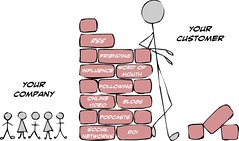
Customers are Ignoring You (Photo credit: ronploof)
Whether you are a new Interior Designer or an accomplished Interior Designer of repute and long standing there is always a need to know who your target customers are. In fact, if you don’t really know your target customers then, unless you are lucky, you will not stay in business long.
Times change. Remember what was a great target market in the boom times might not be if things get tough, you should look at your target markets annually.
There are broadly two types of customer; residential, and commercial. The former would be characterised by an individual or household decision making unit whereas the latter would be characterised as an organisation, potentially an organisation can be very difficult to deal with as it can be more complex with decision makers, buyers, specifiers, influencers and many people involved in the decision making processes.
A potential, residential customer could be a friend, relation, someone down the road, a referral. Essentially someone who wants to ‘do’ their living space.
Click To Read More Interior Design Articles
A potential commercial customer could be a hotel chain, your local restaurant, the office where someone you know works; often it will be a ‘workplace’ of some sorts but it could also include a large property developer/builder building an apartment block or a private aircraft or yacht manufacturer/designer.
What is NOT a target market. Green design is NOT a target market. Kitchen design is NOT a target market. You must always phrase the target market in terms of the customer. So the preceding examples become: People who are environmentally conscious in their interiors purchasing decisions; and People who are replacing their kitchen.
Remember. There are a LOT of people in this world. There are a LOT of workplaces in this world. So you will probably need several criteria to precisely specify your target market.
And here is where it gets tricky.
You can use criteria like: Age; Location; Gender; Income level; Education level; Marital or family status; Occupation; and Ethnic background. But then, really, how meaningful is that for your marketing? If one of your criteria is “educational level” then, for example, ‘graduate’ may well describe all of your previous customers BUT how useful is that criteria in seeking out new customers? Will you really vet everyone that comes to you to see if they have a degree? Will you assume that all graduates are intelligent (very many are not, trust me!)? Will you assume that all graduates are wealthier? In your marketing how exactly can you target graduates? If you use alumni magazines for advertising then I admit that would be a great route to graduates but really alumni magazines!? With the advent of Facebook advertising you CAN specify that adverts are only shown to graduates…so assuming that the Facebook user is telling the truth about themselves then OK I accept that would be reasonable. Think it through, whatever you decide.
So what you are trying to achieve with your target markets is a level of manageable clarity. Clarity in the sense that it becomes clear who your customers are going to (hopefully) be. You can see how your marketing efforts will be focussed towards them. Manageable in the sense that there are enough that you can ‘easily’ target them with the money, time and manpower you have available for marketing.
Do not fall into the trap of saying that your target market is “People who buy my type of service”. That won’t really help you! despite it being obviously true.
Once you properly know your target markets (which might require some research) you will be able to work out how big they are. You will be able to see how easily you can get your message to them. You will be able to assess if they can afford your services. Much of your marketing will ‘fall into place’ relatively straightforwardly once you have figured out what you are selling and who you are selling it to.
Remember that there are LOTS of people out there trying to get the same business that you are. So you have to be smart. The obvious market may well be obvious to 100 other interior designers and your basic design service the same as the one offered by those 100 other designers. Often it is good to aim for a less crowded market with a relatively unique offering that is suited precisely to that market. Easier “said”, than “done”, of course.
Here are some suggestions:
Commercial Interiors
Hospitality & Leisure
Marine
Medical
Aerospace
Residential Interiors
Age
Location
Gender
Income level
Education level
Marital or family status
Occupation
Ethnic background
Eco-buyers
Buy to let
New builders
Renovators
Landlords
Tech savvy
Time poor family
Friends
Networks/ past client networks
If the target user of your service is someone you might not directly contact and you have to go through someone else (usually an organisation). then that organisation becomes your channel to market.
If you have any additions to suggest please add them via a comment below. I will put them into this list.
There are links below to more related and detailed stuff. Here are some of the posts I previously wrote or you can find them all in one go by <clicking here>
Upholstery Linen is notoriously difficult for interior designers to source. Sourcing linens for curtains is easy enough but often linens are not woven with sufficient strength to score Martindale results that are high enough to warrant using the fabric for upholstery.
Some suppliers can be a little evasive and will quote the weight of the linen as a measure of the linen’s quality. The implication is that the higher the weight the better suited the fabric will be for upholstery. There is some truth in that implication but you cannot say for certain that high-weight linen is inherently suitable for upholstery. Get the Martindale!
Most KOTHEA luxury upholstery linens have inherent Martindale rub tests of around 20,000 rubs with one range further strengthened to 85,000 rubs for contract usage – 20,000 Martindale being eminently suitable for domestic upholstery.
Furthermore, when buying upholstery- (or curtain-) linen you need to know whether or not it will shrink when washed. Linen ALWAYS shrinks. So what you have to find out is whether or not it has been pre-shrunk before you buy it. A common way of pre-shrinking linen is through the sanforisation process.
Click To Read More Interior Design Articles
Here are the details of our new 2011 upholstery linens that are named Recline, Relax and Restful. We have many others, these are just the new ones:
Project 365: January Mosaic (Photo credit: Greg McMullin)
I have worked on, sold and managed many projects in the corporate world and interiors world. It strikes me that the nature of ‘projects’ is very similar across all industries.
How you propose to engage with the client to tackle the project will win you the business. Price and competence are essential.
New clients might not trust you enough to feel they can commit to your services for the entire project, so bear that in mind.
Sometimes, risk elements in the project are high or unknown – you must deal with these in your proposal/pitch.
(Nugget 1: Highlighting risks where others haven’t could win you the project on the risk issues alone).
Anyway, the point of this article is to summarise different approaches to charging for projects. You’ve probably heard of most of them, but maybe not all:
1. The design fee
“I’m an interior designer, and I provide a fantastic service. I charge you for my skills, and you benefit from me being able to buy things for you at trade price; I don’t profit from the things I buy for you”.
This is a fair and honest pitch. Well done, I’d think about buying from you. It probably won’t differentiate you from anyone else, though.
2. The markup
“I’m an interior designer, and I provide a fantastic service; I’m going to do it for free for you, though. I have to make a profit, so I’ll make that on the difference between trade and retail prices for the things I buy for you.”
I don’t like this, but I know it is widely used in the industry. Firstly your service is so good that you are giving it to me free? Really? Things given away for free are generally valued very lowly in business. However, this approach might appeal to a cash-strapped buyer, so don’t dismiss it. Secondly, can I trust you to charge the fair and correct margin? Probably not (I don’t know you; how can I trust you?); you probably won’t have any transparency on your purchases and their actual retail and trade prices. Besides, a savvy client can get many things at trade price anyway; buying is easy (ish) – selecting and creating is more the art, where the value lies.
This is the best way to make money. Read on, I know you don’t believe me!
Many of the top consultancy companies in the world manage their fixed-price projects carefully and in great detail. They win the projects essentially because of their low price, which is conditional in many conditions. Once the client cannot meet those conditions, the price increases (a lot). After committing to a company, the client finds it difficult to pull out later and change suppliers. In any case, they share the blame for incorrectly specifying the project at the outset, so that is not a reason to think of ditching the new supplier.
(Nugget 2:) To make lots of money, you must understand what you must deliver in detail. You have to know all the risks, where things can go wrong, and how you will handle those eventualities. You have to be clear about what is and what is not included. (Of course, add-ons for what was not included initially will cost a LOT later when the client changes their mind!)
This relies on you being organised and the client being less organised. In the corporate world, many buyers are now very organised, so this approach to projects is becoming less profitable. These projects often become acrimonious unless one side gives in over points of contention that arise “I thought XXX was included” – you’ve been there.
Remember that when extracting every ounce of $/£ out of your client, at least be nice, polite, and friendly about it. Seriously.
Of course, if you’re new to the industry, you might go for this approach to win the business, and you MIGHT strike it lucky based on little or no detailed preparation. Or you might not.
4. Phased Approach
This works best where unknowns that the client appreciates exist; it’s a good and fair way of making money.
You identify the phases of the project: scope, functional design, technical design, aesthetic design, etc – whatever you choose to call them is unimportant. You come to a financial arrangement for each phase before it happens. When the first phase finishes, you definitively quote for the subsequent one. You might have indicated the cost of all phases earlier, but you should clarify upfront that you can revise prices as risks become more apparent. The great things about this approach are inertia, deliverables and risk.
‘Inertia’ is because clients are unwilling to change suppliers unless annoyed. In this case, it’s probably a good time to move on as you’ve messed up and lost their trust.
‘Risk’ because you MUST plan for all risks in this approach. Your prices include the risks, and you say you are charging a lot for phase H because of risks X, Y and Z.
‘Deliverables’ are used when you revise (typically up) the cost of a subsequent phase because the client has changed the deliverables (no matter how small the change).
Oh, and of course, it’s easier for the client to commit to small sums than the whole thing.
5. Mentoring
Here’s one you probably haven’t considered.
Sometimes, you know that a client is fishing for ideas for their project. You know they are going to do it themselves. (Nugget 3:) If you know that, why not tailor your proposition to that fact? “Look, Mr X, here are the 8 phases of an interior design project; you can probably do much of them yourself, but you are not experienced. I am. Let me work with you half-daily to help you in the various stages. If there’s one bit you are not happy with, like instructing builders or architects, I can do that bit for you.”
“I like this approach,” says client A. “I’m not a designer, but one day I might like to be; it can’t be that hard, and yes, I know I don’t yet have all the skills, so having someone to help me along would help.”
Of course, many clients will find their projects too time-consuming or their skills lacking. That’s fine, though, because they will already commit to you when they realise that, so you will be there to take over and finish it. At a price, of course!
The secret of this one is to snare the project that others have no chance of winning because of their approach.
6. Selective Phase Bidding
I wouldn’t say I like this one.
You essentially bid for just the phases that you are an expert at. Essentially, if you do this, you will rarely win.
Many clients do not want to deal with many suppliers and want one monthly invoice.
Yet you might not feel comfortable to handle all aspects. The solution is a partnership with another supplier. Partnerships are fraught with danger but can sometimes work out well. (Nugget 4:) Make sure you work with someone you trust, and that they know that partnership involves reciprocation, i.e., they have to get you involved in their next project.
[polldaddy poll=2242449]
7. Capped Price
“I will charge you based on my time and the cost of the materials. However, you have a budget, so I promise I will not exceed it.” Crazy, don’t get involved in this type of project unless you are desperate. How do you benefit when taking on all the risk? This could cost you thousands.
8. Floor Price
This sounds more like it! A minimum price! However, it would help to sweeten this with discounted rates above the floor price. Hence, the client understands that if the floor is exceeded, you are making much less than you usually do and will strive to avoid that situation happening as you want only to do profitable work.
This one can work well; get your numbers worked out before you start.
9. Time Boxing
This is an excellent approach for the creative bits of a project, less so for converting your designs to their built and installed reality where potentially huge sums are involved.
You accept a fixed time limit and budget to deliver anything from a colour scheme to a concept apartment. You identify all phases of a project where such an approach is sensible. The great thing is that deadlines are met and budgets are adhered to for your client. Your client might not get quite as much as they wanted, or you might have had to throw more resources at the project than you would have liked, but in either case, the loss will probably not be that great in the grand scheme of things. This works well if you have a genuinely trusting relationship with the buyer.
Make sure you combine this with a LIMITED list of ‘must haves’ for the time box you are working on. This must-have list places a risk on you, but in this scenario, I think that is fair.
It’s also quite an innovative way of managing projects, so it is a good differentiator when pitching for work. It gives you an aura of managerial competence to even know about such an approach (maybe!).
10. Risk Sharing
You identify the risks in a project, and if the risk materialises, you agree to share the risk burden over and above the costs already agreed. I wouldn’t say I like this approach. Avoid it by arguing for a separate piece of work to assess the risk in detail so it can be adequately bid for. The real problem with the approach is that you will get a financial hit for something you have little knowledge or control over. It’s probably unfair on you, but it is acceptable if the risks are small as a goodwill gesture.