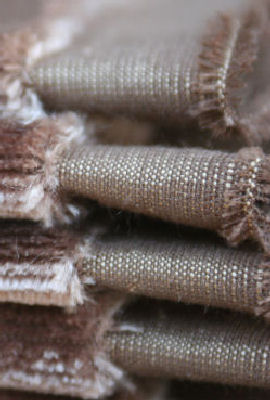
Fabric Tips #12: Rolling a velvet

Image via Wikipedia

You’ve just ordered a new velvet and unrolled it to admire your purchase. But how do you re-roll it?

When you roll almost any fabric you should have the face on the inside. With a velvet this is the pile so you have the pile on the inside.

Some, but not all, velvet piles stand straight up others will ‘lay down’. for the former it does not matter which way you then roll the fabric (provided the pile is on the inside). However for typically longer pile which lays down (ie you can brush it flat with your hand in one direction only) then you should roll the fabric down the pile as you return it to its roll.

Hopefully that made sense. Good luck.

Fabric Tips #11: Mohair Velvet – How To Store

Image via Wikipedia – Alpaca Wool can be made into luxurious alpaca velvet…if you can find it

How to store Velvet.

The same instructions apply to all velvets.

Some background first: As an interior designer you buy and handle many fabrics. You may have wondered why some fabrics come in rolls of up to 100m whereas other come in much smaller lengths. Is this because of their value? The likelihood of them being sold quickly enough? Or perhaps longer lengths of some fabrics would be just to heavy for someone in a warehouse to physically carry or indeed too heavy for a courier to carry? Or perhaps it’s something to do with the thickness of the roll?

Well there is some truth no doubt in all of these reasons and others to. But one very important consideration with a velvet and especially with a Mohair velvets is the weight of the fabric and the weight of the fabric ON ITSELF. Because velvets have a pile they are thicker and heavier than other fabrics as they contain more material; similarly some velvets such as many mohair velvets have a dense pile…again more fabric and more weight.

There comes a point when the sheer weight of the roll of fabric becomes too much for the pile of the first part of the wrapped fabric on the roll and the inherent weight of all the fabric can cause damage to the pile. So velvets and especially mohair velvets have smaller lengths on the roll. Sometimes 25m but sometimes also 40m and 50m per roll.

So the length of fabric on a roll will be impacted by the weight of the fabric per linear metre AND the fact that a pile fabric can be more affected by added weight than other fabric.

So, how to store.

1. Store horizontally

2. Store with no other, external weight applied to the fabric.

3. Covered up to avoid exposure to dirt and dust i the air  -especially if stored for long periods

Typically you will find that many of our velvets come to you in special containers where the velvet is on a roll and suspended by special cardboard ends in the boxes. For small volumes of velvet on a single roll there is often no need for these special containers. Where the velvets are supplied in suspended roll containers it is safe to store the velvet in this form. Ideally youwould have a horizontal racking system for rolls of fabric as lengths can easily be cut off as and when you need them but cleary most interior designers do not have this facility.

The safest method of course is to let your supplier hold the stock and order cut lengths from them. It de-risks you damaging the fabric. Unless of course the supplier can specifically reserve entire rolls just for you, you would have the potential problem of dye lot or batch variation of colour with many fabric dyes. There would normally be a charge for an additional service such as this.

Upholstery Linen – Sourcing Luxury Upholstery Linen in the UK

Upholstery Linen
Upholstery Linen

Upholstery Linen is notoriously difficult for interior designers to source. Sourcing linens for curtains is easy enough but often linens are not woven with sufficient strength to score Martindale results that are high enough to warrant using the fabric for upholstery.

Some suppliers can be a little evasive and will quote the weight of the linen as a measure of the linen’s quality. The implication is that the higher the weight the better suited the fabric will be for upholstery. There is some truth in that implication but you cannot say for certain that high-weight linen is inherently suitable for upholstery. Get the Martindale!

Most KOTHEA luxury upholstery linens have inherent Martindale rub tests of around 20,000 rubs with one range further strengthened to 85,000 rubs for contract usage – 20,000 Martindale being eminently suitable for domestic upholstery.

Furthermore, when buying upholstery- (or curtain-) linen you need to know whether or not it will shrink when washed. Linen ALWAYS shrinks. So what you have to find out is whether or not it has been pre-shrunk before you buy it. A common way of pre-shrinking linen is through the sanforisation process.

Click To Read More Interior Design Articles

Here are the details of our new 2011 upholstery linens that are named Recline, Relax and Restful. We have many others, these are just the new ones:

Name: Recline

Usage: Luxury Contract Upholstery

Colourways: 24

Width:   135cm

Comp:  54% Li 35% Co 11% Pa

Weight: >350g/m2

Notes:   Martindale >85,000

Request Samples

Name: Relax

Usage: Luxury Domestic Upholstery

Colourways: 24

Width:  135cm

Comp: 100% Li

Weight: >265 g/m2

Notes:   Martindale >15,000

Request Samples

Name: Restful

Usage: Heavyweight Luxury Domestic Upholstery

Colourways: 4

Width:  135cm

Comp: 100% Li

Weight: >470 g/m2

Notes:   Martindale >45,000

Request Samples


Contract Upholstery Fabric – How to Specify It

For a comprehensive guide to specifying fabric for hotel and hospitality projects, including Martindale thresholds by room type, BS 7176 fire certification, cleaning regime compatibility, and dye lot strategy, see: How to Specify Fabric for Hotel and Hospitality Projects.

A quick guide to specifying contract upholstery fabrics. The main areas to consider are as follows.

1. Determine Use

Is it panelling or seating? For seating you will need to consider flammability (cigarette, match, and Crib 5) and abrasion (Martindale).

2. Fabric Composition

The composition of the fabric including the yarn and weave will affect long-term wear, appearance, and technical performance. Natural fabrics such as wool can be more expensive but generally offer good handle and technical characteristics including natural flame retardancy. Man-made fabrics are usually easier to maintain but require careful selection to achieve the right aesthetic.

3. Flammability

The standard for contract seating acceptable throughout the EU is EN 1021 Parts 1 and 2 (cigarette and match). Higher-level standards in the UK are BS 5852 Crib 5 and BS 7176. The standard for vertical surface fabrics is BS 476 Part 7. For a full explanation see our complete guide to BS 5852 Crib 5.

4. Abrasion

Check the Martindale rub count for the fabric. For contract seating in hotels, restaurants, and offices, a minimum of 40,000 Martindale rubs is the standard threshold.

5. Environmental Considerations

Natural fibres such as wool generally have better environmental credentials than synthetic alternatives. Nylon in particular has a high environmental impact.

6. Care and Maintenance

Contract fabrics typically deteriorate from dirt accumulation rather than abrasion. Follow the manufacturer’s cleaning instructions. Remove stains promptly and vacuum regularly.

Request Samples

Order cutting samples of any fabric from our current collections. Trade accounts only.

Order Cuttings

Fabric Abbreviations and Textile Label Codes: A Complete Reference for Interior Designers

Fabric Abbreviations and Textile Label Codes: A Complete Reference for Interior Designers

Two separate systems: Fabric labels carry both fibre composition abbreviations (WO for wool, CO for cotton, PES for polyester) and cleaning code abbreviations (W, S, WS, X). They are different systems with different purposes.
Most searched: WS, WV, WP, PA, CV, EA — these are fibre composition codes, not cleaning codes. WS means cashmere goat; it is not the cleaning code for water-soluble cleaning.
Cleaning codes: W means water-based cleaning. S means solvent or dry cleaning only. WS means either method. X means vacuum or brush only — no liquid cleaning.
European standard: ISO 2076 defines the standard fibre abbreviations used across the EU. Some Italian and European variants differ from the ISO codes.

Fabric labels on upholstery textiles, curtain fabrics, and soft furnishings carry two distinct types of abbreviated code: fibre composition codes declaring what the fabric is made from, and cleaning codes declaring how it should be maintained. Understanding the difference between the two systems, and knowing what each code means, is a practical daily requirement for any interior designer or specifier. This reference covers both systems in full.


Fibre Composition Abbreviations

Fibre composition abbreviations on fabric labels follow ISO 2076, the international standard for textile fibre names. The codes below are the standard abbreviations used across the UK and EU. All EU fabrics must carry a label declaring fibre content by percentage using these codes.

Natural Protein Fibres

WO — Wool. Fleece of the domestic sheep.

WV — Virgin wool. Wool that has not previously been processed into a textile product. Distinct from recycled or reclaimed wool. Also written as New Wool on British labels.

WP — Alpaca wool. Fleece of the alpaca. In some Italian labelling WP also indicates baby alpaca specifically.

WL — Llama wool.

WS — Cashmere. Fibre from the undercoat of the cashmere goat, known in German as Kaschmir and in French as Cachemire. WS appears on cashmere fabric and cashmere throw labels as the fibre composition code. It is not a cleaning code.

WM — Mohair. Fleece of the Angora goat. Used in mohair velvet upholstery fabric and mohair knit fabrics.

WK — Camel hair.

WA — Angora wool. Fibre from the Angora rabbit. Distinct from WM (mohair, which is from the Angora goat).

SE — Silk. Natural protein fibre produced by the silkworm. In German the word for silk is Seide, hence SE.

Natural Cellulosic Fibres

CO — Cotton. The most widely used upholstery and curtain fibre globally.

LI — Linen (flax). Bast fibre from the flax plant. Also known by its German name Leinen or French lin.

HA — Hemp. Bast fibre from the cannabis plant. In German Hanf.

JU — Jute. Bast fibre, typically used in hessian and backing fabrics.

SI — Sisal. Leaf fibre from the agave plant.

CR — Coir. Coconut fibre used in matting and some backing applications.

Man-Made Fibres from Natural Sources

CV — Viscose (also known as rayon). Regenerated cellulosic fibre made from wood pulp. Widely used in fabric linings, velvet piles, and blended upholstery fabrics. Also written as VI on some Italian labels.

CMD — Modal (also known as polynosic). A modified form of viscose with higher wet strength.

CLY — Lyocell. Regenerated cellulosic fibre produced in a closed-loop solvent process. Sold under the brand name Tencel by Lenzing AG.

CA — Acetate. Cellulose acetate, a semi-synthetic fibre with a silky handle. Not suitable for FR treatment at significant proportions.

CTA — Triacetate. Similar care and treatment limitations to CA.

CUP — Cuprammonium (cupro). Used in some luxury linings and smooth-handle fabrics.

Synthetic Fibres

PES — Polyester. The most widely used synthetic fibre globally. Trevira CS is a permanently flame-retardant variant of polyester.

PA — Polyamide (nylon). In some European labelling also appears as NY.

PAN — Acrylic (polyacrylonitrile). Not suitable for FR treatment. Solution-dyed acrylic such as Sunbrella is the standard for outdoor and marine upholstery. In Italian labelling sometimes abbreviated as PM.

PP — Polypropylene. Not suitable for FR treatment.

PUR — Polyurethane. Used in stretch fabrics and as a bonding layer in coated or laminated textiles.

EL — Elastane (also known as spandex or Lycra). Also written as EA on some Italian labels.

MT or ME — Metallic fibre.

AF — Other fibres not otherwise classified.

Common Italian and European Label Variants

VI — Viscose (equivalent to CV in ISO standard).

EA — Elastane (equivalent to EL in ISO standard).

PM — Acrylic or polyester (context-dependent in Italian labelling).

PC — Acrylic (polyacrylonitrile, equivalent to PAN).

PBT — Polybutylene terephthalate, a form of polyester used in some technical fabrics.

WP — Baby alpaca in some Italian labelling.


Cleaning Code Abbreviations

Cleaning codes appear on upholstery fabric data sheets and on care labels attached to finished upholstered pieces. They are a separate system from the fibre composition abbreviations.

W — Water-based cleaning. The fabric can be cleaned using water-based cleaning agents and foam upholstery cleaners. This code does not mean the fabric is waterproof — it means water-based products can be applied to the surface without damage.

S — Solvent-based cleaning only. The fabric should be cleaned using dry-cleaning solvents only. Water applied to an S-coded fabric will typically cause watermarks, pile distortion, or shrinkage. Most velvet fabrics — including mohair velvet, cotton velvet, and silk velvet — carry an S code. This is the single most important cleaning code for interior designers to communicate to clients and housekeeping teams.

WS — Either water-based or solvent-based cleaning may be used. Note that WS as a cleaning code is entirely distinct from WS as a fibre composition code (cashmere). The context — care label or fibre content label — determines which meaning applies.

X — No liquid cleaning. The fabric should only be maintained by vacuuming or brushing. No water-based or solvent-based liquid cleaners should be applied.

P — Professional dry cleaning only (used on garment care labels following GINETEX international care symbols).

F — Professional dry cleaning with petroleum-based solvent (GINETEX care symbols).


Understanding WS, WV, and WP: The Most Commonly Confused Abbreviations

Three abbreviations cause consistent confusion because they look like cleaning codes but are fibre composition codes.

WS is cashmere. WV is virgin wool. WP is alpaca or baby alpaca. All three are fibre composition abbreviations defined by ISO 2076. They appear on fabric content labels alongside the percentage of each fibre present — for example, 90% WS 10% SE means 90% cashmere and 10% silk. They have no connection to cleaning instructions.

When a fabric data sheet or care label shows WS followed by a percentage, it is always a fibre content declaration. When WS appears alone on a care instructions line or inside a cleaning care symbol, it is always a cleaning code.


Quick Reference List

  • AB — Abaca
  • AF — Other fibres
  • CA — Acetate
  • CLY — Lyocell / Tencel
  • CMD — Modal
  • CO — Cotton
  • CR — Coir
  • CTA — Triacetate
  • CUP — Cuprammonium / Cupro
  • CV — Viscose / Rayon
  • EA — Elastane (Italian variant of EL)
  • EL — Elastane / Spandex / Lycra
  • HA — Hemp
  • JU — Jute
  • LI — Linen / Flax
  • ME / MT — Metallic fibre
  • PA — Polyamide / Nylon
  • PAN — Acrylic
  • PBT — Polybutylene terephthalate
  • PC — Acrylic (Italian variant)
  • PES — Polyester
  • PM — Acrylic or polyester (Italian variant)
  • PP — Polypropylene
  • PUR — Polyurethane
  • SE — Silk
  • SI — Sisal
  • VI — Viscose (Italian variant of CV)
  • WA — Angora wool
  • WK — Camel hair
  • WL — Llama wool
  • WM — Mohair
  • WO — Wool
  • WP — Alpaca / Baby alpaca
  • WS — Cashmere
  • WV — Virgin wool

Cleaning codes:

  • W — Water-based cleaning safe
  • S — Solvent / dry clean only
  • WS — Water or solvent cleaning safe
  • X — Vacuum or brush only. No liquid cleaning

For fabric care symbols and international care label icons, see our fabric care symbols guide. For cleaning codes by fabric type including mohair velvet and faux leather, see our fabric hand and tactile properties guide. For mohair velvet and upholstery fabric ranges, visit the mohair velvet upholstery page. .

Request Samples

Order cutting samples of any fabric from our current collections. Trade accounts only.

Order Cuttings

What Is BS 476 Part 7 Class 1 ( BS476 )

BS476 Part 7 Class 1 is the FR / Fire Retardancy test for contract wall covering.

In the case of fabric wall coverings, the fabric is held vertically and subjected to a flame. If the rate of spread of any flame falls below a certain level the test is passed.

The test is a severe one. It is appropriate for example, in hotels and offices.

When organising treatment for your fabric ask for it to be treated so that it passes this standard test and inform the treatment company that the fabric will be subsequently tested.

What is BS5867 / BS 5867 part 2 type B? type C?

For the full guide to BS 5852 Crib 5 fire standards for contract upholstery, see: BS 5852 Crib 5: A Complete Guide for Interior Designers and Specifiers.


BS 5867 Part 2 Type B is the contract fire retardancy standard for curtains.

As an interior designer you do not need to understand the technical details of the test. However you are responsible for the project and must:

  • Confirm what standard is required for your project.
  • Specify fabric that meets that standard.
  • Prove that the fabric installed complies.

Here is what to do:

1. Determine the fire retardancy standard required. This may involve contacting the local fire officer. Confirm what documentation you need to provide.

2. Confirm with your fabric supplier whether the fabric inherently meets the standard or requires treatment.

3. On purchasing the fabric, specify the treatment required. Say to the fabric company: treat this fabric to BS 5867 Part 2 Type B and provide documentation confirming this has been done.

4. A treatment certificate confirms the fabric has been treated to the standard. It does not confirm the fabric has passed the test. For larger projects, arrange for your specific batch of fabric to be independently tested after treatment at a UKAS-accredited testing laboratory (not the treatment house). At the end of that process you will receive documentation confirming the fabric meets the standard.

Related: fire retardancy for contract upholstery, Crib 5 and BS 7176.

Test Details

Test method

A sample of the fabric, vertically held, is exposed to a small flame. For Type B (hotels and similar) the ease of ignition is observed. It is noted whether the flame reaches any edge of the specimen and whether any burning pieces fall. For Type C (NHS environments) the fabric is further assessed for behaviour once the flame is removed but when the fabric may still be smouldering. The fabric is tested before and after laundering: Type B requires 12 wash cycles at 40 degrees; Type C requires 50 wash cycles at 40 degrees.

Type B performance criteria: The edges must remain completely intact and no burning debris should fall.

Request Samples

Order cutting samples of any fabric from our current collections. Trade accounts only.

Order Cuttings

Fabric Tips #10

Interior Designers are sometimes asked for the environmental credentials of their specification. Here are some figures that give you an idea of the greenness of different yarns used in fabric production. The figures show the energy consumption (per kilo in KWH) required to make the fibres. Of course this is far from the total carbon footprint of the finished delivered and fully made up cushion or sofa or curtain. But it is a starting point often covering the more energy intensive part of the process.

17 Wool
27 Viscose
32 Polypropylene
35 Polyester
69 Nylon

Clearly natural wool wins hands down!

As a side note, the “Campaign For Wool” should start to get media coverage throughout the rest of 2010 with the patronage of HRH Prince Charles. The society of British Interior Design are planning to give wool a big push “All we are saying is…give fleece a chance”. Their tagline. Great! Well it made me laugh!

Mohair Velvet, Silk Velvet: How to upholster using it

Silk Velvet Upholstery Fabric TextileMohair Velvet and Silk Velvet buyers consider this: You have just invested a considerable amount of money in a high quality silk velvet or mohair velvet. Are you really considering upholstering with it yourself. Use an experienced upholsterer who, to be brutally honest, should not need the instructions that follow.

Some velvets are woven with a nap others are not. It is not a problem either way. If there is a nap you need to know which way it goes as that affects the process of upholstering. When you run your hand down the mohair velvet or silk velvet the smoothed direction indicates the direction of the nap. Remember this, it is important.

I’m assuming that you have already checked that the fabric is not damaged and that each piece is from the same dye lot.

The nap should be upholstered downwards for:

– the back;

– the seat; and

– side surfaces.

The nap should be upholstered from the outside inwards for:

– arm rests.

How do you flip your cushions? Top to bottom or left to right?

Most people flip from top to bottom. It is therefore standard upholstering practice to upholster the front and the back the opposite way. IE when they are flipped over the nap is the same.

You should use a layer of wadding between the foam and the fabric. The wadding can be either cotton or synthetic it does not really matter but check with any fire rating requirements. Again check that you are using the right kind of foam but HR foam or cold foam are both fine.

However if the pile is vertical then we advise the additional use of a cotton slip-cover.

Going back to the foam for a minute we advise that you use white wadding. In certain circumstances it is possible that grey wadding will ‘bleed’ causing marks on your beautiful Mohair Velvet. For example this may be caused from moisture used in the cleaning process.

Always use wadding on the arm rests as a protective layer to help eliminate ‘sharp’ edges. Using wadding on arm rests will thus reduce wear and tear considerably.

For the piping never use synthetic piping cord, always use cotton piping cord. As with the arm rests this will reduce wear and tear by eliminating the ‘sharper edges’.

Again to reduce wear and tear also use the length of the fabric to make the piping. this will look better as well.

Happy Upholstering

What Is Trevira CS? Inherently Flame-Retardant Polyester Explained

What Is Trevira CS? Inherently Flame-Retardant Polyester Explained

What it is: Trevira CS is a brand name for a permanently flame-retardant polyester fibre manufactured by Trevira GmbH in Germany. The CS stands for Comfort and Safety.
How it works: The flame-retardant additive is incorporated into the polyester polymer during fibre production — it is part of the fibre itself, not a surface treatment applied afterwards.
Why it matters: The fire resistance is permanent. It cannot be washed out, worn off, or degraded by cleaning. Fabric made from Trevira CS does not require topical FR treatment to achieve contract fire standards.
Certification: Trevira CS fabric can achieve BS 5867 Part 2 Type B and Type C for curtains and BS 5852 Crib 5 for upholstery, depending on fabric construction.

Trevira CS is one of the most widely used inherently flame-retardant fibres in the UK and European contract interiors market. It is specified for curtains and upholstery in hotels, offices, healthcare facilities, and public buildings where fire compliance is required and the permanence of the fire performance is commercially important. This guide explains what Trevira CS is, how it differs from topically treated polyester, and where it is and is not appropriate to specify.


Inherent vs Topical Flame Retardancy

Standard polyester fabric does not meet UK contract fire standards without treatment. The two routes to compliance are topical FR treatment — applying chemical compounds to the fabric surface after weaving — or using a fibre with inherent flame retardancy built into the polymer from manufacture.

Trevira CS takes the second route. The phosphorus-based flame-retardant compound is added to the polyester melt during fibre extrusion. It becomes part of the polymer chain rather than sitting on or in the fabric surface. This means the fire performance is genuinely permanent — it survives laundering, dry cleaning, and normal use without degradation and without the re-treatment requirements associated with topically treated fabrics.

This permanence is the primary commercial advantage of Trevira CS over topically treated alternatives in high-frequency-cleaning environments such as healthcare curtains and hotel restaurant seating where laundry cycles are regular and frequent.


Fire Standards Trevira CS Can Achieve

Fabric woven from Trevira CS yarn can achieve BS 5867 Part 2 Type B for curtains and drapery, and Type C — which includes a laundering pre-conditioning requirement — making it appropriate for hospital cubicle curtains that are regularly laundered. This is the most demanding UK curtain fire standard and one that few non-inherent fabrics can meet reliably over repeated wash cycles.

For upholstery, Trevira CS fabric can be constructed to achieve BS 5852 Crib 5, though the specific fabric construction — weave density, pile height if applicable, and backing — affects the result. A fabric containing Trevira CS yarn is not automatically Crib 5 certified: the specific fabric as constructed must be tested and certified by a UKAS-accredited laboratory.

Trevira CS fabric also achieves good performance against the IMO fire standards used in marine and yacht interiors, making it a practical specification for vessels requiring FTP Code compliance. See our IMO marine fire standards guide for marine application requirements.


Where Trevira CS Is and Is Not Appropriate

Trevira CS is well suited to curtain fabrics in healthcare, hospitality, and institutional environments where BS 5867 Type C compliance and launderability are required simultaneously. It is also appropriate for acoustic panel fabrics and wall lining fabrics where a surface spread of flame classification is needed without reliance on topical treatment. For high-frequency-cleaning upholstery in healthcare environments, Trevira CS upholstery fabric is a practical alternative to silicone leather where a fabric aesthetic is preferred.

Trevira CS is standard polyester in all its non-fire properties. It does not have the tactile warmth of natural fibres, the lustre of mohair or silk, or the inherent sustainability credentials of wool or linen. For hospitality and high-end residential interiors where tactile quality and aesthetic warmth are the primary criteria, natural-fibre fabrics with independent fire certification are typically preferred over Trevira CS. For the distinction between inherent and topical fire resistance across fibre types, see our FR treatment and fibre compatibility guide.


Frequently Asked Questions

Does Trevira CS need FR treatment?

No. The flame-retardant property is inherent to the fibre — it is part of the polymer structure from manufacture. Fabric made from Trevira CS does not require topical FR back-coating or wet-padding treatment to achieve its fire performance. This is what distinguishes it from standard polyester fabric, which would require topical treatment to meet contract fire standards.

Does Trevira CS fire performance survive washing?

Yes. Because the flame retardancy is part of the fibre polymer rather than a surface application, it is not affected by washing, dry cleaning, or abrasion. This makes Trevira CS particularly appropriate for healthcare curtains and other applications requiring regular laundering without re-treatment or re-certification.

Is all Trevira CS fabric automatically Crib 5 certified?

No. Trevira CS yarn has inherent flame-retardant properties, but the specific fabric woven from it must be tested and certified by a UKAS-accredited laboratory to confirm it meets the required standard for the specific application. The weave construction, pile height, and backing all affect the fire performance of the finished fabric. Always obtain a test certificate for the specific fabric being specified rather than assuming certification from the yarn specification alone.


For the Crib 5 standard for upholstery, see our Crib 5 guide. For curtain fire standards including BS 5867 Type B and Type C, see our hotel fabric specification guide. For inherent vs topical fire resistance across fibre types, see our FR treatment and fibre compatibility guide. For how FR treatment works, see our how FR treatment works guide.

Request Samples

Order cutting samples of any fabric from our current collections. Trade accounts only.

Order Cuttings