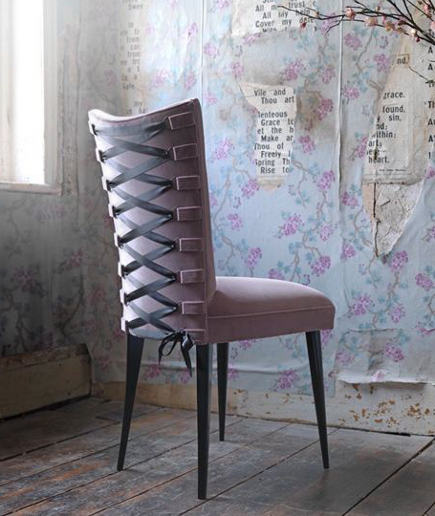
I was searching the net for some information on black velvet upholstery when I came across this interestingly upholstered velvet chair.
Nice image from attic-mag.
Not sure if you can buy that wallpaper however 😉

Passionate About Fabrics
I was searching the net for some information on black velvet upholstery when I came across this interestingly upholstered velvet chair.
Nice image from attic-mag.
Not sure if you can buy that wallpaper however 😉

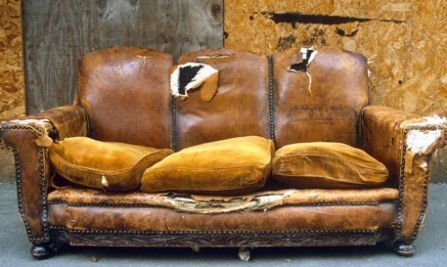
Chic, shabby chic or a bit of a mess?
Leather upholstery is limited by the size of the hide. Probably not that much of an issue on smaller sofas.
Faux leather can have very high abrasion resistance and both can be treated for fire resistance.
Care and maintenance is easier with faux leather. Repairs and colour matching are easier with faux leather, which is important if you under-order/under-specify or just need to buy some more if the project scope increases.
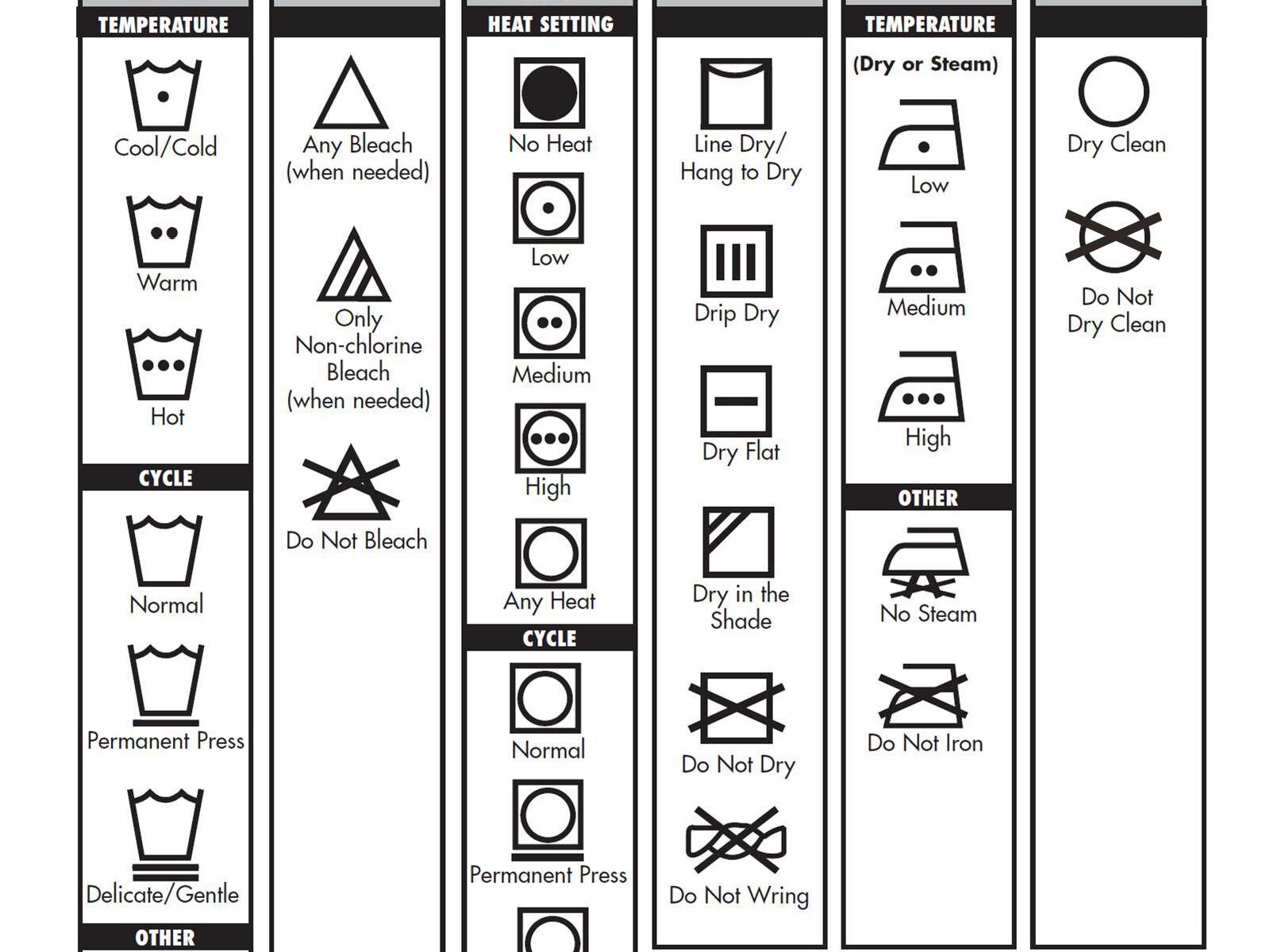
Fabric care symbols appear on bolt ends, data sheets, and specification documents for every fabric you specify. For interior designers, understanding them is not optional. A client who washes a dry-clean-only velvet sofa, or applies a water-based cleaner to a solvent-only fabric, will hold you responsible for the result. This guide covers the two separate symbol systems that apply to interior fabrics: the ISO 3758 care symbols used on fabric labels, and the upholstery cleaning codes used on furniture and fabric data sheets. It also covers the key updates introduced in ISO 3758:2023.
For related specification guides from Kothea, see the Martindale rub test guide, the BS 5852 Crib 5 guide, and the light fastness and Blue Wool Scale guide.
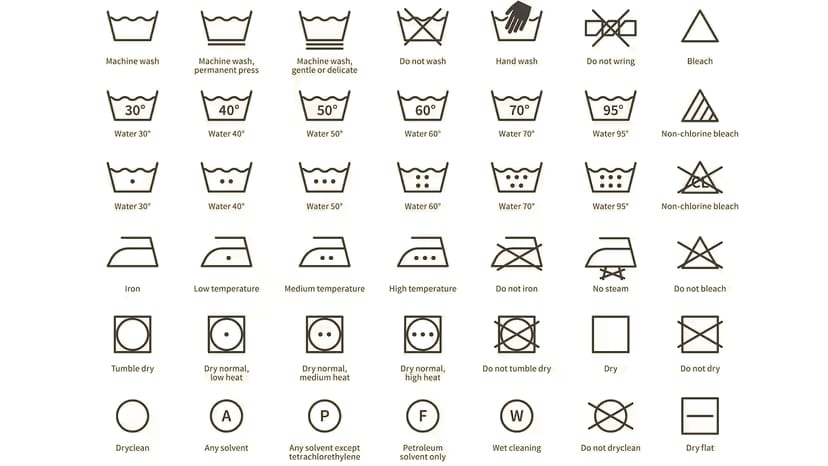
This is the point most frequently misunderstood when specifying interior fabrics. ISO 3758 care symbols, the pictograms showing a washing tub, iron, triangle, and circle, are a garment and textile labelling system. They appear on fabric bolt ends and care labels and cover washing, bleaching, drying, ironing, and dry cleaning. They apply to the fabric as a material.
Upholstery cleaning codes, W, S, WS, and X, are a separate system used on upholstered furniture labels and fabric data sheets. They specify what type of cleaning agent is safe to use on the finished upholstered piece. They apply to the fabric as installed.
A fabric data sheet may show both. The ISO symbols tell you how to care for the fabric before and during upholstery. The cleaning code tells your client how to maintain the piece once it is in use. Both matter and neither substitutes for the other.
Five categories of symbol appear in a standard sequence on every care label: washing, bleaching, drying, ironing, and dry cleaning. A cross through any symbol means that process must not be applied. A single dot or line within a symbol indicates a reduced or gentle setting. Double dots or lines indicate a normal or higher setting.
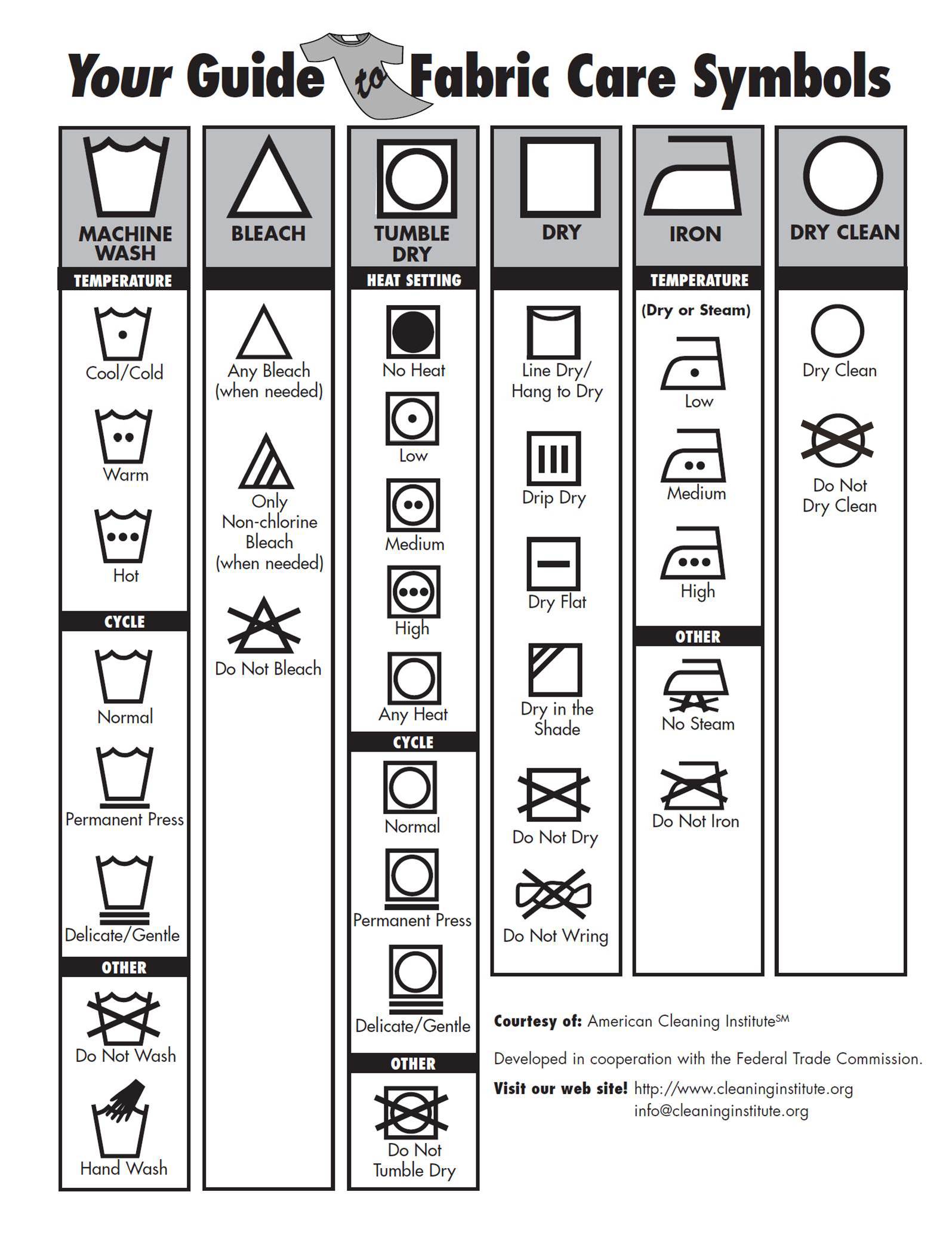
Washing symbols use a tub shape. A plain tub indicates machine washing is permitted. A hand in the tub indicates hand wash only. A tub with a cross means do not wash by any method. The temperature appears as a number inside the tub or as dots, with one dot for 30 degrees Celsius, two for 40, three for 60, and four for 95. A single bar beneath the tub indicates a reduced agitation or synthetic cycle. Two bars indicate the delicate or wool cycle.
Bleaching symbols use a triangle. A plain triangle permits all bleaching agents. A triangle with two diagonal lines permits only non-chlorine bleach. A triangle with a cross means do not bleach.
Drying symbols use a square. A circle inside the square indicates tumble drying is permitted. One dot inside the circle means low heat. Two dots mean normal heat. A cross through the circle means do not tumble dry. A square with a single horizontal line in the middle means dry flat. A square with a curved line at the top means line dry.
Ironing symbols use an iron shape. One dot means low heat up to 110 degrees Celsius. Two dots mean medium heat up to 150 degrees. Three dots mean high heat up to 200 degrees. A cross means do not iron. Two lines beneath the iron mean do not use steam.
Dry cleaning symbols use a circle. A plain circle means dry cleaning is permitted using any solvent. Letters inside the circle indicate which specific solvents are safe: F indicates hydrocarbon solvents, P indicates perchloroethylene and hydrocarbon solvents, and W indicates wet cleaning. A circle with a cross means do not dry clean.
The 2023 revision of ISO 3758 introduced several additions that may appear on fabric data sheets for recently developed or certified ranges.
A new dedicated hand-wash symbol was formalised, showing a hand inside the washing tub with a temperature indicator. Previously hand washing was indicated by the hand symbol alone without a temperature. The 2023 version allows temperature dots to appear alongside the hand symbol to specify the maximum water temperature for hand washing.
A no-steam ironing symbol was added, shown as an iron with two lines beneath it and a cross, distinguishing it from the general do-not-iron instruction. This allows a fabric to be ironed at low temperature on a dry setting while prohibiting steam, which is relevant for fabrics whose finish or surface texture is sensitive to moisture rather than heat.
The dry cleaning circle was expanded to include the W symbol for professional wet cleaning, recognising the increasing availability of controlled aqueous cleaning processes in specialist laundries as an alternative to traditional solvent-based dry cleaning.
If you are working with a fabric whose data sheet shows symbols you do not recognise, check whether they comply with the 2023 revision before making a cleaning recommendation to a client.
The W, S, WS, and X codes appear on upholstered furniture labels and fabric specification sheets. They are the system your client’s housekeeper or cleaning contractor needs to know.
W means water-based cleaning only. Use a water-based shampoo or upholstery cleaner with a clean cloth. Do not use solvent-based cleaners as these may damage the fabric or its backing. Most synthetic fabrics and many treated natural fibres carry a W code.
S means solvent-based cleaning only. Use a dry-cleaning solvent. Do not use water as it can cause shrinkage, watermarks, or damage to the fabric structure. Fabrics carrying an S code include many untreated natural fibres, velvets, and fabrics with water-sensitive finishes.
WS means either water-based or solvent-based cleaning is acceptable. This is the most versatile code and indicates a fabric that can tolerate both cleaning methods depending on the nature of the stain.
X means vacuum or light brushing only. No liquid of any kind should be applied to the fabric. Fabrics carrying an X code are typically fragile, water-sensitive, or finished in a way that would be irreversibly damaged by any liquid. For serious staining on an X-coded fabric, a specialist conservation cleaner should be engaged.
Velvet requires specific care guidance beyond the standard codes. The pile direction of velvet affects both its appearance and how it responds to cleaning. Always work in the direction of the pile when applying any cleaning agent or when brushing. Cleaning against the pile can cause permanent crushing or an apparent change in colour.
For mohair velvet, dry clean only is the standard recommendation for serious soiling. Spot cleaning with a barely dampened lint-free cloth is acceptable for minor fresh stains, working in the direction of the pile. Water should not be applied heavily as it can cause watermarks or pile matting. For full care guidance see our post on cleaning and maintaining mohair velvet.
If a fabric has been topically treated with a fire-retardant finish to achieve a Crib 5 pass, cleaning can degrade the treatment. Dry-cleaning solvents in particular can strip a back-coating. The treatment provider should be consulted before any cleaning regime is recommended to a client for a topically treated fabric. Inherently fire-retardant fabrics, such as mohair velvet with an inherent Crib 5 pass, are not affected by this issue because the fire resistance is a property of the fibre itself rather than an applied coating.
What do the letters W, S, WS, and X mean on an upholstered sofa label?
W, S, WS, and X are upholstery cleaning codes that indicate what type of cleaning agent is safe for the fabric. W means use water-based cleaners only. S means use solvent-based dry-cleaning agents only. WS means either method is acceptable. X means vacuum or brush only, with no liquid of any kind. These codes are separate from the ISO 3758 care symbols on fabric labels and apply specifically to the maintenance of the finished upholstered piece in use.
Can you use water to clean a velvet sofa?
Only if the sofa fabric is coded W or WS. A velvet sofa labelled S must be cleaned with a dry-cleaning solvent only. Water applied to an S-coded velvet can cause watermarks, pile matting, and permanent colour change. For a sofa coded WS, a very lightly dampened lint-free cloth worked in the direction of the pile is acceptable for fresh minor stains. Always test any cleaning method on an inconspicuous area first and allow to dry fully before assessing the result.
What does a cross through a care symbol mean on a fabric label?
A cross through any ISO 3758 care symbol means that process must not be applied to the fabric. A cross through the washing tub means do not wash by any method. A cross through the iron means do not iron. A cross through the tumble dry circle means do not tumble dry. A cross through the dry cleaning circle means do not dry clean. When a cross appears, applying that process would damage the fabric and the instruction must be followed precisely.
What is the difference between care symbols on a fabric bolt and the cleaning code on a sofa label?
Care symbols on a fabric bolt follow ISO 3758 and cover washing, bleaching, drying, ironing, and dry cleaning of the fabric as a material. The cleaning code on a sofa label, W, S, WS, or X, is a separate system that specifies what cleaning agent is safe for the fabric as an installed upholstered piece. Both systems are relevant to interior fabric specification and aftercare advice, but they serve different purposes and apply at different stages of the fabric’s life.
Does dry cleaning a fabric remove a Crib 5 fire treatment?
For fabrics with a topical Crib 5 fire treatment, dry-cleaning solvents can degrade or remove the back-coating that provides fire resistance. Before recommending any cleaning regime for a topically treated fabric, confirm the appropriate method with the FR treatment provider. Fabrics with an inherent Crib 5 pass, such as mohair velvet, are not affected by this issue because the fire resistance is a property of the fibre itself and is not removed by cleaning.
What is the cleaning code for mohair velvet upholstery?
Mohair velvet upholstery is typically coded S, meaning solvent-based dry-cleaning agents only. Water applied directly to mohair velvet can cause watermarks, pile matting, and an apparent change in colour that is difficult or impossible to reverse. For minor fresh stains, a barely dampened lint-free cloth worked in the direction of the pile is acceptable as a first response. Any serious soiling should be referred to a specialist dry cleaner with experience of velvet upholstery.
What is the cleaning code for faux leather upholstery?
Faux leather upholstery is typically coded W or WS, meaning water-based cleaning is safe and in most cases the preferred method. A clean damp cloth is the standard approach for PVC and PU faux leathers. Avoid harsh solvents unless specifically confirmed as safe by the manufacturer, as some solvent-based agents can damage the surface coating or cause discolouration over time.
How do you clean linen upholstery fabric?
Most upholstery linen is coded S or WS depending on the specific range and finish. Pre-washed linen is generally more tolerant of spot cleaning with a water-based solution than untreated linen. Always confirm the cleaning code on the fabric data sheet before advising a client. Linen should never be saturated with liquid and should be dried naturally without applied heat to avoid shrinkage.
What happens if you use water on a fabric coded S?
Applying water to a fabric coded S can cause irreversible damage including watermarks, shrinkage, pile distortion in velvets, and loss of surface finish. The S code indicates that the fabric structure or finish is sensitive to water and that only dry-cleaning solvents are safe. If water has been applied accidentally, blot immediately without rubbing, allow to dry naturally, and consult a specialist upholstery cleaner before taking any further action.
What does dry clean only mean for an upholstered piece?
Dry clean only on an upholstered piece corresponds to the S cleaning code and means only solvent-based cleaning agents should be used. For upholstered pieces that cannot be removed and taken to a dry cleaner, a specialist in-situ upholstery cleaning service should be engaged. These services apply solvent-based agents on location without saturating the fabric or the foam beneath it.
How do you read care symbols on a fabric data sheet?
Care symbols on a fabric data sheet follow ISO 3758 and appear in a fixed sequence from left to right: washing, bleaching, drying, ironing, and dry cleaning. A cross through any symbol means do not apply that process. Numbers or dots inside the washing tub indicate the maximum temperature in degrees Celsius. A bar beneath the tub indicates reduced agitation. These symbols describe how to care for the fabric as a material. The cleaning code, W, S, WS, or X, is listed separately and describes how to maintain the finished upholstered piece.
Can you iron velvet upholstery fabric?
Velvet should not be ironed directly. The heat and pressure of an iron will crush the pile permanently. The care label for velvet will typically show a cross through the iron symbol or, at most, a single-dot low-heat symbol with the instruction to iron on the reverse only. If velvet requires refreshing after crushing or creasing, holding a steam iron a few centimetres above the surface and brushing gently in the direction of the pile is the recommended method. Do not allow the iron to make contact with the fabric face.
Does washing a fabric remove its Crib 5 fire retardant treatment?
Repeated washing can degrade the back-coating of a topically treated Crib 5 fabric over time. The BS 5852 standard includes a water-soak test as part of full certification, meaning a certified fabric has demonstrated resistance to a single water soak, but this does not guarantee indefinite resistance to repeated cleaning. Always confirm the recommended cleaning method with the treatment provider for topically treated fabrics. For inherently Crib 5 fabrics such as mohair velvet, the fire resistance is a property of the fibre and is unaffected by cleaning.
Order cutting samples of any fabric from our current collections. Trade accounts only.
Order Cuttings

Faux Leather and, indeed, vinyls in general have widely varying compositions. So it is very difficult to generalise about FR treatment.
However, as interior designers know, they are great for contract projects because of the excellent abrasion properties and the excellent ease of ongoing care and maintenance. IE they maintain their appearance relatively easily for extended periods.
Contract projects of course pose flammability requirements for the interior designer to determine and specify.
Typically CRIB5 is required for contract upholstery.
Some faux leathers come pre-treated; perhaps containing silicon/Teflon or other substances within the vinyl that limits or excludes the spread of flame required in a crib 5 test.
However some faux leathers require treating. That’s to be expected to a degree as faux leather is a relatively versatile fabric and can be used for a variety of end uses – but hence the required FR treatment will vary.
We recently treated some black faux leather to pass FR for contract curtains. In that case it was possible to treat the back of the fabric (it had a thin absorbent layer on the back) and that was sufficient to stop the spread of flame.
Another brown faux leather that we make has a speciality foam backing, slightly thicker than normal. Whilst this will take the same kind of chemical as the one for curtains the CRIB5 test has a more tricky flame to deal with. Also of consideration is the adhesive required to fix the backing and vinyl together. This adhesive may not be fire resistant again adding to the difficulty of treatment.
The thicker the backer the more luxurious the feel, perhaps. But the more difficult the treatment can be. Some sort of liner / interliner to the rear may well work to stop the flame spreading in a FR test. However, the thicker the foam backing the further away that interliner might be.
We have some specialist backing layers that themselves once set alight release gases (carbon dioxide) that reduce the spread of flame elsewhere. These backing layers do not noticeably add to the thickness of the faux leather.
&n
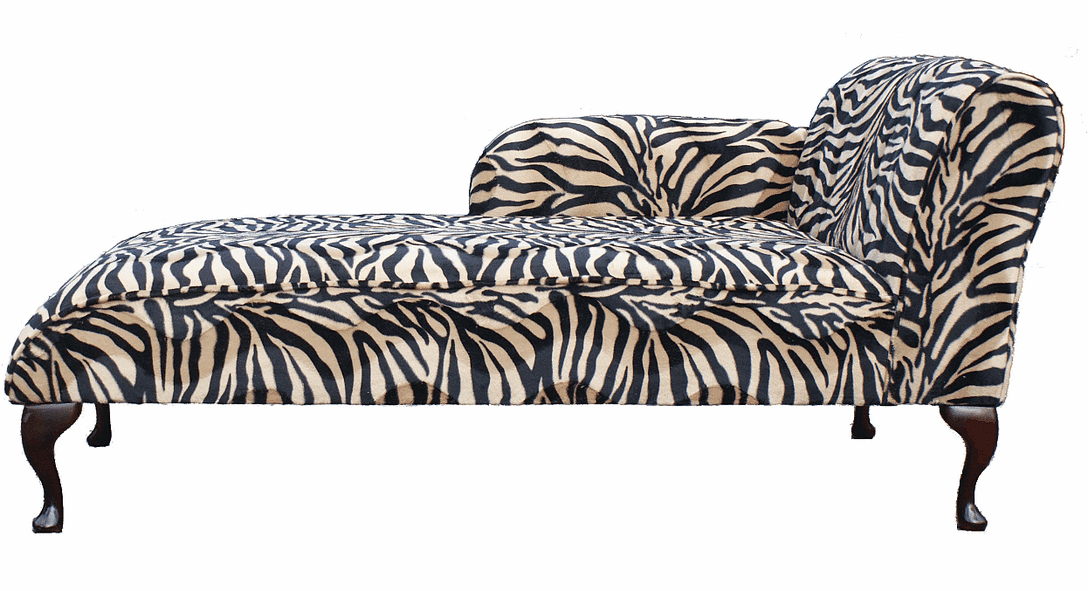
![2224c8482e2e204212a64f1dc4e62ce6[1]](https://www.kothea.com/wp-content/uploads/2013/12/2224c8482e2e204212a64f1dc4e62ce61.jpg) I need one as well. Will we get a discount for 2? These look pretty good. Even better with our velvets on 😉 A nice bit of kid mohair perhaps.
I need one as well. Will we get a discount for 2? These look pretty good. Even better with our velvets on 😉 A nice bit of kid mohair perhaps.

Consider faux leather too. Avoids considering the animal issues and has better making-up and cleaning properties (and cheaper usually)

Fabric Suppliers In The UK To Top Market Interior Designers & Architects are shown in the following directory listing:.
Abbot and Boyd 020 7351 9985
Altfield 020 7351 5893
Alton Brooke 020 7376 7008
Borderline 020 7823 3567
Brian Yates 01524 35035
Brunswig 020 7351 5797
Bruno Triplet 020 7823 9990
Chase Erwin 020 8875 7441
Colefax 020 7244 7427
Colony Fabrics 020 7351 3232
Donghia 020 7823 3456
Gainsborough Silk 01787 372081
Henry Bertrand 020 7349 1477
Jab 020 7349 9323
Jane Churchill 020 7244 7427
Jrobertscott 020 7376 4705
KOTHEA 020 8943 4904
Kravet 020 7795 0110
Lee Jofa 020 7823 3455
Lelievre 020 7352 4798
Manuel Canovas 020 8877 6400
Nobilis 020 7351 7878
Pierre Frey 0207 376 55 99
Robert Allen 01494 474741
Sacho Hesslein 020 7352 6168
Silk Gallery 020 7351 1790
Turnell and Gigon 020 7259 7280
Watts Westminster 020 7376 4486
Zimmer and Rhode 020 7351 7115
Zoffany 08708 300 350
Many of these fabric companies sell a wide range of products including: chenille, contract fabric, faux / fake leather, mohair velvet, linen velvet, cotton velvet, wool, hand woven products, natural silk, cashmere and damask for upholstery, curtains and cushions.
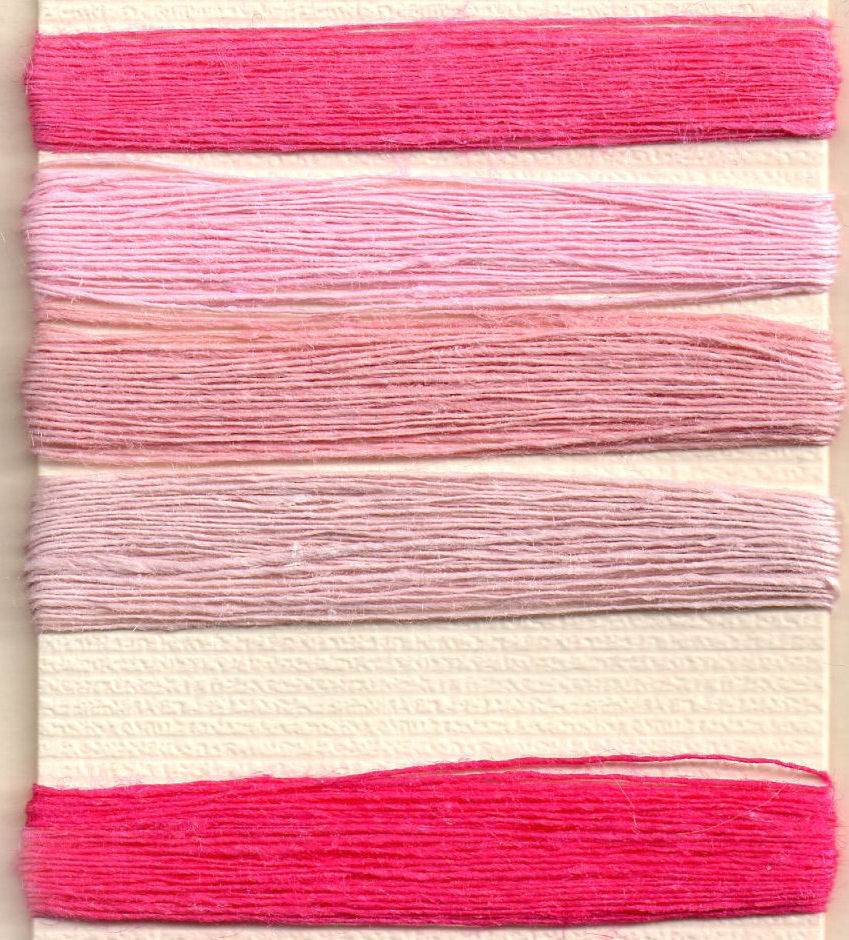 Pink linen is a rather rare and unusual flower. Not often specified in your average interior designer’s scheme. I found this scan that we had emailed someone recently for the client to choose for some curtains. We were even able to introduce different pinks into the warp and weft of the linen for an unusual effect. (We can do that with most of our linen colours).
Anyway, I just thought the pink linen image looked nice and I wanted to share it with you!

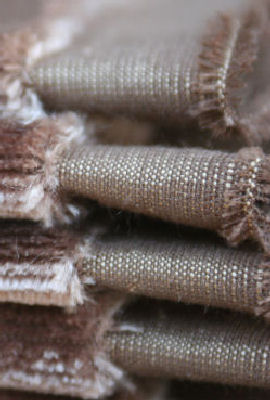
Silk Velvet really is one of the great upholstery velvets. It looks great, it feels great and it can be up to the job if your upholstery velvet is chosen wisely.
If your last and only experience of a velvet was sitting on one in the cinema then you really haven’t lived!
Firstly let’s look at silk velvet’s suitability for upholstery. It can have a Martindale Rub Test result of over 20,000 – so it CAN be readily suitable for many upholstery uses.
Composition. Just because it is sold as 100% silk can be misleading and not necessarily relevant. Is this 90% silk velvet better than that 100% silk velvet? You just can’t answer that by simply looking at the composition.
A silk velvet that is sold as being 100% silk may in fact be a 100% silk velvet pile and 100% cotton backcloth. There is nothing inherently wrong with that. If it is the look and feel of the silk that you are looking for then maybe it’s best to just consider the pile (assuming the backcloth is up to the job of course). One of our fine silk velvets has a 100% pile and then a backcloth of silk and cotton – with the cotton being added for strength and the overall silk content being 90%. Compare this to our Italian Silk & Cashmere Velvet which has a 70% silk + 30% cashmere pile.
Next look at the silkiness or the shininess. If you are looking for a silk velvet you will usually want a shine.
Consider too the length of the pile. Again, there is nothing inherently good or bad about a long or short pile. A shorter pile may be more rigid and upright and that could be a characteristic that you are looking for. Alternatively, a longer pile will probably lay better in one direction – and you may well want that characteristic.
The weight of the fabric in grams per metre is often used as a measure of quality. That is not always true and could, for example, easily be distorted by a heavy and poor quality backcloth.
My personal preference would be to get my hand on a sample; feel it and look at it. What I look for and prefer is a slightly more rigid and consistent pile with a very dense weave. I would look carefully at the country of manufacture. I prefer an Italian velvet (mainly because it sounds better!) but if not Italian then I would certainly only consider a velvet produced in mainland western Europe. But don’t copy me, have the confidence to choose what you like – you are going to have to live with it. I would now choose my upholsterer carefully; many years ago a velvet-covered chair came back for me from a local upholsterer and the pile was not running in a consistent direction…it didn’t look great (read ‘awful’). So don’t, like me, assume that all upholsters know what they are doing with velvets, they patently don’t all know. I would then read our guide to upholstering with velvet – a designer’s worksheet and armed with a bit of knowledge quiz your upholsterer carefully.
Ever wondered what a Martindale rub test looks like?
We have already shown a video of the machine in action here. Of some additional interest are the following faux leather samples that recently came back to us from the Martindale testing laboratory.
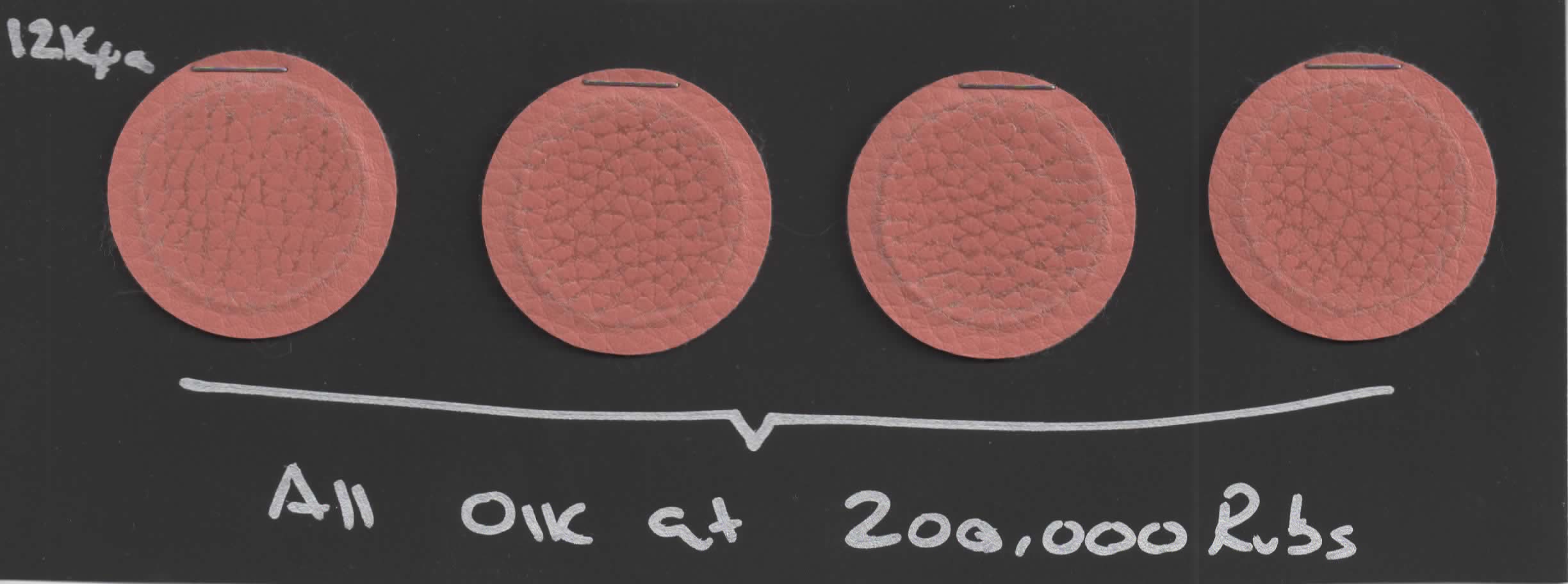
The image above shows the circular cuttings taken of the fabric after being rubbed 200,000 times. As you can see, this faux leather lasted well above the industry standard of 100,000 rubs.