Fabric for Wall Panels and Headboards: BS EN 13501-1, BS 476 Part 7 and Headboard Fire Standards

Fabric for Wall Panels and Headboards: Fire Standards and Specification Guide for Interior Designers

Wall lining standard: BS EN 13501-1 (new projects) / BS 476 Part 7 (legacy specifications)
Most commercial interiors require: Euroclass B or C — circulation routes require B-s1,d0 or better
Crib 5 does not qualify fabric for wall use — wall panels must be tested as a composite with their substrate
Headboards: confirm with fire officer whether BS 5852 or BS EN 13501-1 applies before specifying

Fabric applied to walls and fabric used in headboards occupies a regulatory category that is distinct from upholstery fabric and frequently misunderstood. The standard that governs contract upholstery, BS 5852, is not typically the governing standard for wall linings, though it may still be required in parallel for padded elements where the fire strategy treats them as upholstered furniture. Wall-mounted fabric falls primarily under the surface spread of flame framework: BS EN 13501-1 for new UK projects, or BS 476 Part 7 for legacy specifications. BS EN 13501-1 is now the modern standard for most new work and uses a different classification system from BS 476 Part 7, based on a different test methodology. The difference matters because a fabric that carries a full BS 5852 Crib 5 certificate may not satisfy the requirements for a wall panel application in the same room.

Headboards introduce a further complication. Whether a headboard must meet the upholstery standard or the wall lining standard depends on how it is constructed and installed, and on the interpretation of the fire officer or building control officer responsible for the project. This guide explains both frameworks, where they overlap, and how to specify correctly for each application.

For the upholstery fire standard referenced throughout this guide, see our complete guide to BS 5852 Crib 5.


Specifier Decision Framework

Before researching specific fabrics or requesting certificates, confirm the answers to the following questions in order. They determine which standards apply and what testing is required.

Is the fabric fixed to the wall as a surface lining? If yes, the primary standard is BS EN 13501-1 for new projects, or BS 476 Part 7 for legacy specifications. Confirm the required Euroclass with the fire officer before selecting fabric.

Is the wall-fixed element padded, upholstered, or thick enough that the fire strategy may treat it as furniture? If yes, confirm with the fire officer whether BS 5852 or BS 7176 is also required in parallel with the wall lining standard.

Is the fabric in a circulation route or means of escape? If yes, the required Euroclass is typically more demanding, often B-s1,d0 or equivalent. Confirm the specific requirement for the building type and area.

Is it a headboard? Confirm whether the headboard is classified as upholstered furniture (BS 5852 or BS 7176) or as a wall surface element (EN 13501-1 or BS 476 Part 7). See the headboard section below.

Is the application acoustic? Confirm that the face fabric is not coated or laminated in a way that reduces acoustic transmittance, and that the composite panel has been tested as an assembly.


The Wall Lining Standards: BS EN 13501-1 and BS 476 Part 7

BS EN 13501-1 is the current primary fire classification standard for construction products and building elements in the UK and Europe, and is the system most new projects specify to. It classifies reaction to fire using a Euroclass system of A1, A2, B, C, D, E, and F, with suffix designations for smoke production (s1, s2, s3) and flaming droplets (d0, d1, d2). The Euroclass system is based on the Single Burning Item test (EN 13823) and additional small flame tests, and measures a broader range of fire behaviours than the earlier British Standard tests.

BS 476 Part 7 is an older British Standard still referenced in many legacy specifications and some current projects. It classifies surface spread of flame from Class 1 to Class 4, with Class 1 representing the lowest spread. Euroclass B is often considered broadly comparable to Class 1 in practice, but the two systems use different test methods and are not directly equivalent. Where a project specifies in BS 476 terms, confirm with the fire officer or building control authority whether the EN classification is also acceptable as an alternative, and which system takes precedence.

For commercial buildings in England and Wales, Approved Document B of the Building Regulations increasingly references Euroclass requirements for wall and ceiling linings. For most internal areas, Euroclass B or C is required. For circulation areas and means of escape, a higher Euroclass, typically B-s1,d0 or better, may be required. The specific requirement varies by building type, area of use, and the fire strategy for the project. Always confirm the applicable standard and classification level with the fire officer or building control authority before specifying.


Euroclass Quick Reference

The BS EN 13501-1 Euroclass system is unfamiliar to many designers coming from a background in BS 476 or BS 5852. The main classes for wall and ceiling linings are as follows.

A1 and A2 are non-combustible or limited combustibility materials. Stone, concrete, glass, and mineral wool products typically achieve these classes. No fabric achieves A1. Some treated or composite fabrics on non-combustible substrates can approach A2.

B indicates very limited contribution to fire. This is the class typically required for wall linings in most contract commercial environments and is often considered broadly comparable in practice to Class 1 under BS 476 Part 7, though the two are not directly equivalent.

C indicates limited contribution to fire. Acceptable in some less critical internal areas depending on the fire strategy. Often considered broadly comparable in practice to Class 2 under BS 476 Part 7.

D and E indicate higher contribution to fire and are generally not acceptable for wall linings in commercial environments. F indicates no performance determined.

The suffix designations add further information. s1, s2, s3 indicate smoke production from low to high. d0, d1, d2 indicate flaming droplet production from none to high. A specification of B-s1,d0 means Euroclass B with low smoke and no flaming droplets, which is typically required in the most demanding areas such as means of escape. Where the suffix is not specified in a project brief, confirm the required level with the fire officer as it significantly affects which materials are acceptable.


Why Substrate Assembly Testing Is Not Optional: Real Examples

The following failures occur regularly on wall panel and headboard projects and are preventable only if the assembly is tested before specification is finalised.

Fabric passed Crib 5 but failed the wall panel test on MDF. A designer specified a mohair velvet with a full Crib 5 certificate for a hotel wall panel. The fire officer required BS 476 Part 7 Class 1 for the wall application. The Crib 5 certificate did not apply. The fabric was then tested on MDF and achieved only Class 2. FR treatment was required, adding three weeks to the programme.

Same fabric, different outcome on a different substrate. The same fabric, when tested on plasterboard with a mineral wool backing, achieved Class 1 without treatment. The substrate had determined the outcome, not the fabric alone. The panel system was redesigned around the plasterboard configuration.

Velvet classification changed after FR treatment was applied. A linen velvet achieved Class 2 untreated. FR treatment was applied to reach Class 1. The treatment visibly altered the pile handle and introduced a slight sheen to the surface that was unacceptable to the client. The fabric was replaced and the programme was delayed by four weeks.

Certificate rejected because the installation adhesive differed from the tested configuration. A fabric wall panel had been tested and certified using a specific contact adhesive. The site contractor used a different adhesive for practical reasons. The building control officer required re-testing of the as-built configuration.


Why Wall Fabric Must Be Tested as an Assembly

The most important practical point in specifying fabric for wall panels is that the fire test must be conducted on the fabric as it will actually be installed, including the substrate to which it is fixed and the method of fixing. A fabric tested on one substrate may achieve Class 1. The same fabric fixed to a different substrate with a different adhesive may achieve only Class 2 or Class 3. The certificate is valid for the tested combination only.

This means that a supplier’s claim that a fabric is Class 1 must be read carefully. Class 1 to what substrate? With what backing? Using what adhesive or fixing method? If the project’s substrate or installation method differs from the tested configuration, a new test is required or the supplier must confirm that the existing test covers the intended configuration.

For fabric-covered wall panels, the typical assembly consists of the face fabric, a backing or interliner, and a substrate panel, most commonly MDF, plasterboard, or a proprietary acoustic panel. The face fabric and the substrate together must be tested as a composite. The backing, if any, forms part of the tested assembly and cannot be substituted without affecting the validity of the certificate.


BS 5852 and BS 476 Part 7: Different Standards for Different Applications

BS 5852 measures how an upholstered composite of fabric and filling responds to an ignition source placed at the junction of the seat and back, simulating the conditions most likely to start a fire in a piece of seating. It is a composite test and the result applies to the specific combination of cover fabric and filling tested.

BS 476 Part 7 measures how quickly flame travels across the surface of a wall lining material when exposed to radiant heat. It is a surface test and the result applies to the specific fabric and substrate combination tested, as they would be installed on the wall.

The two standards test for different fire behaviours under different conditions and are not interchangeable. A fabric that passes BS 5852 Crib 5 for use on a sofa has not been tested for surface spread of flame on a wall. A fabric that achieves Class 1 to BS 476 Part 7 for use on a wall has not been tested for resistance to ignition as an upholstery composite. A fabric used for both wall panels and seating in the same project may need to be tested to both standards separately.


Specifying Fabric for Wall Panels in Practice

Before selecting a fabric for a wall panel application, confirm the following with the fire officer, building control officer, or the project’s fire strategy consultant.

What classification is required for wall linings in this building and this room? The answer will be Class 1 or Class 0 to BS 476 Part 7, or its EN equivalent, and may vary between different areas of the same building. Circulation routes and means of escape typically require a higher standard than finished rooms.

Has the specific fabric been tested to the required standard, and in what configuration? Request the test certificate and confirm that the substrate, backing, and fixing method in the certificate match the proposed installation.

If the fabric has not been tested, can the supplier arrange testing? Many specialist fabric suppliers and FR treatment companies can arrange composite testing through a UKAS-accredited testing laboratory. The test typically requires samples of the fabric and substrate together and takes three to four weeks. Budget for this in the project programme.

Does the fabric require topical FR treatment to achieve the required classification? If so, the same considerations apply as for upholstery: the treatment must be appropriate for the fabric type, must not visibly alter the appearance or handle, and must be carried out by a reputable specialist. The treated fabric must then be tested in the treated state, as the treatment forms part of the tested configuration.


Velvet on Walls

Velvet is a common choice for fabric wall panels in hospitality environments, luxury residential projects, and acoustic installations. The pile surface of velvet creates a warm and visually distinctive finish and provides genuine acoustic benefit. However, velvet requires careful specification for wall applications because the pile surface presents additional combustible material compared to a flat-woven fabric of the same fibre and weight.

The pile surface of velvet affects surface spread of flame performance through a combination of surface geometry, mass per unit area, and fibre type. The three-dimensional pile structure can encourage faster initial flame spread than a flat fabric of similar composition, though the fibre type is often the more significant variable. A mohair or wool velvet, whose fibre has inherent fire-resistant properties, may achieve a better surface spread of flame classification than a flat synthetic fabric of the same weight. Always test the fabric in its final pile form, including whether the pile will be cut or uncut, and with any surface treatments applied.

Mohair velvet, which carries natural fire-resistant properties arising from the protein structure of the fibre, performs better in surface spread of flame testing than cotton or linen velvet of equivalent construction. However, a wall panel application must be independently tested regardless of the fibre type. A Crib 5 certificate for mohair velvet as upholstery does not confer any classification under BS 476 Part 7 for wall use.

For full detail on velvet types and their fire characteristics as upholstery fabrics, see our velvet types compared guide.


Acoustic Wall Panels

Fabric-covered acoustic panels are a common specification in hospitality, office, and residential projects where both aesthetics and sound absorption are required. The acoustic performance of a panel depends primarily on the density and thickness of the absorptive core, typically a mineral wool, polyester fibre, or acoustic foam substrate, and is not significantly affected by the face fabric provided the fabric is sufficiently open in weave to allow sound to pass through.

The face fabric for an acoustic panel must allow sound to pass through rather than reflect it. Most upholstery velvets are sufficiently open in construction to be acoustically semi-transparent, though heavy coatings, tight laminated backings, or very dense pile can significantly reduce sound absorption. Faux leather and PVC-coated fabrics are acoustically reflective and are not suitable as the face fabric of an acoustic panel unless acoustic performance is not a requirement. Confirm the acoustic transmittance of the face fabric with the panel manufacturer before specifying, particularly if the fabric has any backing applied.

The fire classification of an acoustic panel is determined by the composite of face fabric, core material, and substrate. The core material in many proprietary acoustic panels is inherently non-combustible mineral wool, which significantly supports the fire performance of the overall panel. Confirm the composite test data with the acoustic panel manufacturer rather than specifying the face fabric and core separately and assuming the combination will achieve the required classification.


Headboards: The Regulatory Ambiguity

Headboards are the most ambiguous fabric application in interior specification from a fire standard perspective. Whether a headboard must meet the upholstery standard BS 5852 or the wall lining standard BS 476 Part 7 depends on its construction, its method of fixing, and the interpretation of the fire officer or building control authority for the project.

A headboard that is freestanding, or attached to the bed frame and structurally independent of the wall, is typically treated as upholstered furniture. In a hotel or other commercial environment this means the fabric and filling composite should meet BS 5852 Crib 5, and for hotel projects the full BS 7176 Medium Hazard standard is appropriate. For full detail on hotel headboard specification see our hotel fabric specification guide.

A headboard that is fixed directly to the wall and forms part of the wall surface may be treated as a wall lining under the building’s fire strategy, in which case BS 476 Part 7 Class 1 is the appropriate standard rather than BS 5852. In some projects, particularly where a large padded wall panel extends beyond the width of the bed and forms a feature wall, the fire officer may treat the entire panel as a wall lining.

The correct approach in any commercial project is to confirm the applicable standard with the fire officer before selecting the fabric, rather than assuming which standard applies. Where uncertainty exists, specifying a fabric that can be tested to both BS 5852 Crib 5 and BS 476 Part 7 Class 1 eliminates the ambiguity, though both tests will need to be carried out separately and the certificates documented separately.


Headboard Classification at a Glance

The applicable fire standard for a headboard depends on its construction and installation method. The following gives the typical position, though confirmation with the fire officer is always required.

  • Freestanding or bed-mounted headboard: typically treated as upholstered furniture. Standard: BS 5852 Crib 5 and, for hotel projects, BS 7176 Medium Hazard.
  • Wall-fixed padded panel forming a headboard: may be treated as a wall surface element. Standard: BS EN 13501-1 or BS 476 Part 7, confirmed with fire officer.
  • Large feature wall panel extending beyond the bed: typically treated as a wall lining throughout. Standard: BS EN 13501-1 for the full panel area.
  • Ambiguous or mixed construction: confirm in writing with the fire officer before specifying. Where both standards may apply, test to both separately.

What to Ask Your Fabric Supplier

Before ordering fabric for a wall panel or headboard project, confirm the following with the supplier.

Has the fabric been tested to BS EN 13501-1 or BS 476 Part 7 for wall applications? If so, what Euroclass or Class was achieved? On what substrate was it tested, and what adhesive or fixing method was specified in the test? A certificate that does not specify the substrate configuration provides limited assurance.

Can the fabric be tested on the substrate configuration proposed for this project? If the supplier’s existing certificate covers a different build-up, confirm whether re-testing is available and the lead time and cost involved.

If FR treatment is required to achieve the classification needed, has the supplier arranged treatment for this fabric before? What effect does the treatment have on the pile handle and appearance? Can treated samples be provided for client approval before treatment of the full order?

If a backing or interliner is part of the proposed panel build-up, has the fabric been tested with that specific backing? Backers and interliners form part of the tested assembly and changing them may affect the classification.


Kothea Fabrics for Wall Panel and Headboard Applications

Mohair velvet from Kothea achieves Martindale rub counts of 80,000 to 100,000 and carries independently certified Crib 5 passes on the tested ranges without topical treatment. For headboard applications where BS 5852 Crib 5 is the applicable standard, the active mohair velvet ranges are suitable subject to confirmation with the fire officer. For wall panel applications requiring BS 476 Part 7 Class 1, the fabric would need to be tested in the specific composite configuration intended for the project.

Faux Leather 3 from Kothea achieves in excess of 100,000 Martindale rubs with a Crib 5 fire rating and a wipe-clean surface. It is suitable for headboards where BS 5852 is the applicable standard and is practical for hotel bedroom headboards where cleaning compatibility is a consideration. As a coated fabric it is acoustically reflective and is not suitable as the face of an acoustic wall panel.

For any wall panel or headboard project requiring specific fire certification, contact Kothea to discuss the certification status of the relevant ranges and the testing options available.


Quick answers

What fire standard applies to fabric on walls in a commercial building?
Fabric fixed to walls in commercial buildings in the UK must meet the surface spread of flame standard BS 476 Part 7, with Class 1 required for most internal wall and ceiling linings under Approved Document B of the Building Regulations. In circulation areas and means of escape, Class 0 performance may be required, combining Class 1 spread of flame with compliance with the fire propagation index of BS 476 Part 6. The European equivalent classification system, BS EN 13501-1, uses different class designations and should be confirmed separately. Always confirm the specific requirement with the fire officer or building control authority for the project before specifying.

Does a Crib 5 certificate qualify fabric for use on walls?
No. BS 5852 Crib 5 is the fire standard for upholstered seating. It tests how a composite of fabric and filling responds to ignition sources placed at the junction of a seat and back. BS 476 Part 7 tests the surface spread of flame across a wall lining material under radiant heat. The two standards test different fire behaviours and are not interchangeable. A fabric with a Crib 5 certificate must be independently tested to BS 476 Part 7 in the intended wall panel configuration before it can be specified as a wall lining.

Does the substrate affect the fire classification of a fabric wall panel?
Yes, significantly. The fire classification under BS 476 Part 7 applies to the fabric as installed, including the substrate to which it is fixed and the adhesive or fixing method used. The same fabric can achieve different classifications depending on the substrate. A certificate obtained on one substrate configuration does not apply to a different substrate. Always confirm that the substrate, backing, and fixing method in the test certificate match the intended installation before specifying.

What fire standard applies to hotel bedroom headboards?
This depends on how the headboard is constructed and installed. A headboard that is freestanding or attached to the bed frame is typically treated as upholstered furniture and should meet BS 5852 Crib 5 and, for hotel projects, BS 7176 Medium Hazard. A headboard fixed directly to the wall as part of the wall surface may be treated as a wall lining requiring Class 1 surface spread of flame to BS 476 Part 7. The applicable standard should be confirmed with the fire officer before specifying. Where uncertainty exists, specifying a fabric that can be independently tested to both standards eliminates the ambiguity, though both tests are required separately.

Can velvet be used on walls in a hotel or commercial interior?
Yes, subject to achieving the required fire classification in the specific wall panel configuration. Velvet is widely used on fabric wall panels in hospitality environments and provides acoustic benefit alongside aesthetic quality. The pile surface of velvet increases combustible material at the surface and may require FR treatment to achieve Class 1 under BS 476 Part 7, depending on the fibre and construction. The fabric must be tested in its final form, as installed, with the intended substrate. Mohair velvet performs better in surface spread of flame testing than cotton or linen velvet due to the natural fire-resistant properties of mohair fibre, but all velvet wall panel applications require independent testing. A Crib 5 certificate as upholstery does not qualify any velvet for use as a wall lining.

Is fabric suitable for the face of an acoustic wall panel?
Most plain-woven fabrics including velvet are acoustically semi-transparent and are suitable as the face of an acoustic panel. The face fabric should not have a dense coating or laminate that reflects sound. Faux leather and PVC-coated fabrics are acoustically reflective and are not suitable for acoustic panels. The fire classification of the panel is determined by the composite of face fabric, core, and substrate and should be confirmed with the acoustic panel manufacturer using composite test data, rather than specifying the face fabric and core separately.

What Martindale count do I need for a fabric-covered wall panel?
Martindale rub count is a measure of abrasion resistance for upholstery fabric and is not a primary specification criterion for wall panels. Wall panels are not subject to the sustained friction of seating use and do not require the same Martindale thresholds as contract upholstery. That said, a fabric with a reasonable abrasion resistance of 20,000 rubs or above is practical for a wall panel application as it will resist minor contact, brushing, and cleaning without visible degradation. For headboards, a minimum of 25,000 rubs is appropriate. For full guidance on Martindale thresholds see our Martindale rub test guide.


For pattern matching and fabric quantity calculation on wall panel projects with large-scale repeats, see our pattern matching guide. For fabric specification at each RIBA Plan of Work stage including wall panel decisions, see our RIBA Plan of Work fabric guide.

For the surface spread of flame standard applicable to fabric wall and ceiling linings, see our BS 476 Part 7 guide.

For velvet as an acoustic treatment in home studios and music rooms, see our fabric for home studio acoustics guide.

Request Samples

Order cutting samples of any fabric from our current collections. Trade accounts only.

Order Cuttings

Hotel Fabric Specification Guide: Martindale, Crib 5, Cleaning and Dye Lots

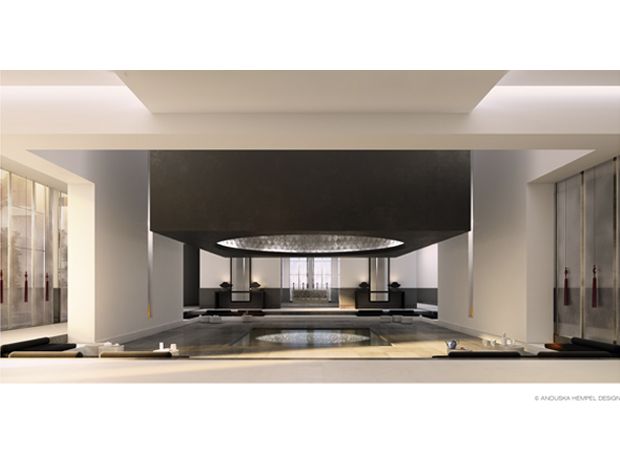
Anouska Hempel Design

How to Specify Fabric for Hotel and Hospitality Projects: A Complete Guide for Interior Designers

Minimum Martindale: 40,000 rubs (bedroom) / 60,000 rubs (restaurant and bar) / 80,000–100,000 rubs (lobby)
Fire standard: BS 7176 Medium Hazard — not just Crib 5
Cleaning code: W or WS preferred — S-coded fabrics are often incompatible with hotel housekeeping
Download: Hotel fabric specification checklist (PDF)

Hotel and hospitality fabric specification is categorically different from residential work. The same fabric that performs well in a client’s drawing room will fail visibly within months in a hotel bedroom. The difference is not only the volume of use but the nature of that use: guests treat hotel furniture differently from their own, housekeeping applies chemicals that residential cleaning never encounters, and the fire authority expects documentation that a residential project never requires. This guide covers every dimension of hotel fabric specification, from Martindale thresholds by room type to dye lot consistency across multi-phase projects.

For the testing standards referenced throughout this guide, see our posts on the Martindale rub test, BS 5852 Crib 5 fire certification, light fastness and the Blue Wool Scale, fabric care symbols and cleaning codes, and velvet types compared.


Understand the Project Before Specifying Any Fabric

Before selecting a fabric, confirm the following with the client or project manager. The answers determine every specification decision that follows.

Brand tier and refurbishment cycle. A budget hotel expecting to refurbish every five years has different durability requirements from a five-star property projecting a ten-year lifecycle. The longer the expected service life, the higher the Martindale threshold should be.

Occupancy pattern. A hotel running at 90% year-round occupancy subjects its furniture to dramatically more use than a seasonal resort. A 24-hour city-centre hotel has different requirements from a boutique property with a primarily weekend leisure clientele.

Housekeeping regime. Ask what cleaning products are used on upholstered surfaces. Many hotels use alkaline-based multi-purpose cleaners across all surfaces. These are effective at removing soiling but can degrade the back-coating on topically treated fabrics over time. If the housekeeping contractor uses a standard alkaline spray on upholstered chairs, specify fabrics with a W or WS cleaning code, or confirm that the specific fabric survives the cleaning agent in use. Solvent-coded fabrics coded S require specialist in-situ cleaning and are not compatible with standard hotel housekeeping routines unless a specialist cleaning contract is in place.

Fire risk assessment category. Under the Regulatory Reform (Fire Safety) Order 2005, the responsible person for the building must carry out a fire risk assessment and procure furnishings accordingly. For most hotel environments the relevant standard is BS 7176 Medium Hazard. Confirm the specific hazard category with the fire officer or the client’s fire safety consultant before specifying.

Project phasing. A hotel refurbished in phases over two to three years will need fabric from the same dye lot across phases, or a supplier able to replicate the colourway in future batches. This is the most frequently overlooked risk in large hotel projects and the one most likely to create a visible inconsistency across rooms completed at different times.


Martindale Thresholds by Room Type

No single Martindale figure applies across an entire hotel. Different areas have different use intensities and the fabric specification should reflect this. These thresholds are industry guidelines rather than formal standards and should be adjusted based on fibre type, construction, and project conditions. The following figures represent the minimum acceptable for each area in a standard UK hotel. For premium properties with longer refurbishment cycles, specify 20,000 to 30,000 rubs above each figure.

Hotel bedroom: desk chair, occasional chair, chaise. Minimum 40,000 Martindale rubs. Guest bedrooms receive regular but not continuous use. A single bedroom chair may be sat in by two guests per night at occupancy, which is low by contract standards but higher than a comparable chair in a private home. 40,000 rubs provides adequate headroom for a five-year refurbishment cycle at typical occupancy.

Hotel bedroom: headboard. Minimum 25,000 Martindale rubs. Headboards are subject to contact rather than seated abrasion. Hair products, moisturisers, and leaning are the primary wear factors. A fabric with good abrasion resistance at 25,000 rubs and a stain-resistant finish is appropriate for most hotel bedroom headboards. For boutique hotels expecting a longer first-refurbishment interval, specify 40,000 rubs. See the headboard section below for fire rating considerations specific to this application.

Restaurant and dining seating. Minimum 60,000 Martindale rubs. Restaurant seating in a busy hotel receives sustained use from breakfast through dinner service, often with multiple seatings per day. Food and beverage spills are frequent. The fabric must combine high abrasion resistance with good stain resistance and a cleaning code compatible with damp wiping between services. High-performance faux leather, often tested to 100,000 or more Martindale rubs or equivalent methods, is one of the most practical specifications for high-volume restaurant seating. For properties where aesthetics require a woven fabric, specify a minimum of 60,000 rubs with a stain-resistant finish.

Bar and lounge seating. Minimum 60,000 Martindale rubs. Bar seating receives the most demanding use of any upholstered surface in a hotel. Guests sit for extended periods, often in close-fitting clothing that generates sustained friction, and spills involving alcoholic beverages are common. For bar stools and high-seat bar chairs where the seating surface is under direct and continuous pressure, 80,000 rubs is a more defensible specification. Alcohol can also degrade certain topical fabric finishes, which is a reason to favour inherently resistant fabrics or faux leather in bar applications.

Hotel lobby seating. Minimum 60,000 to 100,000 Martindale rubs depending on the lobby’s function. A lobby used primarily as a transit space with limited seating use can be specified at 60,000 rubs. A lobby that doubles as a working space, café, or meeting point and receives continuous use throughout the day requires 80,000 to 100,000 rubs. Lobby furniture is also highly visible and first-impressions critical, which means early visible wear is commercially significant regardless of actual structural failure.

Meeting room and event space seating. Minimum 40,000 Martindale rubs. Meeting room chairs receive intense but intermittent use. A conference chair may be occupied for six to eight hours during a full-day event and then unused for days. 40,000 rubs is sufficient for most meeting room applications. For chairs used in training rooms or learning environments with continuous daily occupation, specify 60,000 rubs.

Spa and wellness seating. Minimum 40,000 Martindale rubs, with additional consideration of moisture and skincare product resistance. Guests using spa facilities arrive in robes or swimwear, and skincare products including oils and lotions come into contact with seating surfaces. Specify fabrics whose cleaning code permits water-based cleaning and confirm compatibility with the specific products used in the spa. Faux leather is often the most practical choice for spa seating.


Fire Rating for Hotel Environments

The fire standard for most UK hotel upholstery is BS 7176 Medium Hazard. This standard incorporates BS 5852 Crib 5 and additionally requires the cigarette and match tests and a water-soak test to simulate cleaning. The specification document must state the specific foam used in the test, as BS 7176 is a composite test of fabric and filling combined, not of the fabric alone.

In practice, many fabrics that pass BS 5852 Crib 5 can be used to achieve BS 7176 Medium Hazard when combined with the appropriate filling, but BS 7176 is a broader composite standard with additional requirements including cigarette, match, and water-soak testing. The difference is also in the documentation: a BS 7176 certificate names the end-use environment and the foam specification, making it a more defensible document for a contract project. For hotel upholstery, specify BS 7176 Medium Hazard rather than simply Crib 5 and request the full certificate naming the foam used in the test. Always request full test certificates rather than relying on generic compliance statements.

For mohair velvet that achieves a Crib 5 pass without topical treatment, confirm that the specific range has been independently tested to BS 5852 and request the test certificate. Where applicable, the certificate should also demonstrate compliance to BS 7176 Medium Hazard or indicate the foam configuration under which the test was conducted.

For curtains in hotel bedrooms and public areas, the applicable standard is BS 5867 Part 2 Type B, which is a separate standard from BS 5852 and governs vertically hanging fabrics. The two standards are not interchangeable. A Crib 5 certificate for an upholstery fabric does not qualify the same fabric for use as a contract curtain.

For full detail on the Crib 5 test, inherent versus topical certification, and BS 7176 hazard categories, see our complete guide to BS 5852 Crib 5.


The Hotel Cleaning Regime and What It Means for Fabric Specification

The housekeeping regime is the single most underspecified variable in hotel fabric selection. Fabrics are routinely tested in laboratory conditions, but hotel cleaning products introduce chemical stresses that standard abrasion tests do not replicate.

Standard hotel housekeeping uses multi-purpose alkaline cleaners for daily surface cleaning across guest rooms and public areas. These products, typically in the pH 8 to 11 range, are effective against the greases, body oils, and food residues that accumulate on upholstered surfaces. However, alkaline cleaners can progressively reduce the effectiveness of some topical FR treatments and may cause surface dulling or discolouration on certain pile fabrics. Cleaning codes indicate suitable cleaning methods but do not guarantee resistance to specific commercial cleaning chemicals.

The practical consequence for specification is as follows. A fabric with a topical Crib 5 treatment and a solvent-only cleaning code (S) is often incompatible with standard hotel housekeeping unless a specialist cleaning regime is in place. Cleaning codes indicate suitable methods but do not guarantee resistance to specific commercial cleaning chemicals. Prefer fabrics suitable for water-based cleaning (W or WS), or confirm compatibility with the actual cleaning products used by the hotel’s housekeeping contractor before finalising the specification. In most hotel projects, the simpler solution is to specify fabrics whose FR certification does not depend on topical treatment, or to select faux leather or other wipe-clean surfaces for high-contact areas.

Deep cleaning of upholstered furniture in hotels typically occurs two to four times per year, using specialist upholstery cleaning services. At this frequency, cumulative chemical exposure is significant over the course of a five or ten-year refurbishment cycle. When specifying a fabric for a long-lifecycle hotel project, ask the supplier to confirm the fabric’s resistance to the specific cleaning agents the hotel uses, and request confirmation in writing before finalising the specification.


Light Fastness in Hotel Environments

Hotel bedrooms present a wide range of light exposure conditions. A north-facing bedroom on the fourth floor of an urban hotel receives very little natural light. A south-facing suite on a high floor with full-height glazing may receive intense direct sunlight for much of the day. The same fabric specified throughout a hotel will perform very differently in these two environments.

For hotel bedrooms with standard glazing and mixed orientations, specify grade 5 where possible for upholstery fabrics and curtains. For south-facing bedrooms, suites with large glazed areas, and hotel lobbies with skylights, specify grade 6 or above. For glazed atriums and hotel exteriors or terraces, specify grade 7 to 8 and use specialist outdoor-rated fabrics.

Modern hotel glazing frequently incorporates low-e coating or UV-filtering film, which reduces UV transmission and can extend the effective service life of a fabric beyond what the grade alone would suggest. If the project specification includes high-performance glazing, factor this into the light fastness requirement but do not reduce the grade below 5 on that basis. Glazing specifications can change during a refurbishment and fabrics need to perform adequately under worst-case light conditions.

For full guidance on light fastness grades and what they mean by room orientation, see our guide to light fastness and the Blue Wool Scale.


Dye Lot Consistency Across Large Projects

A hotel project may specify the same fabric across 200 bedrooms, three dining areas, and a lobby, with installation spread over two to three years across multiple phases. Unless dye lot consistency is managed proactively, the rooms completed in phase one will have a subtly different colour from those completed in phase three.

Dye lot variation is a normal property of any dyed fabric. Even the same colourway produced by the same mill in the same month can show variation between rolls that is invisible side by side but visible when comparing a freshly installed chair with one installed eighteen months earlier. In a hotel where guests move between rooms, this variation is commercially significant.

The practical approach is as follows. At the point of specification, confirm with the supplier the minimum quantity that can be reserved from a single dye lot for the full project. For very large projects, request that the supplier weave the full quantity from the same yarn batch and production run where possible. Where this is not possible, establish the supplier’s tolerance standards for dye lot variation and ensure that comparison samples are retained from the first delivery for matching against subsequent deliveries.

For phased projects where new fabric cannot be reserved in advance, specify the colourway and confirm with the supplier that the range will remain in production for the duration of the project. Discontinued colourways mid-project are the most common cause of unresolvable dye lot inconsistency in hotel refurbishments. For dye lot reservation, cuttings, custom colour matching, and lead time planning across a phased contract, see our lead times, cuttings and custom colour matching guide.


Headboards

Hotel bedroom headboards present a specific specification challenge. The fire standard applicable to headboards is less universally agreed than for seating. BS 5852 is explicitly a test for upholstered seating. Whether a headboard, as a wall-mounted or freestanding fixed element, falls under the same seating standard or under a separate wall-covering or surface-finishing standard depends on how it is constructed and installed.

A headboard that is freestanding or attached to the bed frame and upholstered in the same way as a sofa is often treated as upholstered furniture and specified to BS 5852 Crib 5. A headboard that is fixed to the wall and forms part of the wall surface may be treated as a surface finish and be subject to BS 476 Part 7 or the surface spread of flame classification relevant to that building. Confirm with the fire officer and the hotel’s fire safety consultant which standard applies to the headboard construction specified in the project.

For Martindale specification of headboard fabric, 25,000 rubs is adequate for most hotel bedroom applications. The primary wear on a headboard is contact from hair, hair products, and leaning, rather than the sustained abrasion of seated upholstery. A stain-resistant finish is more valuable on a headboard than an elevated rub count.


Curtains in Hotel Bedrooms and Public Areas

Contract curtain fabrics in hotel bedrooms must meet BS 5867 Part 2 Type B. This is a separate standard from the upholstery fire standards and governs vertically hanging fabrics. The test involves a vertical flame applied to the hanging fabric and measures flame spread and post-flame smouldering. Type B is the standard for most hotel applications. Type C applies to NHS and healthcare environments with more frequent laundering requirements.

Most decorative curtain fabrics require topical treatment to meet BS 5867 Part 2 Type B. Some inherently fire-resistant fabrics, including certain Trevira CS constructions, meet the standard without treatment. The treatment process for curtains involves impregnation or dipping rather than back-coating, and affects different fabric types differently. Sheer and lightweight fabrics are particularly susceptible to visible changes after treatment. Confirm the suitability of the specific fabric for curtain FR treatment with the supplier before specifying.

For hotel bedrooms with south or west-facing windows, curtain light fastness requires the same attention as upholstery. A curtain fabric that faces direct afternoon sun will fade at the fold lines before the body of the fabric shows colour change, creating an irregular striped effect that is difficult to remedy without full replacement. Specify grade 6 or above for curtain fabrics in hotel bedrooms with significant sun exposure.


Kothea Fabrics for Hotel Specification

Mohair velvet from Kothea achieves Martindale rub counts of 80,000 to 100,000 across the active mohair ranges and carries independently certified Crib 5 passes achieved without topical treatment on the ranges tested. The combination of high durability and FR certification without treatment makes mohair velvet suitable for hotel bedroom seating, lobby furniture, restaurant seating at the appropriate rub count, and bar seating at the higher end of the range.

Faux Leather 3 from Kothea achieves in excess of 200,000 Martindale rubs with a Crib 5 fire rating and a wipe-clean surface. Its cleaning code is compatible with water-based hotel housekeeping products. It is suitable for restaurant seating, bar seating, spa seating, headboards, and wall panelling in hotel environments where a wipe-clean surface is required. The 140 cm width and 20-plus colourways make it practical across multiple areas within a single project.

Recline Linen from Kothea achieves 80,000 Martindale rubs and is suitable for hotel bedroom occasional chairs and low-use contract seating where a natural linen aesthetic is specified. Fire treatment is required for contract use.

For full specification data including Martindale rub counts, fire ratings, cleaning codes, and light fastness grades, see the mohair velvet upholstery page, the faux leather upholstery page, and the upholstery linen page.


Quick answers

What Martindale rub count do I need for hotel upholstery?
For hotel bedroom chairs and occasional seating, specify a minimum of 40,000 Martindale rubs. For restaurant and bar seating, specify a minimum of 60,000 rubs, with 80,000 rubs preferred for high-volume bar seating. For hotel lobby seating in continuous use throughout the day, specify 80,000 to 100,000 rubs. For hotel bedroom headboards, 25,000 rubs is the minimum with a stain-resistant finish. These figures are minimums for a standard five-year refurbishment cycle. For premium properties with a ten-year cycle, add 20,000 to 30,000 rubs to each threshold. For full guidance on the Martindale rub test and how rub counts translate to classification, see our Martindale rub test guide.

What fire standard applies to hotel upholstery in the UK?
For most UK hotel environments, the applicable standard is BS 7176 Medium Hazard, which incorporates BS 5852 Crib 5 plus the cigarette and match tests and a water-soak stage. The certificate must document the specific foam used in the test, as BS 7176 is a composite test of fabric and filling together. Specifying BS 7176 Medium Hazard rather than simply Crib 5 provides a more complete and defensible specification for contract hotel projects. Confirm the specific hazard category with the fire officer for the project. For curtains in hotel bedrooms, the applicable standard is BS 5867 Part 2 Type B, which is a separate standard from BS 5852.

Can velvet be used in hotel bedrooms?
Yes. Mohair velvet with a Martindale rub count of 80,000 or above and an independently certified Crib 5 pass achieved without topical treatment is suitable for hotel bedroom seating. The practical limitation is the cleaning code. Most mohair velvet is coded S, meaning solvent-based dry cleaning only, which is not compatible with standard hotel housekeeping routines that use water-based or alkaline cleaners. If the hotel’s housekeeping contractor applies water-based products to upholstered surfaces as routine, a fabric coded W or WS should be specified instead, or a specialist cleaning contract for velvet surfaces must be established in advance.

What is the difference between BS 5852 Crib 5 and BS 7176 for hotel furniture?
BS 5852 Crib 5 is the test method for ignition source 5. BS 7176 is the specification standard for non-domestic upholstered seating that references BS 5852 and additionally requires the cigarette and match stages, the water-soak procedure, and documentation of the specific end-use environment and foam configuration. Similar FR approaches are often used to meet both standards, but BS 7176 certification depends on the full upholstery system including the filling, not the fabric alone. A BS 7176 Medium Hazard certificate is the correct standard to specify for most UK hospitality environments.

How do I manage dye lot consistency on a phased hotel project?
Reserve the full project quantity from a single dye lot at the point of specification, or request that the supplier weave the full quantity from the same yarn batch in a single production run. For projects where this is not possible, retain comparison samples from the first delivery and establish the supplier’s tolerance standards for dye lot variation. For phased projects with undetermined future phases, confirm that the colourway will remain in production for the duration of the project. Discontinued colourways mid-project are the most common source of unresolvable dye lot inconsistency in hotel refurbishments.

Is faux leather suitable for hotel restaurant seating?
Yes. Faux leather is one of the most practical fabrics for hotel restaurant seating. A high-specification PVC faux leather achieving in excess of 200,000 Martindale rubs with a Crib 5 fire rating and a wipe-clean surface is compatible with the cleaning regimes used between restaurant services, resists food and beverage spills, and requires no specialist cleaning contract. The cleaning code of W or WS makes it straightforward for housekeeping staff to maintain. The aesthetic limitation is that faux leather does not replicate the warmth and texture of natural upholstery fabrics, which may not suit the positioning of certain hotel restaurants.

What light fastness grade do I need for hotel bedroom curtains?
For hotel bedroom curtains in rooms with mixed orientations, specify a minimum of ISO 105-B02 grade 5. For south or west-facing bedrooms, suites with large glazed areas, or any bedroom where afternoon sun falls directly on the curtain face, specify grade 6 or above. Curtain fabrics are particularly vulnerable to fading at fold lines, which creates an irregular striped effect before the body of the fabric shows colour change. This is commercially significant in a hotel where curtains are highly visible to guests. For full guidance on light fastness grades and room orientation, see our light fastness guide.

Does hotel housekeeping damage upholstery fabric?
Standard hotel housekeeping cleaning products, typically alkaline-based multi-purpose cleaners, can degrade topical FR treatments on upholstery fabrics over time and may cause surface dulling on certain pile fabrics if applied incorrectly. The risk is greatest with fabrics that have a solvent-only cleaning code (S), as water-based products applied by housekeeping staff will eventually compromise both the fabric surface and any chemical FR coating. To avoid this, specify fabrics with a W or WS cleaning code for hotel bedroom and public area upholstery, or ensure that a specialist cleaning contract is in place for any S-coded fabric specified in the project.


Download the Hotel Fabric Specification Checklist (PDF) — a printable one-page reference covering Martindale thresholds by room type, fire compliance, cleaning compatibility, dye lot strategy, and documentation sign-off.

For mohair velvet thermal and moisture management properties in hospitality, see our mohair thermal properties guide. For healthcare fabric specification, see our healthcare fabric guide. For fabric decisions at each RIBA Plan of Work stage, see our RIBA Plan of Work fabric guide.

For the Building Safety Act 2022 and fabric documentation requirements in higher-risk buildings, see our Building Safety Act and fabric specification guide.

For fabric specification for hotel terraces and semi-outdoor hospitality spaces, see our outdoor terrace fabric specification guide. For the full specification library organised by environment, application, and performance need, see our fabric buying guide by purpose.

Request Samples

Order cutting samples of any fabric from our current collections. Trade accounts only.

Order Cuttings

Velvet Types Compared: Mohair, Cotton, Silk, Linen and Synthetic

Velvet Types Compared: A Complete Specifier’s Guide for Interior Designers and Architects

  • Most durable natural velvet: Mohair, 80,000 to 100,000 Martindale rubs
  • Contract fire standard: BS 5852 Crib 5, inherent in correctly certified mohair; topical treatment required for cotton, linen, and silk
  • Cleaning code: S (solvent only) for most natural velvets; W or WS for synthetic
  • Decorative use only: Silk velvet and cashmere velvet, not suitable for upholstery in regular use

Velvet is a construction method, not a fibre. A velvet fabric is produced by weaving two layers of cloth simultaneously with threads connecting them, then cutting those threads to create an upstanding pile. That pile can be made from almost any fibre, and the fibre is the primary determinant of specification performance, durability, fire rating, cleaning requirements, light fastness, and cost, alongside construction, pile density, and backing. Choosing between velvet types on aesthetic grounds alone is the most common specification error in interior design.

This guide compares the principal velvet types available to specifiers in the UK market across every dimension relevant to a professional specification. For a direct two-way comparison of the two most-specified natural velvets, see our mohair velvet vs cotton velvet guide. For background on the testing standards referenced throughout this guide, see our posts on the Martindale rub test, BS 5852 Crib 5 fire certification, and light fastness and the Blue Wool Scale.

How Velvet Is Made

Understanding the construction helps explain why fibre choice matters so much in velvet. In warp pile velvet, the pile yarns run along the length of the fabric and are woven over wires or rods. When the rods are withdrawn and the loops cut, a cut pile is formed. In double-cloth velvet, two fabrics are woven face to face simultaneously, joined by pile threads that are then cut to separate them and create pile on both faces. The resulting fabric has a distinct face and back, with the pile standing perpendicular to the base cloth.

The density and height of the pile, the twist of the pile yarn, and the weight and construction of the base cloth all affect performance. The most fundamental variable is the fibre from which the pile is made.

Mohair Velvet

Fibre origin: Hair of the Angora goat, primarily from South Africa and Turkey. South Africa produces more than half of the world’s mohair supply and is the global benchmark for quality. A long-staple, smooth, lustrous fibre with exceptional tensile strength.

Martindale rub count: 80,000 to 100,000 and above, depending on construction and pile density. Mohair velvet achieves the highest rub counts of any natural-fibre velvet and is the most reliably suitable natural-fibre velvet for heavy contract use. Kothea’s mohair velvet ranges are independently tested and achieve between 80,000 and 100,000 Martindale rubs across the active collections.

Fire rating: Mohair fibre, like wool, has natural flame-resistant properties arising from its high protein content. A correctly woven and constructed mohair velvet can achieve a BS 5852 Crib 5 pass without topical chemical treatment, depending on construction and backing. This is not universal across all mohair velvets and must be confirmed by an independent test certificate for the specific range. Kothea’s active mohair velvet ranges carry independently certified Crib 5 passes without topical treatment. Where this is confirmed, the certification does not depend on chemical coatings, is unaffected by cleaning, and does not alter the handle or appearance of the fabric.

Cleaning code: S. Dry-cleaning solvent only. Water applied to mohair velvet can cause watermarks and pile matting. For minor fresh stains, a barely dampened lint-free cloth worked in the direction of the pile is acceptable as a first response.

Light fastness: ISO 105-B02 grade 4 to 5 in light colourways and grade 5 to 6 in dark colourways. Suitable for most residential environments. For south-facing rooms, specify dark colourways or confirm the specific colourway grade with the supplier.

Pile appearance: High lustre with a characteristic directional sheen. The pile reflects light differently depending on viewing angle and pile direction, producing the depth of colour associated with luxury upholstery velvet.

Suitable applications: Heavy contract upholstery including hotel seating, restaurant banquettes, theatre and hospitality seating, residential sofas and chairs, headboards, cushions, and curtains.

Not recommended for: High-light environments without confirming the colourway grade. Outdoor or semi-outdoor use. Applications requiring machine washing.

Cost position: Premium.

Cotton Velvet

Fibre origin: Cotton plant. A short-staple natural cellulose fibre, widely grown and relatively inexpensive.

Martindale rub count: 20,000 to 60,000 depending on construction, pile density, and backing. Cotton velvet varies enormously in quality. A well-constructed heavyweight cotton velvet can achieve sufficient durability for general domestic and light contract use. A thin, loosely woven cotton velvet intended for curtains or cushions may achieve 10,000 rubs or fewer. Always confirm the specific Martindale figure for the range you are specifying.

Fire rating: Topical treatment required. Cotton fibre does not pass BS 5852 Crib 5 inherently. A back-coating of flame-retardant chemicals must be applied before use in contract environments. See our complete guide to Crib 5 for detail on inherent versus topical certification. For the risk of dye colour change after FR treatment, see our dye types and FR treatment guide.

Cleaning code: S or WS depending on the specific range. Cotton velvet treated with a back-coating for Crib 5 may require solvent-only cleaning to avoid degrading the treatment.

Light fastness: Grade 4 to 5 typically with standard reactive dyes.

Pile appearance: Matte to semi-matte. Cotton pile lacks the lustre of mohair and does not produce the same directional sheen.

Suitable applications: Domestic upholstery, cushions, curtains, and headboards.

Not recommended for: Heavy contract use without FR treatment and independent testing. High-humidity environments.

Cost position: Mid-range. Cotton velvet is typically less expensive than mohair at equivalent pile weights but requires the additional cost of FR treatment for contract use.

Silk Velvet

Fibre origin: Cocoon of the silkworm Bombyx mori. Silk is a continuous filament natural protein fibre of exceptional fineness and lustre.

Martindale rub count: Below 15,000 in most cases. Natural silk is the weakest of the natural-fibre velvets in abrasion terms. Silk velvet is decorative fabric, not upholstery fabric in the contract sense of the word.

Fire rating: Topical treatment is possible for domestic standards but silk velvet cannot reliably achieve a full Crib 5 pass for contract use.

Cleaning code: S. Dry-clean only. Silk is highly water-sensitive.

Light fastness: Grade 2 to 4 typically. Silk velvet should not be used in rooms with significant natural light exposure. See our light fastness guide for full context.

Pile appearance: The most lustrous of all velvet pile types.

Suitable applications: Decorative cushions, occasional chairs in low-use residential rooms, curtains in low-light environments, bed throws.

Not recommended for: Any contract application. South-facing rooms.

Cost position: High to very high.

Linen Velvet

Fibre origin: Flax plant. Linen is a bast fibre extracted from the stalk of the flax plant.

Martindale rub count: 15,000 to 25,000 typically. Kothea’s Linen Velvet achieves 20,000 Martindale rubs with a SI 1324 cigarette test pass.

Fire rating: Not inherently Crib 5. For contract use, FR treatment or a Schedule 3 interliner is required.

Cleaning code: S or WS. Confirm on the data sheet.

Light fastness: Grade 4 to 5 with standard reactive dyes.

Pile appearance: Matte. Linen velvet has a distinctly textural, natural surface character.

Suitable applications: Domestic upholstery, curtains, cushions, decorative headboards.

Not recommended for: Heavy contract use. High-humidity environments.

Cost position: Mid-range.

Cashmere and Cashmere-Silk Velvet

Fibre origin: Undercoat of the Himalayan Cashmere goat.

Martindale rub count: Low. Cashmere fibre is too fine and too short-staple to produce velvet with meaningful abrasion resistance for upholstery use. Kothea’s Cashmere Silk Velvet is specified for curtains only.

Fire rating: Topical treatment is technically possible but the handle and appearance of cashmere velvet are typically altered by the coating process.

Cleaning code: S. Dry-clean only.

Light fastness: Moderate. Cashmere is a protein fibre and susceptible to UV degradation.

Pile appearance: Extraordinarily soft handle with a subtle, fine lustre.

Suitable applications: Curtains, decorative cushions, bed throws, accent pieces in low-use residential rooms.

Not recommended for: Upholstery of any kind in regular use. Contract environments.

Cost position: Very high.

Synthetic Velvet: Trevira CS and Polyester

Fibre origin: Petrochemical derivatives. Trevira CS is a branded inherently fire-retardant polyester fibre manufactured in Germany.

Martindale rub count: High. Synthetic velvet typically achieves 50,000 to 150,000 Martindale rubs depending on construction.

Fire rating: Trevira CS is inherently flame-retardant. The flame retardancy is a permanent property of the polyester polymer and survives cleaning.

Cleaning code: W or WS typically.

Light fastness: Grade 6 to 7 typically. Solution-dyed synthetic velvet achieves the highest light fastness ratings available in velvet form.

Pile appearance: Varies considerably by construction.

Suitable applications: Contract upholstery where fire certification and durability are the primary requirements. Healthcare environments. Transport seating.

Not recommended for: Ultra-luxury residential briefs where natural fibre handle and appearance are client requirements.

Cost position: Lower to mid-range.

Alpaca Velvet

Fibre origin: Fleece of the South American alpaca.

Martindale rub count: 20,000 to 40,000 typically, depending on construction.

Fire rating: Alpaca is a natural protein fibre with moderate inherent fire resistance, but cannot be assumed to pass BS 5852 Crib 5 without specific independent testing. Request the test certificate from the supplier.

Cleaning code: S typically.

Light fastness: Grade 4 to 5 with standard acid dyes.

Pile appearance: Soft and slightly matte with a gentle natural lustre.

Suitable applications: Luxury residential upholstery, cushions, and occasional seating.

Not recommended for: Heavy contract use.

Cost position: High.

Specification Summary by Application

For heavy contract upholstery in hotels, restaurants, bars, and hospitality environments, mohair velvet with an independently certified Crib 5 pass achieved without topical treatment, and a rub count of 80,000 or above, is the most reliable natural-fibre specification. Synthetic Trevira CS velvet is the alternative where budget or client preference for machine-cleanable fabric applies.

For residential upholstery in moderate-use rooms, cotton velvet at 25,000 to 40,000 Martindale rubs is a sound mid-range specification. Linen velvet at 20,000 rubs suits briefs requiring a natural textural aesthetic.

For decorative applications, cushions, and occasional chairs in low-use rooms, silk velvet, cashmere velvet, or alpaca velvet are appropriate where budget allows and the client accepts the care requirements.

For south-facing rooms or high-light environments, confirm the specific ISO 105-B02 grade before specifying any velvet. Mohair in dark colourways, synthetic velvet, and solution-dyed fabrics offer the most reliable light fastness performance.

Quick answers

What is the most durable velvet for contract upholstery?
Mohair velvet is the most durable natural-fibre velvet for contract upholstery, achieving Martindale rub counts of 80,000 to 100,000 depending on construction. It also carries an inherent BS 5852 Crib 5 fire rating without topical treatment, making it the only natural-fibre velvet that meets both the durability and fire certification requirements of most UK contract environments without additional cost or treatment. High-specification synthetic velvet using Trevira CS fibre can achieve comparable or higher rub counts and also carries inherent fire resistance, at a lower cost but with a different aesthetic.


What is the difference between mohair velvet and cotton velvet?
Mohair velvet is made from the hair of the Angora goat and achieves Martindale rub counts of 80,000 to 100,000 with an inherent Crib 5 fire rating. Cotton velvet is made from cotton fibre and typically achieves 20,000 to 60,000 Martindale rubs depending on construction, with no inherent Crib 5 rating. Cotton velvet requires topical FR treatment for contract use. Mohair velvet has a characteristic directional sheen and depth of colour that cotton velvet does not replicate.


Can silk velvet be used for upholstery?
Silk velvet is not suitable for upholstery in regular use. It typically achieves fewer than 15,000 Martindale rubs, which places it in the decorative category unsuitable for seating. Silk is also highly photosensitive, with a light fastness grade of 2 to 4, meaning it will fade in rooms with natural light exposure. Silk velvet cannot reliably achieve a BS 5852 Crib 5 certification for contract use.


Does mohair velvet have an inherent Crib 5 fire rating?
Mohair fibre has natural flame-resistant properties and a correctly woven mohair velvet can achieve a BS 5852 Crib 5 pass without topical chemical treatment, depending on construction and backing. This is not guaranteed for all mohair velvets by fibre type alone and must be confirmed by an independent test certificate for the specific range. Kothea’s active mohair velvet ranges carry independently certified Crib 5 passes without topical treatment. This distinguishes correctly certified mohair velvet from cotton, linen, and silk velvets, all of which require topical treatment to achieve Crib 5.


What velvet is best for south-facing rooms?
For south-facing rooms, specify velvet with an ISO 105-B02 light fastness grade of at least 6. Mohair velvet in dark colourways achieves grade 5 to 6. Synthetic velvet and solution-dyed fabrics typically achieve grade 6 to 7. Silk velvet and cashmere velvet should not be specified for south-facing rooms. Cotton and linen velvet achieve grade 4 to 5, which is borderline for sustained south-facing exposure.


What is the difference between cut pile velvet and uncut pile velvet?
In cut pile velvet the pile loops are cut during production, producing upstanding individual fibres that create the characteristic dense, soft surface. In uncut pile or loop pile velvet the loops remain intact, producing a harder, more textural surface. Most upholstery velvet is cut pile. Some decorative velvets combine cut and uncut areas to create pattern, known as ciselé or voided velvet.


How do I clean velvet upholstery without damaging the pile?
The cleaning method depends on the cleaning code assigned to the specific fabric. Most velvet upholstery is coded S, meaning solvent-based dry-cleaning agents only. Water applied to an S-coded velvet can cause watermarks and permanent pile distortion. Always work in the direction of the pile when applying any cleaning agent or brushing.


Is linen velvet suitable for contract upholstery?
Linen velvet is suitable for light contract use, subject to FR treatment and confirmation of the Martindale rub count for the specific range. A well-constructed linen velvet at 20,000 Martindale rubs meets the minimum threshold for general contract use. However, linen velvet does not pass BS 5852 Crib 5 inherently and requires topical treatment or an appropriate interliner for contract environments.


For velvet specification in hotel and hospitality projects, see our hotel fabric specification guide. For velvet on walls and headboards, see our wall panels and headboards guide. For when velvet is the wrong choice, see our when not to use velvet guide. For pilling resistance by velvet type, see our pilling resistance guide. For mohair thermal properties in hospitality, see our mohair thermal properties guide. For colour fastness and crocking, and for how to name and specify colour precisely, see our colour fastness and crocking guide and colour naming and specification guide.

For full specification data including Martindale rub counts, fire ratings, and light fastness grades by range, see the mohair velvet upholstery page and the silks page.

For guidance on using velvet as an acoustic treatment in home studios and music rooms, see our fabric for home studio acoustics guide.

For the full specification library organised by environment, application, and performance need, see our fabric buying guide by purpose.

Request Samples

Order cutting samples of any fabric from our current collections. Trade accounts only.

Order Cuttings

Light Fastness and the Blue Wool Scale: Fabric Specification Guide

Light Fastness and the Blue Wool Scale: A Complete Guide for Interior Designers and Specifiers

Light fastness is a fabric’s resistance to fading when exposed to light. For interior designers, it is one of the most practically consequential specifications you will make. A fabric that fades within two years in a south-facing room represents a specification failure regardless of how well it performs on every other measure. This guide explains how light fastness is tested, what the Blue Wool Scale grades mean, which grades to specify for different applications, and how light fastness interacts with fibre type, dye method, and room orientation.

This is the third in a series of technical specification guides from Kothea. The first covers the Martindale rub test and the second covers BS 5852 Crib 5 fire certification.
For why velvet in pale colourways in south-facing rooms is a specific light fastness risk, see our when not to use velvet guide. For colour naming, systems, and metamerism, see our colour naming and specification guide. For the companion test covering dye transfer and crocking, see our colour fastness and crocking guide.


What Light Fastness Means

Light fastness measures how much a fabric’s colour changes when exposed to light. It is not the same as colour fastness generally, which covers a broader range of stressors including washing, rubbing, and perspiration. Light fastness specifically measures the effect of ultraviolet and visible light on the dye or pigment within a fabric.

Fading occurs when light energy breaks down the chemical bonds in a dye molecule, altering its ability to absorb and reflect specific wavelengths of light. The result is a shift in the perceived colour of the fabric, which may manifest as bleaching, yellowing, or a change in hue depending on the dye type and fibre.

The speed and extent of fading depends on the fibre type, the class of dye used, the dyeing method, the intensity and spectrum of light the fabric is exposed to, and the presence of UV filtering in the glazing of the windows in the room.

Light fastness should not be confused with shade change in velvet, which is the apparent change in colour caused by pile being pushed in different directions through use. Shade change is a mechanical phenomenon and is not related to dye degradation or light exposure.


How the Test Works

The standard test for light fastness in the United Kingdom and Europe is ISO 105-B02: Colour Fastness to Artificial Light: Xenon Arc Fading Lamp Test. The fabric specimen is placed in a controlled chamber and exposed to a xenon arc lamp, which produces a spectrum of light representative of natural daylight at the D65 standard illuminant. This simulates the conditions of a south-facing interior window.

The specimen is assessed at intervals by comparing the degree of colour change against a set of eight reference fabrics known as blue wool references, numbered 1 to 8. These references are produced and calibrated by specialist manufacturers such as James Heal, who supply accredited test houses worldwide. Each blue wool reference is dyed with a different dye to produce a known and calibrated resistance to fading. Blue wool 1 is the most fugitive and blue wool 8 is the most resistant. Each successive reference is approximately twice as resistant to fading as the previous one, giving the scale a geometric rather than linear progression. The difference between grade 5 and grade 6 represents twice the resistance of grade 4 to grade 5, not an equal step.

The result awarded to the fabric is the number of the blue wool reference that most closely matches the degree of fading shown by the test specimen. A fabric rated at grade 5 has faded to a degree equivalent to blue wool reference 5 under the same exposure conditions.


The Blue Wool Scale: What Each Grade Means

Grade 1 indicates very poor light fastness. The fabric will fade rapidly under even moderate light exposure. No upholstery or curtain fabric should be specified at this grade.

Grade 2 indicates poor light fastness. Significant fading is expected within a short period. Not suitable for any interior application where appearance durability matters.

Grade 3 indicates moderate light fastness. Acceptable only for very low-light environments with no direct sunlight exposure. Not recommended for curtains or upholstery in standard residential or contract use.

Grade 4 indicates good light fastness and is the recognised minimum for interior furnishing fabrics. Suitable for residential upholstery and curtains in rooms with indirect or limited natural light. Not recommended for south-facing rooms with large glazed areas or for high-light contract environments.

Grade 5 indicates very good light fastness and is the recommended minimum for most residential upholstery and curtain specifications. Suitable for rooms with moderate natural light including east and west-facing rooms.

Grade 6 indicates excellent light fastness and is recommended for south-facing rooms, high-light residential environments, and standard contract interiors including hotels and restaurants.

Grade 7 indicates very high light fastness. Recommended for environments with prolonged or intense light exposure including glazed atriums, conservatories, and south-facing hospitality spaces.

Grade 8 indicates the maximum achievable light fastness and is reserved for the most demanding light environments including marine, semi-outdoor, and direct sunlight applications.


Specification Thresholds by Application

For residential upholstery in rooms with limited or indirect natural light, grade 4 is the minimum acceptable threshold. For residential upholstery in rooms with moderate natural light, specify grade 5 or above. For south-facing rooms or rooms with large glazed areas, specify grade 6 or above. For contract upholstery in hotels, restaurants, and offices with standard glazing, specify grade 5 as a minimum with grade 6 preferred. For glazed atriums, hotel lobbies with skylights, or any environment with prolonged daylight exposure, specify grade 6 to 7.

For curtains, the same grading applies but the exposure is usually more direct and more sustained than for upholstery. A curtain fabric in a south-facing room should be specified at grade 6 or above regardless of whether the curtains are habitually closed or drawn.

For marine, yacht, or semi-outdoor applications, grade 7 to 8 is the appropriate range and specialist outdoor-rated fabrics should be specified rather than standard interior upholstery fabric.


The Effect of Room Orientation

Room orientation is one of the most underspecified variables in fabric selection. A north-facing room in the UK receives no direct sunlight at any time of year, and a grade 4 or 5 fabric is typically adequate. An east-facing room receives direct morning sun for a limited period. A west-facing room receives afternoon sun, which can be intense in summer. A south-facing room receives direct sunlight throughout the day from spring through autumn, with peak UV intensity between midday and 3pm.

The difference in light exposure between a north-facing and south-facing room in London over a twelve-month period is very significant. A grade 4 fabric that performs adequately in a north-facing study may show visible fading within eighteen months in a south-facing drawing room.

Always ask the client which direction the principal windows face and factor that into the light fastness requirement before specifying.


Fibre Type and Dye Method

Not all fibres accept dyes equally, and not all dyes are equally resistant to light degradation. The light fastness of a fabric is a product of both.

Silk is the most photosensitive natural fibre. Silk dyes are chemically susceptible to UV degradation, and silk fabrics typically achieve lower light fastness ratings than wool, cotton, or linen. Silk and silk velvet should be specified with caution in high-light environments, and the client should be advised of this limitation explicitly before specification is finalised.

Wool and mohair accept reactive and acid dyes that can achieve good light fastness ratings when correctly selected. Well-dyed wool upholstery fabrics typically achieve grade 5 to 6. Mohair, being a wool-derived fibre, has similar dye chemistry. Kothea’s Mohair Velvet Seven is tested independently to ISO 105-B02 and achieves grade 4 to 5 for light colourways and grade 5 to 6 for dark colourways. Darker colourways generally achieve higher light fastness grades because a greater proportion of colour loss is required before a visual change becomes perceptible.

Cotton and linen typically achieve moderate light fastness with standard reactive dyes. Pre-washed and solution-dyed cotton and linen can achieve higher grades depending on the dyestuff selection.

Polyester is inherently more resistant to UV degradation than natural fibres and typically achieves grades 6 to 7. Solution-dyed polyester, where colour is introduced into the fibre during extrusion rather than applied to the surface after weaving, achieves the highest light fastness ratings of any standard interior fabric and is appropriate for the most demanding high-light or semi-outdoor applications.

PVC and PU faux leathers are treated with UV-stabilising additives during manufacture and typically achieve high light fastness ratings. However, UV degradation of the substrate itself can cause surface cracking and loss of surface texture independent of colour change, which is a separate consideration for high-light environments.


What Light Fastness Does Not Measure

The ISO 105-B02 test measures colour change under controlled artificial light. It does not measure the effect of UV-filtering glass, which can significantly reduce UV exposure in modern double or triple-glazed windows. It does not measure the effect of cleaning on dye stability, which is covered by separate fastness tests. It does not predict how a specific fabric will behave in a specific room, because actual exposure varies by latitude, season, window orientation, glazing specification, and curtain or blind usage.

Low-e glazing and UV-blocking film can substantially reduce the UV component of light entering a room, extending the effective service life of a fabric beyond what the grade alone would suggest. If a client is refurbishing a property with high-specification glazing, this should be factored into the specification conversation.


Light Fastness and Crocking

Light fastness should not be confused with crocking, which is the transfer of dye from a fabric surface to another material through rubbing or friction. Crocking is measured by a separate test and graded on a different scale of 1 to 5. A fabric with good light fastness may still crock, particularly when wet.

For dark-coloured velvets in upholstery applications, crocking is a relevant concern particularly where light-coloured clothing is likely. Always check the crocking rating as well as the light fastness grade when specifying dark velvets for seating.


Kothea and Light Fastness

Mohair Velvet Seven from Kothea is tested independently to ISO 105-B02 and achieves grade 4 to 5 for light colourways and grade 5 to 6 for dark colourways, making it appropriate for moderate to high-light residential environments and standard contract interiors with adequate glazing.

For high-light environments, colourway selection is material. A dark colourway at grade 5 to 6 will outperform a pale colourway at grade 4 to 5 in a south-facing room. If the client’s brief requires a pale colourway in a south-facing room, this should be discussed explicitly and the light fastness limitation acknowledged before specification is finalised.

For full specification data on light fastness across the Kothea range, see the mohair velvet upholstery page or contact Kothea directly.


How to Specify Light Fastness

Ask the supplier for the ISO 105-B02 grade and confirm whether the test was carried out by an independent third party laboratory or self-declared by the supplier. Self-declared ratings without an independent test certificate should not be relied upon for contract projects.

State the required minimum grade in your specification as a labelled field. For example: Light fastness minimum grade 5 to ISO 105-B02. This makes the requirement explicit and verifiable.

Where the project involves south-facing rooms, large glazed areas, or a light-sensitive colourway, note this in your specification and confirm with the supplier that the grade applies to the specific colourway being ordered. Light fastness can vary between colourways within the same range, particularly between light and dark shades.


Quick answers

What light fastness grade do I need for a south-facing room?
For a south-facing room in the UK, specify a minimum of grade 6 to ISO 105-B02 for both upholstery and curtain fabrics. South-facing rooms receive direct sunlight throughout the day from spring through autumn, which represents the most demanding light exposure condition in standard residential interiors. Grade 4, the minimum for interior furnishing fabrics generally, is insufficient for sustained south-facing exposure and will show visible fading within one to two years in most cases. If the glazing incorporates UV-blocking film or low-e coating, this will extend fabric performance, but grade 6 remains the appropriate specification baseline regardless of glazing.

What does a Blue Wool Scale grade of 5 mean for upholstery fabric?
A Blue Wool Scale grade of 5, tested to ISO 105-B02, means the fabric’s colour has faded to a degree equivalent to blue wool reference 5 under controlled xenon arc light exposure. Grade 5 is the recommended minimum for most residential upholstery specifications and is appropriate for rooms with moderate natural light including east and west-facing rooms. It is not recommended for south-facing rooms with large windows, where grade 6 is the appropriate minimum. Each grade on the scale represents approximately twice the light resistance of the grade below it, so the difference between grade 5 and grade 6 is significant rather than marginal.

Does silk fabric fade faster than other upholstery fabrics?
Yes. Silk is the most photosensitive of the natural upholstery fibres and typically achieves lower ISO 105-B02 grades than wool, mohair, cotton, or linen under equivalent conditions. The dyes used on silk are chemically more susceptible to UV degradation. Silk velvet and silk upholstery fabrics should not be specified for rooms receiving significant natural light without an explicit conversation with the client about this limitation. For high-light environments, mohair velvet or solution-dyed synthetic fabrics are more appropriate choices.

What is the light fastness rating of Kothea mohair velvet?
Kothea’s Mohair Velvet Seven is tested independently to ISO 105-B02 and achieves grade 4 to 5 for light colourways and grade 5 to 6 for dark colourways. For south-facing rooms, dark colourways at grade 5 to 6 are the appropriate selection from this range. For rooms with indirect or moderate natural light, light colourways at grade 4 to 5 are suitable. Contact Kothea to confirm the grade applicable to a specific colourway before finalising your specification.

Can UV-blocking glazing improve the effective light fastness performance of a fabric?
Yes. Modern low-e glazing and dedicated UV-blocking film reduce the UV component of light entering a room, which is the primary driver of dye degradation in interior fabrics. A fabric at grade 5 installed behind UV-blocking glazing will typically outlast the same fabric at grade 5 behind standard single glazing by a considerable margin. However, UV-blocking glazing does not eliminate UV exposure entirely, and the ISO 105-B02 grade should still be specified at the appropriate level for the room orientation. Treat the glazing specification as a factor that extends fabric performance, not as a substitute for adequate light fastness in the fabric itself.

What is the difference between light fastness and colour fastness?
Light fastness is a specific type of colour fastness that measures resistance to fading caused by light exposure, tested to ISO 105-B02 and graded on the Blue Wool Scale from 1 to 8. Colour fastness is a broader term covering resistance to colour change or transfer from a range of stressors including washing, rubbing (crocking), perspiration, and dry cleaning, each tested to a separate standard within the ISO 105 series and graded on a scale of 1 to 5. A fabric can have excellent light fastness and poor crocking resistance, or vice versa. For contract upholstery, both light fastness to ISO 105-B02 and crocking resistance should be checked and specified independently.


To request cuttings from the Kothea range, including Mohair Velvet Seven with independent ISO 105-B02 light fastness certification.

Request Samples

Order cutting samples of any fabric from our current collections. Trade accounts only.

Order Cuttings

BS 5852 Crib 5: Complete Guide for Upholstery Specification

Brown faux leather chair from April Hamilton

BS 5852 Crib 5: A Complete Guide for Interior Designers and Specifiers

BS 5852 Crib 5 is the fire safety standard required for most contract upholstery in the United Kingdom. If you are specifying fabric for a hotel, restaurant, bar, office, healthcare environment, or any other commercial interior, Crib 5 compliance is the baseline expectation. This guide explains what the standard is, how the test works, the critical difference between inherent and topical certification, and how to specify correctly. For dye types and FR treatment compatibility — which dyes cause fading after treatment — see our dye types and FR treatment guide. For colour fastness and crocking specification, see our colour fastness and crocking guide. For hotel and hospitality projects see our hotel fabric specification guide. For wall panel and headboard applications, a different standard applies: see our guide to fabric for wall panels and headboards.For projects involving yachts or commercial vessels, a separate framework applies: see our guide to IMO marine fire standards for yacht interiors.


What Crib 5 Is

Crib 5 is shorthand for BS 5852 Ignition Source 5. BS 5852, titled Methods of Test for Assessment of the Ignitability of Upholstered Seating, is the British Standard that defines how upholstered furniture materials must behave when exposed to ignition sources of increasing intensity. The standard defines eight ignition source levels. The three that matter most in practice are Source 0 (a smouldering cigarette), Source 1 (a small flame equivalent to a lit match), and Source 5, which is the Crib 5 test.

The name comes from the wooden structure used as the ignition source. A crib is a small lattice of dry timber pieces, stacked five tiers high, weighing approximately 17 grams. The number 5 refers to the number of tiers. The crib is placed on the upholstery assembly and ignited. The test is designed to simulate an ignition event more intense than a match flame, comparable to a burning pile of paper, and is the realistic minimum for contract environments where furniture may be exposed to more severe ignition risks than a smouldering cigarette.


The Three-Stage Test

BS 5852 Crib 5 is not a single test in isolation. To achieve a Crib 5 certification, a fabric must first pass both the cigarette test (Source 0) and the match test (Source 1). Only materials that pass both of these lower-level tests are eligible to proceed to the Crib 5 stage. A material that fails the cigarette or match test cannot be certified to Crib 5 regardless of how it performs under the wooden crib.

For more detail on the cigarette and match stages of BS 5852, see our guide to how FR treatment works.

In the cigarette test, a smouldering cigarette is placed in the crease between the seat and back of the upholstered test rig. The material must show no ignition and no progressive smouldering.

In the match test, a small burner flame is held against the upholstery for 20 seconds. The material must self-extinguish immediately and show no spread of flame.

In the Crib 5 test, the lit wooden crib is placed on the upholstered assembly. All flaming must cease within 10 minutes. The fire must not spread beyond defined limits or penetrate the filling material. There must be no self-sustaining smouldering after the crib has burned out.


The Composite Nature of the Test

This is the point most frequently misunderstood in specification. BS 5852 does not test the fabric in isolation. It tests the full composite assembly: the fabric cover, the foam or filling, and any interliner, all as they would be used together in the finished piece of furniture.

A fabric that achieves Crib 5 certification in one configuration with a specific foam may not achieve it when applied over a different foam. A certificate from a fabric supplier confirms the fabric was tested in a specific configuration. If the foam or filling used in your project differs from the foam used in the test, the certificate may not be valid for your application.

Always confirm with your fabric supplier the exact configuration under which the Crib 5 test was conducted, including the foam specification, before relying on that certificate for a contract project.


Inherent Versus Topical Certification

The single most important distinction in specifying a Crib 5 fabric is whether the certification is inherent or achieved through topical treatment. The practical consequences are significant.

Inherent Crib 5 means the fire resistance is a property of the fibre itself. The yarn from which the fabric is woven is non-combustible or self-extinguishing by its nature, independent of any chemical application. Mohair velvet is the primary example in the Kothea range. Mohair fibre is inherently resistant to ignition, and a correctly woven mohair velvet carries an inherent Crib 5 pass without any treatment being applied. The certification is permanent, unaffected by cleaning, does not alter the handle or surface appearance of the fabric, and carries no additional cost for FR treatment.

Topical or back-coated treatment is applied to a fabric that is not inherently fire resistant. The fabric passes through a bath of fire-retardant chemicals, which are bonded to the reverse of the fabric through a coating process. The resulting fabric can achieve a Crib 5 pass, but with three important caveats.

First, the BS 5852 standard requires a water-soak test as part of full certification. The fabric is soaked in water to simulate cleaning and then retested. Many fabrics that pass the dry Crib 5 test fail after the water-soak stage. An indicative test without the water-soak is not a complete Crib 5 certificate. Do not rely on an indicative certificate for contract projects without confirming with the client and fire officer that it is acceptable.

Second, the coating process can affect the appearance and handle of certain fabrics. Pile fabrics such as velvets are particularly susceptible. Immersion or back-coating can flatten the pile, stiffen the handle, or leave residue on the face of the fabric. This is one of the reasons mohair velvet with an inherent pass is preferable for contract use over cotton or linen velvet that requires treatment.

Third, a topically treated fabric may need re-treatment if cleaned by a method that degrades the coating. Professional cleaning must use methods compatible with the treatment. Confirm the appropriate cleaning regime with the treatment provider before specifying.

For a detailed guide to the treatment process and the difference between Crib 5 and BS 7176, see our guide to how FR treatment works.


BS 7176 and Hazard Categories

BS 7176, Specification for Resistance to Ignition of Upholstered Furniture for Non-Domestic Seating, extends the BS 5852 framework by categorising different commercial environments into hazard levels and specifying the appropriate ignition source requirement for each.

Low hazard covers environments such as offices. Medium hazard covers hotels, theatres, and healthcare waiting areas. High and extreme hazard cover environments such as prisons, secure psychiatric units, and offshore installations.

For most hospitality and commercial interiors the relevant category is Medium Hazard, and the standard associated with it is effectively Crib 5. The practical difference between specifying to BS 5852 Crib 5 and specifying to BS 7176 Medium Hazard is that BS 7176 includes the water-soak stage explicitly and requires the certificate to document the specific end-use environment and foam specification. In complex or sensitive projects, specifying BS 7176 Medium Hazard rather than simply Crib 5 gives a more complete and defensible specification. The treatment applied to achieve both is the same.


When Crib 7 Is Required

Crib 7 follows the same principle as Crib 5 but uses a larger wooden crib, seven tiers high and approximately 126 grams against Crib 5’s 17 grams, producing a more intense ignition source. It is required in high and extreme hazard environments: primarily prisons, secure psychiatric units, and some offshore or industrial installations. The Regulatory Reform (Fire Safety) Order 2005 assigns responsibility for determining the appropriate hazard category to the responsible person managing the building, not to the designer or fabric supplier. If a project falls into a high hazard category, engage a specialist fire safety consultant before specifying.

Crib 5 fabric, when combined with an appropriate FR foam, can sometimes achieve a Crib 7 pass as a composite. This must be verified by testing and documented with the relevant certificate. Do not assume that a Crib 5 fabric will achieve Crib 7 without independent testing.


Curtain Fabrics and the Different Standard

BS 5852 applies to upholstery. Curtain fabrics are governed by a separate standard, BS 5867, which tests vertical hanging fabrics rather than upholstered composites. The two standards are not interchangeable. A curtain fabric certified to BS 5867 is not automatically suitable for upholstery use, and a Crib 5 certified upholstery fabric is not automatically certified for use as a curtain in a contract environment. Always confirm the correct standard for the specific application before specifying.


Kothea Fabrics and Crib 5

Mohair velvet from Kothea carries an inherent BS 5852 Crib 5 pass across all active mohair velvet ranges. The inherent certification means no treatment is required, no additional cost is incurred, the certification survives cleaning, and the handle and surface of the fabric are unaffected. The primary Mohair Velvet range achieves 100,000 Martindale rubs alongside its inherent Crib 5 certification, combining contract-grade durability with the highest fire safety standard for most commercial projects.

Faux Leather 3 from Kothea carries a BS 5852 Crib 5 certification alongside a Martindale rub count in excess of 200,000, making it among the most specification-complete fabrics available for severe contract environments including transport seating, healthcare, and hospitality.

Cotton velvet requires topical treatment to achieve a Crib 5 pass and is not supplied by Kothea with an inherent certification.


How to Specify Correctly

State the standard in full. Ask for BS 5852 Ignition Source 5 (Crib 5), not just Crib 5. The full reference removes ambiguity.

Confirm inherent or topical. Ask the supplier explicitly whether the certification is inherent to the fibre or achieved through topical treatment. If topical, ask whether the full water-soak test was completed and request the certificate confirming it.

Confirm the composite configuration. Ask which foam was used in the test. If your project uses a different foam, the certificate may not cover your specific application.

Use a UKAS-accredited treatment house. If your project requires a fabric to be treated, specify that treatment must be carried out by a UKAS-accredited company. This ensures the process is correctly executed and independently verifiable.

Request the full test certificate. An indicative result is not a certificate. For contract projects, require the independent test certificate before the fabric is upholstered.

Consider BS 7176 for complex environments. For hotel bedrooms, healthcare, or any environment where the hazard category is uncertain, specifying BS 7176 Medium Hazard rather than Crib 5 alone provides a more defensible specification at no additional treatment cost.


Quick answers

What is BS 5852?
BS 5852 is the British Standard that tests the ignitability of upholstered seating. It defines eight ignition source levels, from a smouldering cigarette (Source 0) up to larger wooden crib sources. Crib 5 is BS 5852 Ignition Source 5, the level required for most UK contract upholstery. The standard tests the full composite of fabric, filling, and interliner together, not the fabric alone.


Is BS 5852 the same as BS 7176?
No, though they are related. BS 5852 is the test method for the ignition sources, including Crib 5. BS 7176 is the specification standard for non-domestic seating that references BS 5852, groups commercial environments into hazard categories, adds the water-soak stage explicitly, and requires the certificate to document the end-use environment and foam. For most hotel and contract projects, BS 7176 Medium Hazard is the more complete specification, achieved with the same treatment as Crib 5.


What is a BS 5852 Crib 5 certificate?
A BS 5852 Crib 5 certificate confirms that a specific composite of fabric and filling passed the cigarette, match, and Crib 5 wooden crib tests, including the water-soak stage for full certification. The certificate is valid only for the fabric and foam combination tested. An indicative test without the water-soak is not a full certificate. For contract projects, require the independent certificate from a UKAS-accredited laboratory before the fabric is upholstered.


Does a fabric need to be treated to pass BS 5852 Crib 5?
Not always. Fabrics with inherent fire resistance, such as mohair velvet, pass BS 5852 Crib 5 without any topical treatment because the resistance is a property of the fibre. Fabrics that are not inherently fire resistant, such as cotton or linen velvet, require topical back-coating treatment to achieve a pass. Inherent certification is permanent, survives cleaning, and does not alter the handle, whereas topical treatment can degrade with cleaning and may affect the appearance of pile fabrics.


For surface spread of flame requirements for wall and ceiling linings — a separate standard from Crib 5 — see our BS 476 Part 7 guide.

For fabric sustainability certifications including GOTS and Oeko-Tex, see our fabric sustainability certifications guide. For healthcare fire standards including BS 7176, see our healthcare fabric guide.

For how the Building Safety Act 2022 affects fabric fire certification documentation in higher-risk buildings, see our Building Safety Act and fabric specification guide.

Request Samples

Order cutting samples of any fabric from our current collections. Trade accounts only.

Order Cuttings