
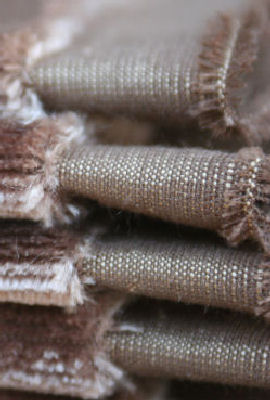
 Cashmere Silk Velvet is one of the world’s most luxurious fabrics. But is it THE most luxurious? Now this is a good question! and a little tricky to answer.
Perhaps the most expensive yarn is from the vicuña (vicuna, vicugna), which is a camel-like animal found in the high alpine areas of the South American Andes. Whilst not an endangered species it is a rare animal and difficult to farm as it tends to escape!
Cashmere yarn comes from the cashmere goat and other goats such as the pashmina goat.
Cashmere and Vicuna have an outer layer of hair which is coarse and rough but protective for the animal. This is the guard hair. Underneath the guard hair is a warm layer of much, much softer hair. This underlayer consists of hollow-fibred hair that is an excellent insulator. The vicuna has the finest of these fibres of any (resultant) wool anywhere in the world.
About 400g of yarn can be produced from one Vicuna compared to 150g from the Cashmere goat, the latter being a smaller animal. There are many more Cashmere goats in the world and I suspect this is why Cashmere is relatively affordable – as it is produced in much larger volumes in a more competitive market.
As an indication, a Vicuna scarf would cost in excess of US$1000. As far as I know, it is not produced in sufficient quantities to be available in a suitable form for interiors use (I could be wrong). But if it were it could be woven with silk to produce THE MOST EXPENSIVE AND BEST woollen silk velvet in the world. A further problem is that the Vicuna fibre can readily be damaged when dyed, again making significant production quantities problematic.
Now, as much of the Cashmere yarn produced comes from China, Australia and other countries…in fact just about anywhere other than Kasmir! it strikes me that is an opportunity waiting to happen for some illustrious, economically-minded, goat breeder out there with friends in the textiles industry. If the production problems could be overcome I could see that there still would be a market for an interiors fabric retailing at in excess of GBP800/m (US£1300/yard) – albeit a small one.
 Perhaps not the most exciting news you will read today I know! We have been aware for a few months that our web site images needed to improve. We re-used the same images again and again. So we have finally acquired a new image for just about every page, all reflecting the product we offer in the relevent area! Well, at least you can sleep soundly tonight knowing that we are happy. I joke of course.