BS 476 Part 7: Surface Spread of Flame for Wall and Ceiling Linings

What it tests: How quickly flame spreads across the surface of a material when exposed to a heat source. Relevant to wall panels, ceiling linings, acoustic panels, and fabric wall coverings.
The four classes: Class 1 is the most restrictive — very limited spread of flame. Class 4 is the least restrictive. Class 0 is a composite designation covering Class 1 surface spread of flame plus a non-combustibility requirement.
What it does not test: Upholstery fire performance. BS 476 Part 7 is a surface lining test, not an upholstery test. Crib 5 and BS 7176 cover upholstered seating.
Who requires it: Building control for non-domestic buildings; the Regulatory Reform (Fire Safety) Order 2005 for occupied non-domestic premises.

Interior designers specifying fabric for wall panels, acoustic panels, and decorative wall linings in commercial environments need to understand BS 476 Part 7 alongside the upholstery fire standards. Where Crib 5 and BS 7176 cover the fire performance of upholstered seating, BS 476 Part 7 covers how quickly flame spreads across surfaces — walls, ceilings, and the materials covering them. The two standards address different fire risks and apply to different elements of an interior specification.


What BS 476 Part 7 Tests

BS 476 Part 7 is the British Standard method for testing the surface spread of flame of building products. It measures how far and how fast a flame travels across the surface of a material when one end is exposed to a defined heat source. The test is conducted on a sample 900 mm long by 225 mm wide, mounted vertically on a radiant heat panel. A pilot flame is applied at one end and the spread of flame along the sample is measured at 90 seconds, 3 minutes, and 10 minutes from ignition.

The results determine which of the four BS 476 Part 7 classes the material achieves. The test is separate from, and not interchangeable with, the upholstery tests. A fabric that passes BS 476 Part 7 Class 1 is certified for use as a surface lining material. This certification says nothing about its performance as an upholstery fabric under Crib 5 or BS 7176 ignition sources.


The Four Classes

Class 1 is the most restrictive classification. Flame spread at 90 seconds must not exceed 165 mm and at 10 minutes must not exceed 165 mm. Class 1 is required for walls and ceilings in most circulation areas, corridors, stairways, and escape routes in non-domestic buildings under the Building Regulations. For fabric wall panels in commercial interiors, Class 1 is the specification that most building control officers and fire risk assessors will expect in occupied non-domestic premises.

Class 0 is not defined within BS 476 Part 7 itself. It is a composite classification used in Approved Document B requiring Class 1 surface spread of flame and additionally meeting non-combustibility or limited combustibility requirements to BS 476 Part 11 or Part 4. Most fabric materials cannot achieve Class 0. Glass fibre and mineral fabrics can. For most commercial interior projects, Class 1 is the practical target for fabric wall linings.

Class 2 is acceptable for wall linings in lower-risk areas of some non-domestic buildings where Class 1 is not explicitly required. In practice, specifiers should aim for Class 1 across commercial interiors to provide a consistent and defensible specification.

Class 3 is the minimum permitted for wall linings in domestic rooms and some low-risk areas of non-domestic buildings under Approved Document B. Not appropriate for escape routes, corridors, or high-occupancy commercial spaces.

Class 4 does not meet any acceptable Building Regulations standard for wall or ceiling linings in habitable spaces.


BS EN 13501-1: The European Equivalent

The European reaction to fire classification system, BS EN 13501-1, uses Euroclass ratings — A1, A2, B, C, D, E, F — with additional designations for smoke production and flaming droplet behaviour. BS 476 Part 7 Class 1 is approximately equivalent to Euroclass B or C. BS 476 Part 7 Class 0 is approximately equivalent to Euroclass B with s1, d0 designations. These are not exact equivalences.

For wall panel and acoustic panel fabric specification in the UK, it is safest to request a BS 476 Part 7 test result specifically from the supplier rather than relying on Euroclass conversion, unless the building control officer for the specific project has confirmed acceptance of Euroclass ratings as equivalent.


Fabric Applications Requiring BS 476 Part 7

Fabric-covered wall panels, whether fixed directly to the wall or suspended on a batten system, form a wall lining. The fabric and any interliner or backing material must be tested together as the composite assembly. A fabric that achieves Class 1 as a face fabric may not achieve Class 1 when applied over a foam interliner, because the combined assembly’s performance depends on all layers.

Acoustic fabric panels installed on walls for sound absorption purposes are wall linings and require BS 476 Part 7 classification. The acoustic infill material — typically mineral wool or acoustic foam — affects the composite panel’s classification. Mineral wool infill is non-combustible. Polyurethane acoustic foam typically achieves Class 2 or 3 at best and will limit the composite panel’s classification accordingly.

Fabric wall coverings applied over plaster or plasterboard similarly form a wall lining. The surface to which the fabric is applied affects the test result, so the fabric should be tested in the configuration as installed.

Headboards in hotel bedrooms are treated as furniture rather than wall linings and are therefore subject to the upholstery standards — Crib 5 and BS 7176 — rather than BS 476 Part 7. For full guidance on headboard specification, see our wall panels and headboards guide.


Achieving Class 1 with Fabric

Most uncoated natural-fibre fabrics will not achieve BS 476 Part 7 Class 1 without topical FR treatment. Cotton, linen, and viscose fabrics ignite readily and will typically achieve only Class 3 or Class 4 without treatment. Wool and mohair have significantly better inherent fire resistance but still typically require treatment to achieve Class 1 for wall lining applications.

Topical FR treatment — typically wet-padding with intumescent or phosphorus-based compounds — can raise most cellulosic fabrics from Class 3 or 4 to Class 1. The treatment must be applied by a UKAS-accredited treatment company and the treated assembly must be tested as a composite with the backing and fixings used in the actual installation. For guidance on FR treatment and dye interaction risks, see our dye types and FR treatment guide.

Some polyester fabrics with inherent flame retardant additives — including Trevira CS — can achieve Class 1 without topical treatment, with better long-term durability than treated natural-fibre fabrics.


Testing and Certification

BS 476 Part 7 certificates must be issued by a UKAS-accredited testing laboratory. A supplier’s own claim that a fabric meets Class 1 is not sufficient for building control purposes. The certificate should specify the fabric tested, the configuration tested including backing materials and fixings, the test standard, and the classification achieved.

For composite wall panel systems, the certificate should cover the full assembly rather than the face fabric in isolation. Testing the face fabric alone and assuming the assembly will achieve the same classification is not reliable.

Certificates should be retained for the life of the installation and included in the building’s fire safety documentation. For projects subject to the Building Safety Act 2022, the classification certificates for all wall lining materials form part of the golden thread. See our Building Safety Act guide for documentation requirements.


Quick answers

What is the difference between BS 476 Part 7 and BS 5852 Crib 5?
BS 476 Part 7 tests surface spread of flame on wall and ceiling lining materials. BS 5852 Crib 5 tests the fire resistance of upholstered seating assemblies. They test different products under different fire scenarios and one certification does not substitute for the other. A fabric certified to BS 476 Part 7 Class 1 for wall panel use requires separate Crib 5 testing if it is also to be used for upholstered seating in the same project.

Do headboards in hotel rooms need BS 476 Part 7 certification?
No. Headboards are classified as furniture and are subject to BS 5852 and BS 7176, not the surface lining standards. A headboard fixed to the wall does not become a wall lining by being attached. Confirm the applicable standard with the building control officer or fire risk assessor for the specific project if there is any doubt.

What does Class 0 mean and can fabric achieve it?
Class 0 is a composite designation in the Building Regulations requiring Class 1 surface spread of flame and additionally meeting non-combustibility or limited combustibility requirements. Most fabric materials cannot achieve Class 0. Glass fibre and mineral fabrics can. For most commercial interior projects, Class 1 is the practical target for fabric wall linings.

Does the fabric or the whole wall panel assembly need to be tested?
The whole assembly — face fabric, interliner, backing, and fixing method — should be tested together. Testing the face fabric in isolation and assuming the composite assembly will achieve the same classification is unreliable, because the thermal behaviour of backing materials significantly affects the test result.

How does BS 476 Part 7 relate to BS EN 13501-1?
BS EN 13501-1 is the European reaction to fire classification using Euroclasses A1 to F. BS 476 Part 7 Class 1 is approximately equivalent to Euroclass B or C, though the equivalence is not exact. For UK projects, always request BS 476 Part 7 results specifically unless the building control officer has confirmed acceptance of Euroclass ratings for the specific project.


For wall panel and headboard fire specification, see our wall panels and headboards guide. For upholstery fire standards, see our Crib 5 guide. For FR treatment guidance, see our FR treatment and fibre compatibility guide.

Request Samples

Order cutting samples of any fabric from our current collections. Trade accounts only.

Order Cuttings

Wyzenbeek vs Martindale: Which Abrasion Test Should You Specify?

Martindale: The standard used in the UK and Europe. Fabric is rubbed in a figure-of-eight motion against a worsted wool abradant. Results in rub counts. Contract minimum 30,000 rubs.
Wyzenbeek: The standard used in the United States. Fabric is rubbed back and forth in straight lines against a cotton duck canvas abradant. Results in double rubs. Contract minimum 15,000 double rubs.
Are they comparable? No. The two tests use different abradants, different motions, and different pass criteria. A Wyzenbeek double rub count cannot be converted to a Martindale rub count.
Which to specify: For UK and European projects, always specify Martindale. For US projects, specify Wyzenbeek. For international projects, request both where possible.

Interior designers working internationally, or sourcing fabric from American suppliers, regularly encounter both Martindale rub counts and Wyzenbeek double rub counts on specification sheets. The two figures look similar — both express abrasion resistance as a number — but they are produced by entirely different test methods and cannot be meaningfully compared. Specifying a Wyzenbeek result on a UK contract project, or a Martindale result on a US project, risks misaligned expectations with clients, contractors, and insurers. This guide explains how each test works, what the results mean, and how to specify correctly for UK and international projects.


The Martindale Test

The Martindale abrasion test is defined by ISO 12947 and BS EN ISO 12947. It is the standard abrasion test used across the UK, Europe, and most international markets outside the United States. When a fabric data sheet lists a rub count without specifying the test method, the default assumption in UK specification is Martindale.

The test works as follows. A circular sample of the fabric being tested is mounted face-down on a machine and rubbed against a standard abradant — a piece of worsted wool fabric — in a figure-of-eight motion that moves the sample across the abradant in all directions simultaneously. This multidirectional motion is designed to replicate the complex, non-linear abrasion that upholstery fabric experiences in real use. The machine counts each complete figure-of-eight cycle as one rub.

The test is run to one of several endpoints. The most common endpoint for upholstery fabrics is fabric breakdown — the point at which two threads have broken or a hole has appeared in the sample. Some test houses also assess and report pilling at intermediate intervals using a separate grading scale. The total rub count at breakdown is the Martindale rub count reported on the data sheet.

For a complete guide to Martindale thresholds by application and what the numbers mean in practice, see our Martindale rub test guide.


The Wyzenbeek Test

The Wyzenbeek abrasion test is defined by ASTM D4157, the American Society for Testing and Materials standard. It is the dominant abrasion test in the US contract furniture and upholstery market. UK designers sourcing fabric from American suppliers, or specifying for projects with US compliance requirements, will encounter Wyzenbeek results on data sheets.

The test works as follows. A rectangular sample of the fabric being tested is mounted on a machine and rubbed back and forth in straight lines — first in the warp direction, then in the weft direction — against a standard abradant. The standard abradant specified by ASTM D4157 is cotton duck canvas, a tightly woven plain-weave cotton fabric significantly more abrasive than the worsted wool used in Martindale. Each complete back-and-forth cycle counts as one double rub.

The Wyzenbeek test runs until the fabric shows noticeable wear or breakdown, and the double rub count at that point is reported. The linear back-and-forth motion differs fundamentally from the multidirectional figure-of-eight motion of Martindale, which is why the two tests produce results that cannot be directly compared.


Why the Results Cannot Be Compared

The most important point for a specifier to understand is that 50,000 Martindale rubs and 50,000 Wyzenbeek double rubs do not represent the same level of abrasion resistance. They are measurements from different instruments using different abradants, different motion patterns, and assessed against different pass criteria.

The cotton duck canvas abradant used in Wyzenbeek is more aggressive than the worsted wool abradant used in Martindale. All else being equal, a fabric tested to Wyzenbeek will reach its endpoint faster than the same fabric tested to Martindale, because the abradant is harsher. This means Wyzenbeek counts tend to be lower than Martindale counts on equivalent fabrics.

However, this relationship is not consistent across all fabric types. Different fibres and constructions respond differently to the two abradants and the two motion patterns. There is no reliable conversion factor between Wyzenbeek double rubs and Martindale rubs. Various informal conversion ratios circulate in the trade — most commonly the suggestion that one Wyzenbeek double rub equals approximately two Martindale rubs — but this ratio has no scientific basis and should not be relied upon for specification.

The only reliable way to compare two fabrics on a like-for-like basis is to ensure both have been tested to the same standard. When building a specification, always confirm which test method produced the figures on the data sheet.


UK and European Thresholds: Martindale

The following thresholds represent current UK and European contract specification practice for Martindale rub counts. For full detail on each threshold and the reasoning behind it, see our Martindale rub test guide.

Light domestic use: 15,000 rubs minimum. Heavy domestic use: 25,000 rubs minimum. Light contract: 30,000 rubs minimum. General contract — hotel lobbies, restaurant seating, office seating: 50,000 to 60,000 rubs. Heavy contract: 80,000 to 100,000 rubs. Severe contract: 100,000 rubs and above.


US Thresholds: Wyzenbeek

The following thresholds are used in the US contract market for Wyzenbeek double rubs. They are not equivalent to the Martindale thresholds above and should not be compared directly.

Residential use: 9,000 to 15,000 double rubs minimum. Light commercial: 15,000 double rubs minimum. Heavy commercial — hotels, restaurants, office seating: 30,000 to 50,000 double rubs. Severe commercial: 100,000 double rubs.


Which Test to Specify and When

For any project in the UK or continental Europe, always specify Martindale to ISO 12947. This is the expected standard, the one UK test houses use, and the one UK and European contract furniture manufacturers certify their fabrics against. If a fabric supplier provides only a Wyzenbeek result and cannot provide a Martindale result, request that the fabric be tested to Martindale before specifying it for a UK contract project.

For projects in the United States, specify Wyzenbeek to ASTM D4157. For international hospitality projects drawing from both European and American suppliers, request both test results where possible and compare within the same test method rather than across methods.

For yacht and marine projects, the fire standard takes precedence over abrasion performance. See our IMO marine fire standards guide.


Pilling: A Separate Test

Both Martindale and Wyzenbeek measure abrasion resistance — structural wear of the yarn. Neither measures pilling resistance, which is the formation of surface fibre balls through tangling of loose fibre ends. Pilling is assessed by a separate test, ISO 12945-2, also run on the Martindale machine but using a different abradant and a different assessment scale. A fabric with an excellent Martindale abrasion count may still pill badly in use. Always request both the Martindale abrasion result and the ISO 12945-2 pilling grade for contract upholstery specification. See our pilling resistance guide.


Quick answers

What is the difference between Martindale and Wyzenbeek?
Martindale rubs the fabric sample in a multidirectional figure-of-eight motion against a worsted wool abradant, counting each cycle as one rub. Wyzenbeek rubs the fabric back and forth in straight lines against a cotton duck canvas abradant, counting each back-and-forth cycle as one double rub. The abradants, motions, and pass criteria are different. The results cannot be directly compared.

Can I convert Wyzenbeek double rubs to Martindale rubs?
No reliable conversion factor exists. Informal ratios circulate in the trade but have no scientific basis and produce unreliable results across different fabric types. The only reliable approach is to test the same fabric to both standards.

What Martindale count should I specify for a hotel?
For hotel bedroom seating: 30,000 rubs minimum. For hotel restaurant and lobby seating: 50,000 to 60,000 rubs. For hotel bar and high-traffic areas: 80,000 to 100,000 rubs. See our hotel fabric specification guide for full detail.

Is Wyzenbeek used in the UK?
Wyzenbeek is not the standard abrasion test in the UK. Martindale to ISO 12947 is the expected test for UK and European contract specification. Wyzenbeek results may appear on data sheets from American suppliers. Always confirm which test standard produced the figures before using them in a UK specification.

What abradant does Martindale use?
The standard Martindale abradant for upholstery fabric testing is worsted wool fabric to ISO 12947-2. Results against different abradants are not directly comparable. Always confirm the abradant used when reviewing a Martindale certificate.


For Martindale thresholds by application, see our Martindale rub test guide. For pilling resistance, see our pilling resistance guide. For hotel specification, see our hotel fabric specification guide.

Request Samples

Order cutting samples of any fabric from our current collections. Trade accounts only.

Order Cuttings

Top UK Interior Designers 2026: London and National

The following is a curated reference list of interior design studios and practitioners active in the UK in 2026, compiled for homeowners, property developers, and clients seeking design representation for residential and commercial projects. The list is organised by location — London studios first, followed by national coverage — and listed alphabetically within each section. No ranking is implied. All studios listed were active and accepting new commissions at the time of compilation.

Kothea is a trade-only supplier of luxury fabrics based in London. We supply fabric directly to interior designers and architects. If you are a homeowner seeking a designer, the studios below can advise on the full range of fabric options available through trade accounts.

Request Samples

Order cutting samples of any fabric from our current collections. Trade accounts only.

Order Cuttings

London Studios

Beata Heuman. Stockholm-born, London-based, Beata Heuman’s studio produces interiors of playful sophistication — bold colour, idiosyncratic furniture, and a distinctive blend of Scandinavian restraint with maximal personality. Her residential work has been widely published and her aesthetic is among the most recognisable in contemporary London design. Website: beataheuman.com

BradyWilliams. Founded by Shayne Brady and Emily Williams, BradyWilliams offers a comprehensive bespoke interior design service for residential and commercial clients. Known for acute detailing, timeless design, and strong project management, the studio operates across London and internationally. Website: studioshaynebrady.com

Buchanan Studio. Led by Jessica Maybury, Buchanan Studio specialises in high-end residential projects with an emphasis on craftsmanship, natural materials, and considered materiality. The studio’s work has a quiet confidence and a strong understanding of bespoke joinery and architectural detail. Website: buchanan.studio

David Collins Studio. One of London’s most established luxury design studios, founded in 1985. The studio — now led by Iain Watson and Simon Rawlings — has defined interiors at iconic London locations and continues to work across hospitality, retail, and high-end residential. Known for layered palettes and architectural precision. Website: davidcollins.studio

Design Haus Liberty. Founded by Dara Huang, Design Haus Liberty blends mid-century and contemporary European influences across residential and commercial projects. The studio has worked with Four Seasons, Cartier, and LVMH alongside a significant private residential portfolio. Website: dhliberty.com

Elicyon. A luxury studio based in Kensington, led by Charu Gandhi. Elicyon works across interior design, interior architecture, and project management on some of London’s most prominent prime residential developments including One Hyde Park, with an international portfolio extending to Dubai, Monaco, and Singapore. Website: elicyon.com

Fran Hickman Design and Interiors. Fran Hickman’s studio is characterised by bold colour, pattern, and confident maximalism. Her residential work is full of personality and her commercial portfolio includes Soho House properties. A strong choice for clients who want distinctive, colour-forward interiors. Website: franhickman.com

Kelly Hoppen Interiors. A global name in luxury interior design, Kelly Hoppen’s studio is known for its East-meets-West aesthetic — neutral palettes, geometric precision, and harmonious spatial composition. The studio has worked on celebrity homes, luxury yachts, hotels, and aircraft. Website: kellyhoppeninteriors.com

Katharine Pooley. Katharine Pooley’s Knightsbridge studio produces polished, sophisticated interiors for the most discerning clients. Her work spans Mayfair and Belgravia townhouses through to international luxury residences and is consistently among the most refined in the London luxury market. Website: katharinepooley.com

Lawson Robb. Lawson Robb bridges architecture and interior design with particular expertise in high-end residential and superyacht interiors. The studio’s technical capability — integrating complex AV, lighting, and environmental systems seamlessly into the interior — sets it apart from purely decorative practices. Website: lawsonrobb.com

Martin Brudnizki Design Studio. Founded in 2000, MBDS is known for bold, timeless, and immersive spaces across hospitality, retail, and residential. Notable projects include Annabel’s, Bacchanalia, and numerous hotel and restaurant interiors in London and New York. Website: mbds.com

Natalia Miyar. Cuban-American designer Natalia Miyar brings an international perspective to London’s design scene. Her interiors are glamorous, refined, and impeccably detailed, with a particular strength in luxury residential. Her studio has grown rapidly since its founding and is among the most watched in the current London market. Website: nataliamiyar.com

Nicky Haslam Design. Nicky Haslam is one of Britain’s most celebrated decorators, internationally renowned for original, glamorous, and authoritatively realised commissions spanning decades. His studio continues to work across residential, hospitality, and commercial projects. Website: nickyhaslamstudio.com

Nina Campbell. Nina Campbell established her practice and shop in 1974 and remains one of the most respected and influential interior designers in the world. Known for stylish, characterful interiors and for her own collections of fabrics and wallpapers, her studio continues to deliver residential and commercial commissions of the highest quality. Website: ninacampbell.com

Oliver Burns. Led by Sharon Lillywhite, Oliver Burns Studio has become an esteemed practice serving some of the world’s wealthiest families and luxury property developers. The studio’s focus on thoughtful luxury, artisanal sourcing, and narrative-led design has produced a client list spanning Belgravia townhouses to international country estates. Website: oliverburns.com

Retrouvius. Not a conventional design studio — Retrouvius specialises in architectural salvage and designing interiors around reclaimed materials. The results are entirely unique: spaces with genuine material history and character that cannot be replicated with new materials. A first choice for clients who want sustainability and authenticity above all. Website: retrouvius.com

Rose Uniacke. Working from her Pimlico Road showroom — part gallery, part antique shop, part design studio — Rose Uniacke creates interiors of extraordinary calm and refinement. Spare, elegant rooms furnished with carefully sourced antiques and her own furniture line. Among the most admired British designers of her generation. Website: roseuniacke.com

Sibyl Colefax and John Fowler. The most venerable name in English decoration, with a client list spanning generations of aristocratic and distinguished families. The current team maintains the firm’s tradition of scholarly, comfortable English country house style while remaining fully contemporary in its approach. Website: sibylcolefax.com

Staffan Tollgård Design Group. An award-winning architectural interior design practice offering a bold take on residential interiors. Staffan Tollgård’s style draws on Asian and Scandinavian functionalism combined with a strong appreciation of furniture as sculptural art. Website: tollgard.com

Studio Ashby. Sophie Ashby’s studio is one of the most consistently exciting in London — warm, layered interiors that mix mid-century pieces with contemporary art and artisan-made objects. Recent projects include The Whiteley development in Bayswater and a growing hospitality portfolio. Website: studioashby.com

Studio Hessian. Scarlett Hessian trained as an architect and brings a rigorous spatial intelligence to residential and commercial interiors. The studio has a significant international presence across London, Stockholm, and the west coast of the United States. Website: studiohessian.com

Taylor Howes. Taylor Howes Designs operates across prime central London and international markets, delivering sophisticated, elegantly layered interiors for high-net-worth residential clients with an established presence in Mayfair, Knightsbridge, and Chelsea. Website: taylorhowes.co.uk


National Coverage

Ben Pentreath. Based in Dorset with a London office, Ben Pentreath is among the most respected English decorators working today. His interiors draw on a deep knowledge of English architectural history and decorating tradition — layered, colourful, and deeply comfortable. His influence on a generation of younger British designers is significant. Website: benpentreath.com

Eadie and Crole. Founded in 2019 by Sophie Eade and Fi Crole, Eadie and Crole operates from Hampshire with a portfolio spanning London townhouses and country house projects across the south of England. Known for elegant, understated interiors that pair subtle hues and natural textures with antiques and contemporary art. Website: eadieandcrole.com

Emily Smoor Interiors. Based in Edinburgh, Emily Smoor’s practice began as an upholstery studio and evolved into full residential and commercial interior design. Her interiors are eclectic, texture-rich, and characterised by a talent for sourcing and combining pieces from different eras and places. Website: fantoush.com

Henry Prideaux Interior Design. Henry Prideaux offers sophisticated, practical schemes notable for unexpected and extraordinary moments. Based from a showroom-studio in Twickenham with a portfolio of residential projects across London and the home counties. Website: henryprideaux.com

Max Rollitt. Max Rollitt is an interior designer, furniture-maker, and antiques dealer working from his Hampshire showroom at Yavington Barn. His interiors are distinctive for their layers of colour, texture, and history — richly composed rooms drawing on antiques, bespoke furniture, and a sophisticated understanding of English decoration. Website: maxrollitt.com

Rita Konig. British-born Rita Konig is a sought-after talent on both sides of the Atlantic, known for her acute understanding of comfortable, personal, and quietly stylish interiors. Her recent collections with Schumacher have further established her international profile. Website: ritakonig.com

SHH Architecture and Interiors. SHH is a London-headquartered practice with a national reach, known for bold palettes, architectural confidence, and exacting detail across residential, hospitality, and commercial projects. Listed in Country and Town House’s 50 Best Interior Designers in the UK in 2025 and 2026. Website: shh.co.uk

Sims Hilditch. Sims Hilditch operates from the Cotswolds and London, specialising in English country houses and town houses. The studio is known for warm, layered interiors that combine strong architectural understanding with a fine eye for antiques, textiles, and colour. Website: simshilditch.com


This list is updated periodically. If you are an interior designer or studio and would like to be considered for inclusion in a future edition, contact us via KOTHEA.com/contact.

Kothea supplies trade fabric to interior designers and architects.

Request Samples

Order cutting samples of any fabric from our current collections. Trade accounts only.

Order Cuttings

Fabric Specification at Each RIBA Plan of Work Stage

The key decision points: Stage 2 establishes palette and mood. Stage 3 fixes performance requirements. Stage 4 produces the procurement specification. Stage 5 manages delivery and installation.
The most common error: Leaving detailed fabric specification to Stage 4 without having confirmed fire standard, Martindale requirements, and cleaning compatibility at Stage 3. Late changes at Stage 4 cause programme delay and cost increase.
For architects: The RIBA/BIID contract schedule of services explicitly covers FF&E specification. Understanding where fabric decisions sit in the Plan of Work helps coordinate the design team’s responsibilities.

The RIBA Plan of Work is the standard framework for organising building projects in the UK, used by architects, interior designers, contractors, and clients to structure the design and construction process from inception to completion. It divides a project into eight stages numbered 0 to 7. Fabric specification decisions are made at different stages with different levels of detail and different commercial consequences. Understanding which decisions belong at which stage prevents the most common fabric specification failures: late changes that cause cost overruns, incomplete fire certification documentation at handover, and procurement without confirmed dye lot availability.

This guide is relevant to both interior designers using the RIBA Plan of Work as a project framework and to architects who carry interior design services within their scope under the RIBA/BIID professional services contracts.


Stage 0: Strategic Definition

Stage 0 is the briefing stage, before the design team is formally appointed. Fabric specification is not a Stage 0 activity, but the strategic brief established at this stage determines the fabric specification constraints that will apply throughout the project.

Key questions that should be answered at Stage 0 and that directly affect later fabric decisions include: Is the building subject to specific fire safety regulations beyond standard Building Regulations — a hotel, a healthcare facility, a licensed premises? Will the interior be maintained by in-house staff or a facilities management contractor, and what are their cleaning capabilities and product preferences? What is the refurbishment cycle — how long must the interior last before planned replacement? Are there sustainability or environmental certification requirements for the project?

These answers will constrain the fabric specification options available at later stages. A project requiring BREEAM Excellent with Oeko-Tex or GOTS certification requirements for textiles should establish this at Stage 0, not discover it during Stage 4 procurement when the chosen fabric ranges may not hold the required certifications. For sustainability certification guidance, see our fabric sustainability certifications guide.


Stage 1: Preparation and Briefing

Stage 1 develops and finalises the project brief. For projects with significant interior design content, Stage 1 should establish the performance requirements that will govern fabric specification at later stages. This is not a stage for selecting specific fabrics, but it is the correct stage to establish the specification envelope within which fabric selection will occur.

Establish the fire standard applicable to each area of the building at Stage 1. For a hotel this means confirming the applicable BS 7176 hazard category for each room type. For a healthcare project it means confirming the HTM 05-03 requirements and the relevant BS 7176 hazard category. For guidance on fire standards, see our Crib 5 guide and hotel fabric specification guide.

Establish the Martindale rub count requirement for each area at Stage 1. The Martindale threshold is a function of the anticipated use intensity. See our Martindale rub test guide for threshold recommendations by room type.

Establish the cleaning regime requirements at Stage 1. Confirm with the client or facilities team what cleaning products will be used in each area, how frequently, and who will apply them. This information is essential for fabric cleaning code compatibility assessment at later stages.


Stage 2: Concept Design

Stage 2 is where the design concept is established and the spatial, material, and aesthetic language of the project is defined. Fabric decisions at Stage 2 are directional rather than specific. The concept palette might establish that lounge seating will be in a warm neutral mohair velvet, dining chairs in a deep blue contract textile, and bedroom headboards in a coordinating soft texture. These are design direction statements, not procurement specifications.

The Stage 2 concept design report should note — even at this directional level — which areas will require Crib 5 certified fabrics, which will require specific Martindale thresholds, and which will require specific cleaning code compatibility. This ensures the Stage 3 specification work begins with the performance envelope already established.

At Stage 2, initiate contact with key fabric suppliers to confirm that fabrics in the intended style and performance category are available within the project budget range. A concept that requires 100,000 Martindale mohair velvet in 40 colourways from a single supplier that does not offer that performance level will fail at procurement regardless of how well it is designed. Early supplier engagement at Stage 2 prevents this.


Stage 3: Spatial Coordination

Stage 3 is the most important stage for fabric specification. This is where specific fabrics are selected, performance criteria are confirmed against the Stage 1 brief, and the information required for cost planning and procurement is assembled. Errors or omissions at Stage 3 are the primary cause of fabric specification failures at Stages 4 and 5.

Confirm the specific fabric range, colourway, and width for every fabric in the scheme at Stage 3. Obtain the relevant technical data sheets from the supplier and confirm that each fabric meets the performance requirements established at Stage 1. For fire rating, obtain the test certificate — not just a supplier’s statement of compliance — and confirm that it covers the filling and construction being used in the specific project. For Martindale, confirm the rub count for the specific colourway ordered, not just the range average.

Obtain sample cuttings and confirm sample availability for mock-up testing if required. For large-scale hospitality or commercial projects, testing a mock-up panel or sample assembly to the required fire standard before committing to procurement is standard practice and eliminates certification risk at Stage 5.

Confirm lead times for every fabric at Stage 3 and identify any long-lead items. Specialist fabrics, bespoke colourways, and fabrics from European mills with minimum order requirements may have lead times of twelve to sixteen weeks or more. For lead times by fabric type, cuttings, dye lot reservation, and the custom colour matching process, see our lead times, cuttings and custom colour matching guide.

Produce a fabric schedule at Stage 3. The schedule should list every fabric in the scheme with its supplier reference, colourway, width, fire certification reference, Martindale count, cleaning code, lead time, and the locations in the building where it will be used.


Stage 4: Technical Design

Stage 4 converts the Stage 3 fabric schedule into procurement specifications — quantities, dye lot requirements, delivery programme, and coordination with the upholstery and curtain making workrooms.

Calculate fabric quantities at Stage 4 using confirmed cut sizes, seam allowances, and — critically — pattern repeat allowances for any patterned fabric in the scheme. See our pattern matching guide for the correct method of calculating pattern repeat allowances. Ordering without pattern repeat allowance is the single most common fabric quantity error and is discovered only when the workroom runs short.

Confirm dye lot availability with suppliers at Stage 4 before issuing purchase orders. For large quantities of a single colourway — a hotel project requiring 800 metres of a specific mohair velvet — confirm that the required quantity can be produced in a single dye lot. Dye lot variation between separately produced batches of the same colourway is visually detectable and will not be acceptable in a high-quality interior.

Coordinate the fabric delivery programme with the upholstery and curtain making workrooms at Stage 4. For upholstery, allow a minimum of four to six weeks between fabric delivery and installation for standard pieces. For complex bespoke upholstery, allow eight to twelve weeks. Build these lead times into the Stage 4 programme and work backward from the site installation date to establish the required fabric order date.


Stage 5: Manufacturing and Construction

Stage 5 is the construction and manufacturing stage. The designer’s role at Stage 5 is quality assurance and programme management rather than specification — the specification was established at Stages 3 and 4.

Inspect fabric on delivery to the workroom before cutting begins. Check the colourway against the approved sample under the lighting conditions of the finished room. For guidance on colour matching and metamerism, see our colour naming and specification guide. Check for any visible defects in the fabric surface. Check that the dye lot reference matches the order. Defects identified before cutting are the supplier’s responsibility to remedy.

Obtain all fire certificates and technical data sheets at Stage 5 and compile them into a building user guide or handover file. For commercial buildings, the Regulatory Reform (Fire Safety) Order 2005 requires the responsible person to be able to demonstrate that all furnishings comply with the applicable standards. The test certificates are the evidence of compliance and must be retained throughout the life of the installation.


Stage 6: Handover

Stage 6 is practical completion and handover to the client. The fabric-specific deliverables at Stage 6 are the fire certification documentation compiled at Stage 5, the fabric schedule updated to reflect the as-installed specification including any late changes, cleaning and care instructions for every fabric in the scheme, the supplier contact details for future reorders, and a maintenance schedule specifying when FR certification should be reviewed.


Quick answers

At what RIBA stage should I select specific fabrics?
Specific fabric selection — confirming the range, colourway, and technical data for each fabric — belongs at Stage 3. The design direction is established at Stage 2 and the procurement details are fixed at Stage 4, but Stage 3 is where the specific selection must be confirmed and tested against the performance requirements established at Stage 1. Leaving specific fabric selection to Stage 4 compresses the time available to identify and resolve problems with fire certification, Martindale counts, and lead times.

When should I order fabric for a large project?
Calculate the required order date by working backward from the site installation date. Allow for workroom production time — typically four to eight weeks for upholstery and curtains. Allow for fabric delivery from the supplier — typically two to four weeks for stock fabrics, up to sixteen weeks for made-to-order or specialist fabrics. Add the pattern repeat allowance calculation time. On a large hospitality project, the fabric order may need to be placed at or immediately after Stage 4 completion to meet a Stage 5 installation programme.

What documents should I hand over to the client at Stage 6?
Fire test certificates for all upholstered seating and curtains, cleaning and care instructions for each fabric in the scheme, the as-installed fabric schedule with supplier references and colourway codes for future reordering, and a note of any re-treatment or re-certification requirements during the life of the installation. The responsible person for the building requires the fire certificates to demonstrate compliance under the Regulatory Reform (Fire Safety) Order 2005.


For Building Safety Act 2022 documentation requirements across all RIBA stages, see our Building Safety Act and fabric specification guide.

For fire certification guidance, see our Crib 5 guide and hotel fabric specification guide. For Martindale thresholds by room type, see our Martindale rub test guide. For pattern repeat allowance calculation, see our pattern matching guide.

Request Samples

Order cutting samples of any fabric from our current collections. Trade accounts only.

Order Cuttings

Pattern Matching in Upholstery and Curtains: A Practical Guide for Interior Designers

Mohair, Cotton and Silk Velvet Textured Upholstery Patterned

The two pattern types: Straight match — each row of pattern repeats horizontally across the width at the same height. Half drop — each alternate width drops by half the vertical repeat before the pattern continues.
Extra fabric required: For a straight match, add one full vertical repeat per cut length. For a half drop, add one and a half vertical repeats per cut length.
The most expensive mistake: Ordering without accounting for pattern repeat on a large-scale repeat fabric. On a 64 cm vertical repeat, the wastage per cut length can exceed 50% of the usable fabric.
The practical rule: Always calculate yardage with the pattern repeat confirmed before ordering. Never estimate.

Pattern matching is one of the most practically consequential fabric skills in interior design and one of the most frequently handled incorrectly at the ordering stage. The error is almost always the same: the quantity of fabric ordered does not account for the waste inherent in aligning a patterned fabric across multiple widths and cut lengths. The result is fabric that runs short before the job is complete, requires a new order from a potentially different dye lot, and causes programme delay and additional cost. This guide explains how pattern repeats work, how to calculate the correct quantity, and how to specify pattern matching requirements clearly to upholsterers and curtain makers.


Understanding Pattern Repeats

A pattern repeat is the smallest unit of the pattern that, when tiled continuously, produces the complete fabric design. It is defined by two dimensions: the horizontal repeat (also called the width repeat or across repeat) and the vertical repeat (also called the length repeat or drop repeat).

The horizontal repeat determines how many times the pattern occurs across the width of the fabric. For a fabric 140 cm wide with a 35 cm horizontal repeat, the pattern repeats four times across the width. This is important for matching patterns across seams in upholstery and across drops in curtaining.

The vertical repeat determines the distance along the length of the fabric before the pattern returns to the same position. For a fabric with a 64 cm vertical repeat, a mark at a given point in the pattern will appear again 64 cm further along the length. This is the dimension that drives fabric wastage in cutting, because cut lengths must begin at the same point in the repeat to allow the pattern to match across widths.


Straight Match vs Half Drop

A straight match (also called a set match) is the simpler of the two main pattern arrangements. Every width of the fabric begins at the same point in the vertical repeat. When two widths are laid side by side, the pattern runs horizontally straight across the join without any vertical offset. Calculating the cut lengths for a straight match requires only one additional vertical repeat per cut length to account for the cutting waste.

A half drop match offsets each alternate width by half the vertical repeat. Width one begins at the top of the repeat. Width two begins at the halfway point. Width three returns to the top. When the widths are laid side by side, the pattern appears to step diagonally across the fabric. The half drop creates a more dynamic, less rigid pattern arrangement and is used for many large-scale geometric and floral repeats.

Calculating yardage for a half drop is more complex than for a straight match. In practice the effective usable repeat per cut length is the full vertical repeat plus half a repeat, not simply the full repeat — giving one and a half repeats per cut length as the minimum allowance.


Calculating Extra Fabric for Pattern Repeats

The standard industry method adds one full vertical repeat per cut length for a straight match, and one and a half vertical repeats per cut length for a half drop. These figures are the minimum safety allowances. For complex upholstery pieces with many separate panels, the wastage per panel compounds and may require a larger safety allowance.

A worked example for curtaining. The window requires four widths of fabric each 280 cm in length. The fabric has a 64 cm vertical repeat and a straight match. The base fabric required is four widths at 280 cm each, totalling 1,120 cm (11.2 metres). The pattern repeat allowance is one full repeat per cut length: four widths at 64 cm each, totalling 256 cm (2.56 metres). Total fabric required: 13.76 metres, rounded up to 14 metres. Ordering 11.2 metres would result in the job running approximately 3 metres short.

The same example with a half drop. The repeat allowance becomes one and a half repeats per cut length: four widths at 96 cm each, totalling 384 cm (3.84 metres). Total fabric required: 15.04 metres, rounded up to 16 metres. On a large scheme — a hotel with 40 windows of this specification — the difference between correct and incorrect pattern repeat calculation is significant in both cost and fabric quantity.


Pattern Matching in Upholstery

Pattern matching in upholstery is more complex than in curtaining because the pattern must be centred and aligned on each visible panel of the piece — seat, back, arms, and cushions — while the joins between panels must match. An upholsterer working with a patterned fabric must plan every cut from the fabric before cutting anything, to confirm that the pattern will align correctly across all panel joins and will be centred on each visible face.

Centring is the starting point. The dominant element of the pattern should be centred on the seat and on the back panel. This centring determines where the first cut of the pattern must be taken from on the fabric width. If the horizontal repeat does not divide equally into the seat width, some pattern will be lost at the sides. This is expected and acceptable. What is not acceptable is an unchecked centring that places a partial motif — half a flower head, half a diamond — at the centre of the seat.

Panel joining must be planned simultaneously with centring. If the seat panel requires the pattern to begin at a certain height, the back panel must begin at the same height in the repeat to allow the join to match at the seat-back junction. Planning all of these alignments together before cutting is the mark of an experienced upholsterer working with pattern fabric. The designer should confirm this planning process will be followed before the upholsterer cuts the fabric.


Large-Scale Repeats: Special Considerations

Large-scale pattern repeats — vertical repeats of 60 cm or above — require the most careful yardage calculation and pre-cut planning. At these scales the wastage per cut length can represent a significant proportion of the usable fabric. For a fabric with a 90 cm vertical repeat used on a chesterfield sofa requiring twenty separate panels, the pattern repeat allowance per panel may be the full 90 cm vertical repeat regardless of the panel height.

Large-scale repeats also demand that the upholsterer confirms the cut plan with the designer before cutting. Once the fabric is cut the pattern alignment is fixed. If a cut is wrong, the pattern in subsequent panels will be permanently misaligned and there may not be enough remaining fabric to recut.


Specifying Pattern Matching Requirements

When handing fabric to an upholsterer or curtain maker with a pattern repeat, specify the following in writing. The pattern type — straight match or half drop. The vertical repeat in centimetres. The horizontal repeat in centimetres. The centring requirement. The join requirement. And the instruction that a cut plan must be presented for approval before any cutting begins on pattern-critical pieces.

On complex pieces, consider requesting a paper pattern plan — a diagram showing which part of the pattern repeat each cut begins and ends at, with all panel joins annotated — before the fabric is handed over. This adds no significant time to the job while preventing the most common pattern matching failures.


Quick answers

How much extra fabric should I order for a patterned fabric?
Add one full vertical repeat per cut length for a straight match pattern. Add one and a half vertical repeats per cut length for a half drop pattern. For upholstery with multiple panels, apply the same allowance per panel rather than per complete piece. Always confirm the exact repeat dimensions from the fabric data sheet, not from the physical sample, before calculating.

What is the difference between a straight match and a half drop?
In a straight match, every width of the fabric begins at the same height in the pattern repeat. The pattern runs horizontally straight across joins. In a half drop, alternate widths are offset by half the vertical repeat. The pattern appears to step diagonally across the fabric. Half drops typically require more fabric and more complex cutting planning than straight matches of the same repeat size.

How do I centre a pattern on an upholstered piece?
Identify the dominant or focal element of the pattern. This element should be centred on the seat panel and the back panel. Lay the fabric across the seat frame or the cut panel template before cutting to confirm the centring visually. Once confirmed, use this as the reference point for all subsequent panel cuts to ensure joins align correctly.

Should I ask my upholsterer to produce a cut plan?
Yes, for any pattern-critical piece — a sofa or armchair with a large-scale repeat, a headboard with a central medallion, multiple matching pieces in a scheme. A cut plan shows which part of the repeat each panel is cut from and confirms that the pattern will align correctly across all joins before any fabric is cut. Make it a standard requirement for any patterned upholstery job.


For how much plain fabric a chair, sofa, or headboard needs before the pattern-repeat allowance is added, see our how much fabric to upholster furniture guide.

For fabric hand and handling properties, see our fabric hand and tactile properties guide. For fabric specification within project stages, see our RIBA Plan of Work fabric specification guide.

Request Samples

Order cutting samples of any fabric from our current collections. Trade accounts only.

Order Cuttings

Fabric Specification for Healthcare Environments: A Guide for Interior Designers

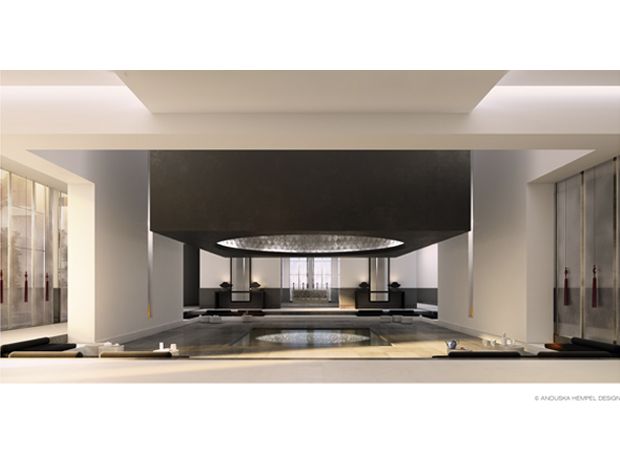
Anouska Hempel Design

The overriding requirement: Every fabric in a healthcare environment must withstand the cleaning regime used in that facility. Confirm the specific products and frequencies with the estates or facilities team before specifying.
Fire standard: BS 7176 Medium or High Hazard depending on the building type and risk assessment. Not Crib 5 alone.
Martindale minimum: 100,000 rubs for patient seating and waiting areas. 60,000 rubs for lower-contact positions.
Fabrics to avoid: Any pile fabric, any fabric with a cleaning code of S, any fabric with a topical FR treatment that degrades with disinfectant cleaning.

Healthcare environments impose more demanding and more specific requirements on interior fabrics than almost any other building type. The combination of clinical cleaning regimes, continuous use, infection control obligations, fire safety requirements, and the extended periods for which patients and visitors are seated creates a specification challenge where a fabric that performs well in a hotel environment may fail completely within months of installation in a hospital or care home. This guide explains the specific requirements, the fabrics that meet them, and the fabrics to avoid.


Infection Control and Cleaning Compatibility

The single most important requirement for fabric in a healthcare environment is compatibility with the cleaning products and regimes used in that facility. Healthcare facilities use cleaning agents significantly more aggressive than those used in hospitality or commercial office environments. Common healthcare cleaning products include sodium hypochlorite solutions at concentrations of 1,000 ppm or above for high-risk areas, quaternary ammonium compounds, hydrogen peroxide solutions, and alcohol-based disinfectants at 70% or above.

Many of these products are incompatible with standard upholstery fabrics. Bleach solutions will strip topical FR treatments, cause colour fade, and degrade most natural fibre fabrics within weeks of regular application. Alcohol-based disinfectants can cause surface breakdown in some PVC faux leathers if the plasticiser formulation is not alcohol-resistant.

Before specifying any fabric for a healthcare project, obtain the specific cleaning products and frequencies used in each area from the estates or facilities management team. Present these to the fabric supplier and request written confirmation of compatibility. Do not rely on general claims of healthcare suitability — obtain confirmation for the specific products used in the specific facility.


Fire Standards for Healthcare

Healthcare buildings are subject to specific fire safety requirements under HTM 05-03 and BS 7176, which specifies fire performance requirements for non-domestic upholstered seating. The applicable BS 7176 hazard category depends on the risk assessment for the specific area.

Medium Hazard under BS 7176 is the minimum for most patient seating, waiting areas, and staff areas in standard healthcare buildings. High Hazard applies to areas where sleeping accommodation is provided — residential care facilities, hospital wards, overnight facilities. Very High Hazard applies to areas where residents have limited mobility or require assistance to evacuate.

BS 7176 includes BS 5852 Crib 5 as its core test for upholstered seating and additionally requires cigarette and match tests. A fabric that simply holds a Crib 5 certificate is not automatically compliant with BS 7176 Medium Hazard. The complete assembly — fabric, interliner, and filling — must be certified to the applicable BS 7176 standard. For guidance on these standards, see our Crib 5 guide and hotel fabric specification guide.

For curtains and cubicle curtains in healthcare environments, BS 5867 Part 2 Type B is the standard requirement. Cubicle curtains used in clinical areas typically require Type C, which includes a launderability pre-conditioning stage confirming that the fire performance survives repeated laundering at 71 degrees Celsius.


Martindale Requirements

Patient seating and waiting area seating in healthcare environments is subject to continuous use throughout the operating hours of the facility. Chairs in an outpatient waiting area may be occupied for sixteen hours a day, seven days a week. The Martindale rub count requirement for this level of use is 100,000 rubs minimum. Seating in lower-contact positions — staff areas, offices, lower-traffic corridors — may be specified at 60,000 rubs minimum, but confirm the use pattern for each position before reducing the specification below 100,000.


Suitable Fabrics for Healthcare

Silicone leather. The strongest all-round specification for patient-contact seating in clinical healthcare environments. Silicone leather is inherently flame resistant without topical treatment, which means its fire performance is not affected by aggressive cleaning. It is compatible with hospital-grade disinfectants including hypochlorite solutions and alcohol-based disinfectants, is non-porous and does not support microbial growth, achieves very high Martindale counts, and is easy to wipe clean to clinical standards.

High-specification PVC faux leather. Compatible with most healthcare cleaning regimes provided the specific formulation has been confirmed as alcohol-resistant and hypochlorite-stable. Healthcare-grade PVC faux leather with welded seams — which eliminates the crevice at the seam line where microorganisms can harbour — is appropriate for patient seating and waiting areas. Confirm that the specific product holds a healthcare suitability certification from the manufacturer. Standard commercial PVC faux leather is not automatically suitable for clinical use. See our faux leather types compared guide for detail.

Coated performance fabrics. Some woven fabrics with a polyurethane or acrylic coating achieve the combination of breathability and cleanability required for patient seating in rehabilitation and residential care environments where patient comfort over extended periods is a higher priority than clinical cleanliness. Confirm cleaning compatibility and confirm that the coating does not crack or peel under the specific cleaning regime used.

Healthcare-specific contract wovens. Some specialist fabric manufacturers produce woven fabrics designed specifically for healthcare use, with inherent antimicrobial properties, high Martindale counts, and confirmed compatibility with healthcare cleaning products. These are appropriate for lower-risk healthcare areas — staff rooms, reception desks, family waiting areas — where the clinical cleaning regime is less aggressive.


Fabrics to Avoid in Healthcare

Any pile fabric — velvet of any fibre type — is unsuitable for patient-contact seating in healthcare environments. The pile structure traps particulate matter, bodily fluids, and microorganisms and cannot be cleaned to clinical standards with the products used in healthcare facilities. For full guidance on velvet specification limitations, see our when not to use velvet guide.

Any fabric with a cleaning code of S is unsuitable for healthcare environments where water-based disinfectant cleaning is routine. Any fabric with a topical FR treatment that degrades with disinfectant cleaning is unsuitable for areas where fire performance must be maintained across the full service life. Standard wool, mohair, linen, and cotton upholstery fabrics are unsuitable for clinical patient-contact areas.


Specific Area Guidance

Patient rooms in acute hospitals require the most stringent specification: silicone leather or healthcare-grade PVC faux leather for any patient-contact upholstery, BS 7176 High Hazard fire certification for all seating, and confirmed compatibility with the full cleaning and disinfection protocol.

Outpatient and waiting areas permit a slightly broader specification. Healthcare-grade PVC faux leather or high-specification coated fabrics are appropriate for seating. The aesthetic can be warmer and less clinical than patient room specification. Fire standard remains BS 7176 Medium Hazard minimum. Martindale minimum 100,000 rubs.

Residential care homes occupy an intermediate position between acute healthcare and hospitality. The fire standard is typically BS 7176 High Hazard for sleeping accommodation areas. The cleaning regime is typically less aggressive than acute healthcare. High-specification contract wovens with confirmed cleaning compatibility may be appropriate for lounge and dining areas.


Quick answers

Can velvet be used anywhere in a healthcare building?
Velvet is unsuitable for any patient-contact seating in clinical or quasi-clinical environments. In low-clinical-risk areas of private healthcare — executive offices, family suites, reception areas with low patient contact — velvet may be appropriate if the cleaning regime is compatible and fire certification is confirmed. Confirm the specific cleaning products and the risk category of the area with the facilities team before specifying.

What fire standard applies to hospital waiting areas?
BS 7176 Medium Hazard is the minimum applicable standard for most hospital waiting areas and outpatient seating. The complete assembly — fabric, interliner, and filling — must be certified, not only the fabric. For areas providing sleeping accommodation, BS 7176 High Hazard applies.

How do I confirm a fabric is suitable for healthcare cleaning?
Obtain the specific cleaning products and concentrations used in the area being specified from the facility’s estates or facilities management team. Present these to the fabric supplier and request written confirmation of compatibility. Where possible, request a sample and test it with the actual cleaning product before finalising the specification.

What is the difference between BS 5867 Type B and Type C for healthcare curtains?
BS 5867 Part 2 Type B requires fire performance before laundering. Type C requires fire performance to be maintained after laundering pre-conditioning at 71 degrees Celsius for a defined number of cycles. For cubicle curtains in clinical areas that are regularly laundered, Type C is the appropriate standard.


For Building Safety Act 2022 requirements — many hospital buildings qualify as higher-risk buildings — see our Building Safety Act and fabric specification guide.

For fire certification standards, see our Crib 5 guide and hotel fabric specification guide. For faux leather types suitable for healthcare, see our faux leather types compared guide.

Request Samples

Order cutting samples of any fabric from our current collections. Trade accounts only.

Order Cuttings

Fabric Sustainability Certifications Explained: GOTS, Oeko-Tex, and the Responsible Wool Standard

GOTS: Global Organic Textile Standard. Covers the entire supply chain from raw fibre to finished fabric. The most rigorous organic textile certification available.
Oeko-Tex Standard 100: Tests for harmful substances in the finished product. Does not certify the farming or production process — only that the finished fabric is free from defined harmful chemicals.
Responsible Wool Standard: Certifies that wool was produced on farms meeting defined animal welfare and land management standards. Does not certify dyeing or finishing.
The practical distinction: These certifications answer different questions. GOTS covers process. Oeko-Tex covers the finished product. RWS covers the raw material. None is a complete sustainability claim on its own.

Interior designers and architects are asked with increasing frequency by clients and developers to specify fabrics with sustainability credentials. The challenge is that sustainability certifications cover different parts of the supply chain, use different methodologies, and make different claims. A fabric described as sustainable may hold an Oeko-Tex certificate — which certifies that the finished fabric contains no harmful substances — but say nothing about the environmental impact of farming, dyeing, or wastewater management. This guide explains what each of the main certifications covers, what it does not cover, and how to interpret them in a specification context.


GOTS: Global Organic Textile Standard

GOTS is the most comprehensive certification available for organic textiles. It covers the entire post-harvest supply chain: ginning, spinning, weaving, dyeing, finishing, and labelling. To carry the GOTS label, a fabric must be produced from at least 70% certified organic natural fibres — fibres grown without synthetic pesticides or fertilisers — and must meet defined environmental and social criteria at every stage of processing.

The environmental criteria within GOTS include restrictions on the chemical inputs permitted in dyeing and finishing. Azo dyes that release carcinogenic amines are prohibited. Formaldehyde finishes above defined limits are prohibited. Wastewater from dyeing and finishing operations must be treated to defined standards before discharge. The certification requires on-site inspection of each processing stage and annual recertification.

The social criteria require that all workers in the certified supply chain are employed under conditions meeting International Labour Organisation conventions — no forced labour, no child labour, safe working conditions, and the right to collective bargaining.

There are two GOTS label grades. The grade labelled Organic requires at least 95% certified organic fibre content. The grade labelled Made with Organic requires at least 70%. In practice, GOTS certification is most commonly found on cotton and linen fabrics. The Responsible Wool Standard is the more relevant certification for wool and mohair.

For interior designers, a GOTS-certified fabric provides the strongest available assurance that the fabric was produced with defined environmental and social standards across the full processing chain. It is the appropriate certification to specify when a client, developer, or project brief requires documented organic or ethical textile sourcing.


Oeko-Tex Standard 100

Oeko-Tex Standard 100 is the most widely held textile certification globally. It certifies that the finished fabric has been tested and found free from harmful substances at levels that could pose a risk to human health. The test covers pesticide residues, heavy metals, formaldehyde, pH, colourfastness, and certain azo dyes.

The critical distinction from GOTS is that Oeko-Tex Standard 100 is a product test, not a process audit. It certifies that the fabric as manufactured does not contain harmful substances above defined thresholds. It does not certify how the fabric was produced. A fabric produced in an environmentally intensive dyehouse using conventional cotton can carry an Oeko-Tex Standard 100 certificate if the finished fabric tests below the defined substance thresholds.

Oeko-Tex Standard 100 has four product classes. Class 1 covers articles for babies and young children. Class 2 covers articles in direct contact with skin. Class 3 covers articles not in direct contact with skin. Class 4 covers decorative materials such as curtains and upholstery fabrics. Most interior fabrics carry Class 3 or Class 4 certification.

For interior designers, Oeko-Tex Standard 100 is a meaningful assurance that the fabric does not contain tested harmful substances above defined thresholds. It is not a comprehensive sustainability claim and should not be presented as one.


The Responsible Wool Standard

The Responsible Wool Standard (RWS) is a certification for wool produced on farms that meet defined animal welfare and land management criteria. It was developed by Textile Exchange and first published in 2016. It certifies the farm and the fibre — not the subsequent processing of the fabric.

The animal welfare criteria within RWS cover the five freedoms and prohibit mulesing — the surgical removal of skin folds around the breech of Merino sheep practised in Australia to prevent flystrike. This makes RWS certification relevant for clients or projects with specific animal welfare requirements.

The limitation of RWS is that it covers the farm and the fibre only. A fabric described as RWS-certified may still have been processed in a dyehouse with no wastewater treatment. For full supply chain assurance on a wool fabric, RWS at the farm stage combined with GOTS at the processing stage provides the most comprehensive coverage — though finding fabrics with both is currently rare in the upholstery market.

Mohair does not currently have an equivalent to the Responsible Wool Standard, though Textile Exchange has been developing a Responsible Mohair Standard. For mohair fabrics with animal welfare concerns, sourcing confirmation from the supplier regarding country of origin and farming standards is the appropriate approach.


GRS: Global Recycled Standard

The Global Recycled Standard certifies that a fabric contains a defined percentage of recycled content — post-consumer or post-industrial — and that the recycled content is traceable through the supply chain. GRS is relevant for fabrics made from recycled polyester, recycled nylon, or other recycled synthetic fibres. It certifies origin of the raw material only, not environmental performance in dyeing or finishing.


REACH

REACH, Registration, Evaluation, Authorisation and Restriction of Chemicals, is a mandatory chemical safety regulation rather than a voluntary sustainability certification. Retained in UK law as UK REACH following EU exit and enforced by the Health and Safety Executive, it applies to every fabric sold into the UK regardless of any additional sustainability claims made about it. This makes REACH the most universally applicable compliance point in the interior fabric supply chain, and the one most commonly assumed rather than confirmed.

REACH restricts substances of very high concern, including a defined list of phthalate plasticisers, above set thresholds. Since November 2020, phthalates including DEHP, DBP, DIBP, and BBP have been restricted to 1,000 mg/kg individually or in combination in consumer textiles and related articles. Heavy metal stabilisers, certain azo dyes that release carcinogenic amines, and formaldehyde above defined limits are also restricted under REACH.

REACH compliance is most commercially relevant for coated and synthetic fabrics, where the polymer chemistry historically relied on plasticisers and stabilisers now restricted or phased out. A REACH compliance statement from a supplier should be accompanied by a specific declaration confirming the absence of restricted substances, rather than a general assurance. For natural fibre fabrics, REACH compliance is relevant to any dye, finish, or flame-retardant treatment applied during processing. For a full treatment of what REACH restricts and what to request from a supplier, see our REACH compliance guide.

Oeko-Tex Made in Green

Oeko-Tex Made in Green combines the substance testing of Oeko-Tex Standard 100 with confirmation that the product was manufactured in facilities that meet Oeko-Tex STeP requirements for environmentally responsible production and socially responsible working conditions. It provides traceability through a product ID or QR code linking the specific article to its certified production facility. Where Oeko-Tex Standard 100 confirms the finished product, Made in Green additionally confirms where and under what conditions it was produced.

Welfare Certifications for Cashmere and Mohair

The Good Cashmere Standard, developed by the Aid by Trade Foundation, certifies cashmere goat welfare, environmental land management, and herder livelihoods across the producing regions, principally Mongolia and China. The Sustainable Fibre Alliance operates a parallel Sustainable Cashmere Standard addressing the same three areas, with a particular focus on preventing overgrazing of cashmere-producing grasslands.

The Responsible Mohair Standard, developed by Textile Exchange, certifies mohair from Angora goat farms through to the final seller in a business-to-business transaction, with every stage of the supply chain independently audited. It addresses animal welfare against the Five Freedoms framework and prohibits practices inconsistent with those freedoms. A product may only carry the RMS label where the mohair content is 100% certified.

None of these three standards covers the dyeing, finishing, or chemical processing stages of fabric production. A cashmere or mohair fabric with a welfare certification at fibre level may still require GOTS or Oeko-Tex certification to address the processing stages separately. For a full treatment of the RMS, GCS, and SFA standards and how to specify and verify them, see our cashmere and mohair welfare certifications guide.

European Flax

European Flax certifies linen grown in Western Europe, principally France, Belgium, and the Netherlands, under defined standards excluding irrigation and genetically modified seed. It addresses the agricultural stage of linen production specifically and is a relevant certification to request where a project brief specifies European-grown linen rather than linen grown and processed elsewhere.

What These Certifications Do Not Cover

No commercially available interior fabric currently carries certifications addressing all dimensions of sustainability simultaneously — water use in farming and processing, energy consumption, chemical management, transport emissions, social conditions at every stage, end-of-life recyclability, and durability in use. When advising clients on sustainable fabric specification, it is more accurate to present the specific claim of each certification held than to characterise any fabric as sustainable without qualification.

Durability is one of the most significant sustainability factors in interior fabric specification and one of the least discussed in sustainability marketing. A fabric that achieves 100,000 Martindale rubs and lasts fifteen years has a substantially lower lifetime environmental impact than a certified organic fabric achieving 30,000 rubs that requires replacement after five years. Both certification and durability matter. Neither is a substitute for the other.


How to Specify Sustainability Credentials on a Project

When a project brief requires sustainable fabric specification, define the specific requirement before beginning the selection process. A brief that simply says sustainable fabrics to be used cannot be met with any precision because sustainable is not a defined term. A brief that says all upholstery fabrics to carry Oeko-Tex Standard 100 Class 3 certification or above is specific, verifiable, and procurable.

Common specifiable sustainability requirements include: Oeko-Tex Standard 100 Class 3 or above for all soft furnishings; GOTS certification for cotton and linen fabrics where organic sourcing is a project requirement; RWS certification for wool and mohair where animal welfare is a requirement; GRS certification for any synthetic fabric used confirming recycled content; and BREEAM or LEED credit compliance where the project carries a formal green building rating requirement.


Quick answers

What is the difference between GOTS and Oeko-Tex?
GOTS certifies the production process across the entire supply chain from organic fibre to finished fabric, including environmental standards for dyeing, finishing, and wastewater, and social standards for workers. Oeko-Tex Standard 100 certifies the finished product — that it tests below defined thresholds for harmful substances. GOTS is a process certification. Oeko-Tex is a product test. They answer different questions and can coexist on the same fabric.

Does Oeko-Tex mean the fabric is organic?
No. Oeko-Tex Standard 100 certifies that the finished fabric does not contain harmful substances above defined thresholds. It does not certify that the fibre was grown organically or that the production process was environmentally sound. A fabric made from conventionally grown cotton in a standard dyehouse can carry an Oeko-Tex Standard 100 certificate if the finished fabric tests below the substance thresholds.

What does mulesing-free mean and why does it matter?
Mulesing is a surgical procedure used on some Merino sheep in Australia to prevent flystrike, performed without anaesthetic. The Responsible Wool Standard prohibits mulesing. For clients with specific animal welfare requirements, requesting RWS certification or supplier confirmation that the wool or mohair is sourced from mulesing-free farms is the appropriate specification approach.

Is a durable fabric more sustainable than a certified one?
Durability is one of the most significant sustainability factors in interior fabric specification. A fabric that lasts fifteen years in a contract environment has a substantially lower lifetime environmental impact than a certified organic fabric that requires replacement after five years. Both certification and durability matter. Neither is a substitute for the other.

Is REACH compliance the same as a sustainability certification?
No. REACH is a mandatory chemical safety regulation under UK and EU law, not a voluntary sustainability certification. Every fabric sold into the UK must comply with REACH regardless of any additional sustainability claims. It restricts substances of very high concern including certain phthalate plasticisers, heavy metal stabilisers, and azo dyes above defined thresholds. A supplier’s REACH compliance statement should be accompanied by a specific declaration confirming the absence of restricted substances rather than a general assurance.

What is the Responsible Mohair Standard?
The Responsible Mohair Standard, developed by Textile Exchange, certifies mohair from Angora goat farms through to the final business-to-business seller, with every stage of the supply chain independently audited against animal welfare criteria based on the Five Freedoms. A product may only carry the RMS label where its mohair content is 100% certified. It addresses fibre-level welfare only and does not cover dyeing or finishing.

What certifications cover cashmere goat welfare?
The Good Cashmere Standard and the Sustainable Fibre Alliance’s Sustainable Cashmere Standard both certify cashmere goat welfare, environmental land management, and herder livelihoods in the principal producing regions of Mongolia and China. Neither certification covers the dyeing or finishing stages of cashmere fabric production, which require separate certification such as GOTS or Oeko-Tex Standard 100.


For fabric performance testing including Martindale rub counts, see our Martindale rub test guide. For fire certification, see our Crib 5 guide. For the full specification library organised by environment, application, and performance need, see our fabric buying guide by purpose.

Request Samples

Order cutting samples of any fabric from our current collections. Trade accounts only.

Order Cuttings

When Not to Use Velvet — and What to Specify Instead

Black mohair velvet upholstery on a regal chair

Velvet fails fastest in: High-UV environments, wet or humid conditions, applications requiring water-based cleaning, tight upholstery with sharp frame edges.
The most common misspecification: Cotton or synthetic velvet in a contract environment without Crib 5 certification, or any velvet in an outdoor or semi-outdoor setting.
What this guide covers: The specific applications and conditions where velvet is the wrong choice and what to specify instead for each scenario.

Velvet is one of the most commercially significant upholstery fabrics in the UK interior design market. It also generates more specification failures than almost any other fabric type. The failures are not caused by velvet being an inferior product — at its best, contract mohair velvet is among the most technically capable upholstery fabrics available. They are caused by velvet being specified in conditions for which it is structurally unsuitable. This guide is a frank account of when not to use velvet and what to choose instead.

For comparative performance data of different velvet types, see our velvet types compared guide.


Outdoor and Semi-Outdoor Environments

No natural-fibre velvet — mohair, cotton, linen, silk, cashmere — is suitable for outdoor or semi-outdoor use. The pile structure of velvet traps and retains moisture, which in outdoor conditions accelerates mould and mildew growth within the pile. UV exposure degrades natural fibre dyes at a much faster rate on outdoor velvet because the pile structure increases the surface area exposed to UV radiation relative to the fabric weight.

Semi-outdoor applications — covered terraces, glazed atriums with opening panels, poolside seating under a canopy — are equally problematic. The combination of occasional direct moisture exposure and sustained UV transmission produces conditions that natural-fibre velvet cannot tolerate.

Specify instead: Solution-dyed acrylic, high-specification outdoor polyester, or marine-grade PVC faux leather with UV stabilisers. See our IMO marine standards guide for marine and outdoor fabric guidance.


High-Humidity Environments

Velvet in sustained high-humidity conditions — spa changing rooms, pool surrounds, steam room lobbies — absorbs atmospheric moisture and does not dry quickly due to the density of the pile. Retained moisture in the pile base creates conditions for mould growth and accelerates deterioration of the backing structure.

Specify instead: PVC or silicone faux leather, both of which are non-absorbent and can be wiped dry. See our faux leather types compared guide.


Applications Requiring Regular Water-Based Cleaning

Most velvet carries a cleaning code of S — solvent-based dry cleaning only. Water applied to S-coded velvet causes watermarks and pile distortion that may be permanent. In any environment where the cleaning team applies water-based products to upholstered surfaces as standard — hotel bedrooms on standard cleaning schedules, restaurant seating cleaned between services with damp cloths, healthcare environments requiring wet disinfection — S-coded velvet is incompatible with the operational reality.

This is the most common operational failure with velvet in hospitality environments. The fabric is specified, installed, and cleaned incorrectly within the first week.

Specify instead: Confirm whether the specific velvet range carries a WS code rather than S. If water-based cleaning is unavoidable throughout the scheme, specify PVC faux leather for those positions and use velvet in areas — headboards, decorative cushions, low-use occasional seating — where the cleaning regime can be controlled.


South-Facing Rooms and High-Light Environments

Velvet in pale colourways in south-facing rooms will show fading faster than an equivalent flat-woven fabric. The pile structure presents a larger surface area to light than a flat weave of the same fibre and weight, accelerating photodegradation of the dye. For guidance on light fastness ratings and room orientation, see our light fastness and Blue Wool Scale guide.

Specify instead: Confirm the ISO 105-B02 grade for the specific colourway before ordering. For very high-light conditions, specify dark mohair velvet colourways or move to a flat-woven fabric in a light-fast colourway for the most exposed positions.


Tight Upholstery Over Sharp Frame Edges

Velvet pile is vulnerable at points where the fabric is pulled tightly over sharp frame edges — the corners of seat pads, the edges of dining chair backs. At these points the pile is subjected to sustained localised tension that gradually pulls fibres from the pile base, causing thinning and eventually pile loss. When specifying velvet for an upholstery project, ensure the furniture specification calls for appropriately softened frame edges at all contact points.

Specify instead: For furniture with unavoidably sharp frame edges, specify a flat-woven fabric in a comparable colour and weight. The absence of pile eliminates the pile-loss risk at edges entirely.


Healthcare Environments Requiring Disinfectant Cleaning

Healthcare environments use cleaning products — hypochlorite bleach solutions, quaternary ammonium compounds, alcohol-based disinfectants — that are incompatible with the cleaning codes of most velvet fabrics. The pile structure traps contaminants and cannot be cleaned to clinical standards.

Specify instead: Silicone leather for patient-contact seating in clinical environments. For full guidance, see our fabric for healthcare environments guide.


Budget-Constrained Projects Where Velvet Requires FR Treatment

Cotton, linen, and synthetic velvets that do not carry an inherent Crib 5 certification require FR treatment for contract use. The treatment adds cost, programme time, and introduces dye interaction risks in certain colourways. For a budget-constrained project, the total cost including treatment may exceed the cost of an alternative with inherent certification. See our dye types and FR treatment guide for the specific risks.

Specify instead: Mohair velvet with independently certified Crib 5 achieved without topical treatment eliminates the treatment cost, programme time, and dye risk entirely.


Quick answers

Can velvet be used outdoors?
No natural-fibre velvet is suitable for outdoor or semi-outdoor use. The pile structure retains moisture and the fibres degrade rapidly under UV exposure. For outdoor or covered terrace seating, specify solution-dyed acrylic or marine-grade PVC faux leather engineered for outdoor conditions.

Why does velvet watermark?
Water applied to velvet causes individual pile fibres to mat together in the wetted area as surface tension pulls fibres toward the water droplet. When the water evaporates, the fibres dry in this distorted position. The resulting mark is permanent in most natural-fibre velvets once dried. This is why most velvet carries a cleaning code of S.

Is any velvet suitable for areas that need water-based cleaning?
Some synthetic velvets carry a W or WS cleaning code and can be spot-cleaned with water-based products. Confirm the cleaning code on the specific range data sheet before specifying and test compatibility with the specific cleaning product before installation. No natural-fibre velvet should be specified where water-based cleaning will be applied routinely.

When is velvet the right choice despite its limitations?
Velvet is the right choice when its specific combination of properties — tactile quality, depth of colour, inherent Crib 5 for mohair, high Martindale count, and visual character — aligns with the project requirements and the operational environment is compatible with its care requirements. Hotel lobby seating, restaurant banquettes in dry controlled environments, residential sofas, headboards, cushions, and curtains in appropriate light conditions are all applications where correctly specified velvet performs excellently.


For velvet types and comparative performance, see our velvet types compared guide. For hotel velvet specification, see our hotel fabric specification guide. For alternatives in high-cleaning environments, see our faux leather types compared guide.

Request Samples

Order cutting samples of any fabric from our current collections. Trade accounts only.

Order Cuttings

Mohair Thermal Properties: Why It Works in Hotels Year-Round

Grey Mohair Velvet Upholstery

The key property: Mohair fibre is hollow at the microscopic level, trapping air and providing insulation without the bulk associated with wool.
The practical result: Mohair feels warm to the touch but does not cause overheating in sustained use — it regulates temperature rather than simply retaining heat.
Moisture management: Mohair absorbs up to 30% of its weight in moisture vapour before feeling damp, making it comfortable across a wide range of humidity conditions.
Why it works in hospitality: The combination of thermal regulation and moisture management makes mohair velvet comfortable across seasons and climates without the seasonal specification limitations of most upholstery fabrics.

Most upholstery fabric discussions focus on durability, fire rating, and cleaning compatibility. The thermal and moisture management properties of mohair velvet are less frequently discussed but are commercially significant in hospitality environments where guests sit for extended periods across a wide range of ambient temperatures and humidity levels. This guide explains the physical mechanism behind mohair’s thermal performance, how it compares to other upholstery fibres, and why these properties support specification in hotel and hospitality environments year-round.


The Hollow Fibre Structure

Mohair fibre — the hair of the Angora goat — has a medullated structure. The fibre contains a medulla, a cellular core that runs through the centre of the fibre and creates air-filled spaces within the fibre itself. This hollow structure traps air within the fibre rather than just between fibres as in a conventional yarn. Trapped air is an excellent insulator: it reduces the rate at which heat is conducted away from the body.

The result is a fibre that provides warmth without the density and bulk required by other fibres to achieve the same insulating effect. A mohair velvet achieves its thermal character at a lower pile weight than a wool velvet of equivalent warmth performance. This is commercially relevant in upholstery because it means a warmer fabric without the added weight that can make a piece feel heavy or overbuilt.


Temperature Regulation Rather Than Heat Retention

The distinction between a fabric that retains heat and one that regulates temperature matters for extended seating use. A fabric that simply retains heat will feel warm initially but cause discomfort in sustained contact as body heat accumulates at the fabric surface and cannot dissipate. This is the mechanism behind the stickiness associated with non-breathable synthetic upholstery in warm environments.

Mohair velvet regulates rather than simply retains. The hollow fibre structure and the natural protein composition of mohair allow the fibre to respond to changes in body temperature and humidity. When the body produces more heat and moisture, the fabric absorbs moisture vapour from the skin and the warmer air near the body surface can circulate through the pile structure. When conditions cool, the absorbed moisture is released and the fibre’s insulating properties provide warmth.

This active thermal behaviour is described in textile science as hygroscopic regulation — the fibre’s ability to absorb and release moisture in response to environmental conditions moderates the microclimate between the body and the fabric surface. It is the same mechanism that makes wool and cashmere comfortable across a wider temperature range than synthetic fibres of equivalent weight.


Moisture Management

Mohair can absorb up to approximately 30% of its own dry weight in moisture vapour before the surface of the fibre begins to feel damp to the touch. This high moisture absorption capacity means that perspiration from guests sitting for extended periods is absorbed by the fibre and held within the fibre structure rather than remaining at the fabric surface. The fabric surface continues to feel dry even as the fibre absorbs moisture.

The absorbed moisture is subsequently released as the ambient conditions change — when the guest leaves and the seat is unoccupied, or when the ambient temperature drops — restoring the fabric to its dry state without the need for active drying or cleaning. This self-refreshing behaviour is a practical advantage in hospitality environments where upholstery is in continuous use throughout the day and cannot be dried between seatings.

The moisture absorption also generates a small amount of heat — a property known as heat of sorption — which contributes to the warm sensation associated with wool and mohair in cooler conditions.


Comparison with Other Upholstery Fibres

Cotton and linen are cellulosic fibres with good moisture absorption but no hollow fibre structure. They absorb moisture well but do not provide the same insulating warmth as mohair. A cotton velvet feels cooler to first touch than mohair of equivalent pile weight.

Polyester and other synthetic fibres have very low moisture absorption — typically below 1% of their dry weight. Synthetic upholstery fabrics do not absorb perspiration; it remains at the fabric surface and evaporates slowly, producing the clammy sensation associated with synthetic seating in warm environments. In cool conditions, synthetic fabrics feel cold to first touch because they conduct heat away from the body rapidly.

Faux leather — PVC and PU — has negligible breathability or moisture absorption. It is comfortable for short contact periods but in extended seating in warm conditions the lack of moisture management becomes uncomfortable, a practical consideration where guests may sit for two to three hours.


Why This Supports Year-Round Hospitality Specification

A hotel lobby, bar, or restaurant operates across a wide range of seasonal temperatures. In winter, guests arrive from cold outdoor conditions and the ambient temperature is maintained at 20 to 22 degrees Celsius. In summer, the ambient temperature may be similar but guests arrive warm. The thermal and moisture management demands on the upholstery fabric are very different across these conditions.

Mohair velvet performs well in both conditions because its thermal regulation is active rather than passive. The hollow fibre provides insulation in cool conditions. The moisture absorption capacity prevents surface dampness in warm conditions. The pile structure allows some air circulation through the fabric in warm conditions while maintaining pile density and pile recovery in cool conditions. The result is a fabric that does not need to be specified differently for summer and winter.


Quick answers

Why does mohair feel warm?
Mohair fibre has a medullated hollow core that traps air within the fibre itself, providing insulation without requiring the bulk of denser fibres. The protein structure of mohair also generates a small amount of heat when it absorbs moisture — a property called heat of sorption — which contributes to the warm sensation on first contact. Unlike synthetic fibres, which conduct heat away from the body rapidly and feel cold to first touch, mohair conducts heat more slowly and feels immediately warm.

Does mohair velvet become uncomfortable in warm weather?
No. Mohair can absorb up to approximately 30% of its weight in moisture vapour before the surface feels damp. In warm conditions, perspiration from guests is absorbed into the fibre and held away from the skin surface, keeping the fabric surface dry. In sustained warm-weather use, mohair remains more comfortable than non-breathable synthetic alternatives.

Is mohair velvet suitable for restaurant seating where guests sit for long periods?
Yes, provided the Martindale rub count and fire certification meet the requirements of the specific environment. The thermal and moisture management properties of mohair are well-suited to extended seating use. For restaurant seating Martindale thresholds, see our hotel fabric specification guide.


For mohair velvet specification data including Martindale rub counts, fire ratings, and colourways, see the mohair velvet upholstery page. For velvet type comparisons, see our velvet types compared guide. For fabric hand and tactile properties, see our fabric hand guide.

Request Samples

Order cutting samples of any fabric from our current collections. Trade accounts only.

Order Cuttings

Pilling Resistance in Upholstery Fabric: A Guide for Interior Designers

Silk Velvet Upholstery Mohair

What pilling is: Small balls of tangled fibre that form on the fabric surface through friction and use, altering appearance even when the fabric remains structurally intact.
The test: ISO 12945-2 Martindale pilling test, graded 1 to 5. Grade 5 is no change. Grade 4 is slight surface fuzzing. Grade 3 is moderate pilling. Contract minimum is grade 4.
Highest pilling risk: Short-staple fibre blends, loosely twisted yarns, natural-synthetic blends.
Lowest pilling risk: Long-staple natural fibres, tightly twisted yarns, high-density weaves, mohair velvet.

A fabric can achieve 80,000 Martindale rubs and still pill badly. Abrasion resistance and pilling resistance are distinct properties measured by different tests. A fabric that resists structural wear may nevertheless develop an unsightly surface of small fibre balls within months of use, fundamentally altering its appearance without any yarn breaking. For pile fabrics in particular, pilling can destroy the visual quality of a fabric long before its structural integrity is compromised. This guide explains what causes pilling, how it is tested, which fabrics carry the highest and lowest risk, and what to specify to avoid problems in contract use.

For abrasion resistance and Martindale rub counts, see our Martindale rub test guide. For velvet types and their performance characteristics, see our velvet types compared guide.


What Causes Pilling

Pilling begins when individual fibres work free from the yarn structure through friction and mechanical stress. Loose fibre ends at the surface of the fabric are caught by adjacent surfaces and tangled together into small balls. These balls remain attached to the fabric by the fibres still anchored within the yarn, which is why they do not simply fall off. The ball continues to grow as more loose fibres are captured and incorporated into it.

The size and tenacity of pills varies by fibre type. Natural fibres produce pills that are relatively fragile and may eventually detach from the fabric surface through continued friction. Synthetic fibres produce pills that are anchored by stronger fibres that do not break under continued use. The pills grow, persist, and resist removal. This is why fabrics containing synthetic fibres often pill more visibly and permanently than pure natural-fibre fabrics.

Blended fabrics often pill worst of all. The short, weak natural fibres break loose from the yarn easily, producing the loose ends that form pill nuclei. The stronger synthetic fibres then anchor the pills to the fabric surface, preventing them from detaching. The result is persistent, anchored pills formed from natural fibre content but held in place by synthetic fibre anchors.


The Pilling Test: ISO 12945-2

Pilling resistance is tested to ISO 12945-2 using the Martindale machine with a different abradant. For pilling assessment, the fabric sample is rubbed against itself rather than against a worsted wool abradant. The machine runs for a defined number of cycles and the sample is then assessed visually against reference photographs and graded on a scale of 1 to 5.

Grade 5 indicates no change. Grade 4 indicates slight surface fuzzing or early-stage pilling, barely visible in normal viewing conditions. Grade 3 indicates moderate pilling, noticeable in normal use. Grade 2 indicates distinct pilling. Grade 1 indicates severe, dense pilling across the whole surface.

The test is typically run at 125, 500, 1000, and 2000 cycles. A fabric assessed at 2000 cycles with a grade of 4 or above is considered acceptable for contract upholstery use. The contract minimum is grade 4. A fabric achieving grade 3 at 2000 cycles will show noticeable pilling in use and is not appropriate for contract seating applications regardless of its Martindale abrasion count.


Fibre Types and Pilling Risk

Mohair. Lowest pilling risk of all natural-fibre velvets. The long-staple mohair fibre has fewer free ends per unit length of yarn than short-staple fibres. Fewer free ends means fewer pill nuclei. The smooth surface of the mohair fibre also means that free ends slide rather than tangle, reducing the rate of pill formation. Mohair velvet in contract grades typically achieves grade 4 to 5 at 2000 cycles.

Wool. Low to moderate pilling risk depending on fibre length and yarn construction. Merino wool pills less than coarser short-staple wool. Tightly spun wool yarns pill less than loosely spun yarns of the same fibre.

Cotton. Moderate pilling risk. Short-staple cotton varieties pill more than long-staple varieties such as Egyptian or Pima cotton. Cotton velvet is more susceptible to pilling than mohair velvet because cotton fibres are shorter and the pile construction exposes more free ends per unit area.

Linen. Low pilling risk. Linen is a long-staple bast fibre. The fibre length and relatively smooth surface reduce pill formation compared to cotton.

Polyester. High pilling persistence if it pills at all. Synthetic fibres anchor pills rather than allowing them to detach. When pills do form they are tenacious.

Natural-synthetic blends. Highest pilling risk in practice. Specifying blends for contract upholstery requires specific pilling grade confirmation, not just Martindale abrasion data.


Construction Factors That Affect Pilling

Yarn twist affects pilling directly. A high-twist yarn locks fibres into the yarn structure more firmly, reducing the number of free ends exposed at the surface. A low-twist yarn allows fibres to work free more easily. Two fabrics of the same fibre and weight can have very different pilling grades depending on the yarn construction.

Weave density affects pilling by controlling the movement of yarns at the fabric surface. A tight, dense weave restricts yarn movement and reduces the abrasion between adjacent yarns that generates free fibre ends.

Pile construction in velvet affects pilling through pile height and density. A short, dense pile has fewer exposed free ends per unit area than a long, open pile of the same fibre. Contract-grade velvet is typically specified with a denser, shorter pile than residential velvet partly for this reason.


Pilling in Use: What Clients Experience

Pilling in upholstery is most visible in areas of sustained friction — seat cushions where clothing rubs against the fabric, and armrests. In a hotel or restaurant environment, denim in particular is highly abrasive and accelerates pilling. Pilling is not repairable in the way that surface staining can sometimes be treated. A pilled fabric requires either mechanical depilling — a temporary intervention — or replacement. Brief clients on pilling risk at the point of specification, particularly for natural-fibre pile fabrics in contract environments.


Quick answers

What is the difference between pilling and abrasion?
Abrasion is the physical wearing away of yarn structure through friction, measured by Martindale rub count. Pilling is the formation of surface fibre balls through the tangling of loose fibre ends, measured separately by ISO 12945-2. A fabric can have a very high Martindale abrasion count and still pill badly. Both should be confirmed before specifying a fabric for contract use.

What pilling grade should I specify for contract upholstery?
Grade 4 minimum to ISO 12945-2 at 2000 cycles. For high-traffic environments, grade 4 to 5 is a more defensible specification. Always confirm the grade for the specific colourway being ordered, as pilling grades can vary between colourways in the same range.

Does mohair velvet pill?
Mohair velvet has the lowest pilling risk of any natural-fibre velvet due to the long staple length and smooth surface of the mohair fibre. Contract-grade mohair velvet typically achieves grade 4 to 5 at 2000 cycles. It is the most pill-resistant natural-fibre velvet available for contract upholstery.

Why do natural-synthetic blend fabrics pill so badly?
Natural-synthetic blends combine the pill-forming tendency of short natural fibres with the pill-anchoring strength of synthetic fibres. The result is persistent, anchored pills that grow with continued use. Blended fabrics for contract use require specific pilling grade confirmation before specifying.


For abrasion test method differences between Martindale and Wyzenbeek, see our Wyzenbeek vs Martindale guide.

For abrasion resistance, see our Martindale rub test guide. For velvet types and contract suitability, see our velvet types compared guide.

Request Samples

Order cutting samples of any fabric from our current collections. Trade accounts only.

Order Cuttings