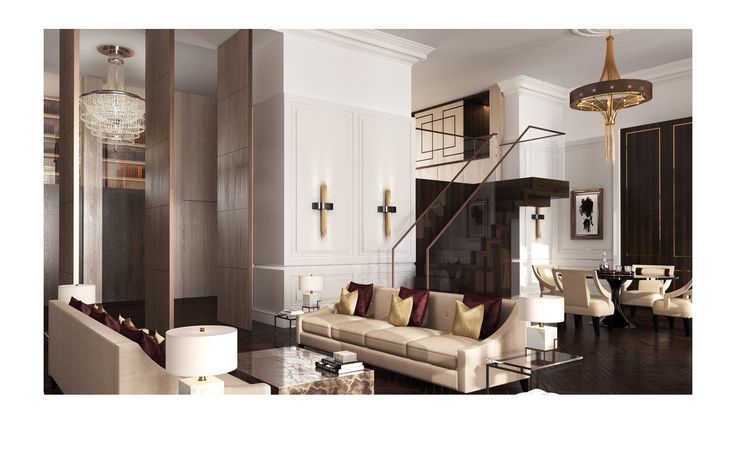
April Hamilton Designs produced this great looking home cinema studio. I remember bringing back a projector from work about 15 years ago, it linked into my laptop and I brought home too one of those pull-down portable screen. 3 of us crammed into a small bedroom watching Finding Nemo (or similar)…how things have changed !! We looove the straightforward colour scheme and, in particular, the red silk velvet cushions and beautifully textured brown upholstery fabric.
KOTHEA supply numerous velvet collections including luxurious Italian Silk Velvet fabric which can readily be used for cushions as well as residential upholstery.
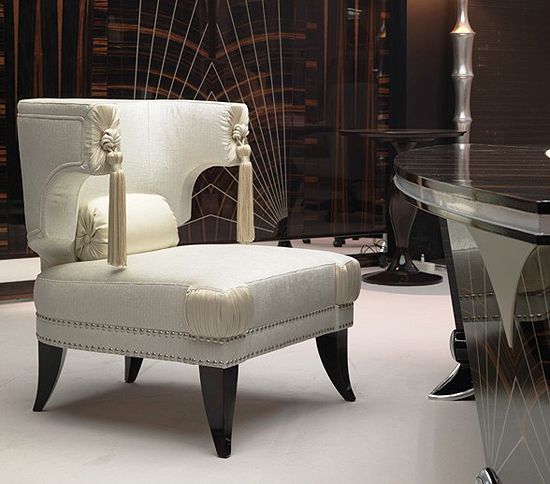
This rather regal looking High Back Neoclassical Chair is from Taylor Llorente, another of the great or unusual chair and seating designs. We love the white silk upholstery fabric. At KOTHEA we have many silk collections including faux silk for non-fading curtains – ideal in contract situations where there are high light levels. You can get samples of KOTHEA fabrics here.
A nice straightforward and great looking bar interior from Trevillion. The banquette and bar face/wall look great in the brown faux leather. As do too the bar stools with the brown faux leather upholstery.
Striking black faux leather upholstery contrasting with an ornate white wooden frame.
KOTHEA faux leathers are meet many of the most demanding interior design requirements our clients present us with. From marine walling to contract upholstery. We have it covered (ha ha!).
I’ve covered the leather vs. Faux Leather debate before on this blog. Today we received this interesting newsletter (reproduced below) from one of our suppliers who tests fabric. HSTTS. Whilst the detail will probably wash over most of our heads it is VERY enlightening to see all the stuff that is in leather (below). You assume that leather is natural as it comes from an animal but look at all the chemicals that can be used in the treatment/curing process for leather production. Sobering stuff.
EU amends REACH on hexavalent chromium
On 25th March 2014 the EU published REgulation 301/2014 concerning the presence of hexavalent chromium in leather articles and leather components of other articles.
Under the new Regulations the amount of Chromium VI present in leather articles or leather parts of articles shall not exceed 3 mg/kg (0.0003 % by weight). The method of test for Chrmium VI is BS EN ISO 17075.
The new Regulation has a 12 month transitional period until 1st May 2015 to allow the sale of existing stocks of leather articles and leather goods into the EU market. After this date, leather components or articles must comply with the new restriction limit.
EU adds 11 new CMR substances to Annex XVII
On 27th March 2014, the EU issued Regulation 317/2014 amending REACH (Regulation 1907/2006) concerning the classification of carcinogenic, mutagenic and reprotoxic substances (CMR).
Under the new amendment, indium phosphide (CAS No 22398-80-7) has been added to Annex XVII Appendix 2 “List of carcinogens – category 2”. Indium phosphide is used in the semi-cocnducter industry and is unlikely to be found in most textile products.
Trixylyl phosphate (CAS No 25155-23-1) and 4-tert-butylbenzoic acid (PTBBA)(CAS No 98-73-7) have been added to the list of toxic for reproduction chemicals in appendix 6. Trixylyl phosphate may be found in some flame retardents and plasticisers in plastics and is often combined with phthalates, some of which are also controlled under REACH Regulations. PTBBA is sometimes used as a thermal stabiliser for PVC and in the production of polyester and alkyd resins. The restrictions on these 3 substances come into immediate effect as from 1st April 2014.
A further 8 substances (1 carcinogen and 7 reprotoxic substances) have also been added to the Appendices of Annex XVII. These include:
Of these, APFO and PFOA (also sometimes known as C8) used to be employed in the manufacture of Teflon® and Gore-Tex® and may still be used in the manufacture of similar textile coatings and treatments. Similarly DHP may be found in flexible PVC, PU and rubber coatings included the expanded coating layer of leathers and textiles, PVA adhesives and paints. The restrictions on these substances will take effect from 1st January 2015.
In addition “pitch, coal tar high temp” has been reclassified as a carcinogen (category 1), mutagen and reprotoxic substance.
More great design from London based superyacht designer, Andrew Winch. Simple, luxurious. The marine environment presents issues when choosing fabrics. The ever-present sunlight and rain/wind/salt focuses the yacht manager on maintaining surfaces even more so than a hotel’s housekeeper. KOTHEA have some great marine fabrics including white and beige faux leather.
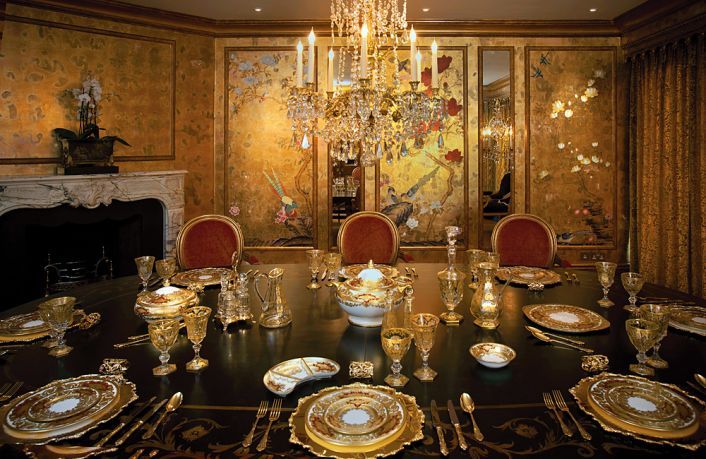
Annabel Hall Design created this opulent and golden interior, probably in deepest, darkest Surrey. KOTHEA sell several gold fabrics ranging from luxurious silks to contract grade faux leather upholstery fabric.
Designers 1508 London created this luxuriously designed London room Beautifully high ceilings with great attention to many details. We love the classically simple upholstery with a plain taupe-to-beige linen.
Anna Owens Designs have this great master bedroom shot. We particularly like headboards with textured or unusual fabrics. One of our favourites is Faux Leather – upholstery or headboards, fine either way.
Most interior designers these days use social media. They might not use it effectively but they do use it. They might be using the wrong social media…but, yes, most still use it.
You: So, how do I best choose social media to ‘reach out’ (well that means “sell”, I guess) to my target markets?
Me: Well, silly, you use the same social media that your (potential-) clients use.
You: Ah! But what are they?
Me: Oh! 🙂
Well of course “It depends” is really the answer. Just as there are different types of interior designer so too are there different types of customer. If you understand your ‘type(s)’ of customer then you should already know where they digitally hang out. If, indeed, they do that sort of thing at all. Some won’t.
Anyway, as a guideline look at and consider the following:
A. Interior Designer With A Shop or online shops (e-commerce)
Choose: Mass-market retail-type social media: Twitter, pinterest, Google+ and Facebook
You need to work with images, with advertising and frequent/unique content in a highly sales driven way. Focussing on content that converts to sales leads.
B. Practice-Based Residential interior designer (mid-, top-end)
You need a great portfolio showcase somewhere. Probably on your own website. You might also reach out with your selected portfolio to PINTEREST. There’s also a good chance that many of your clients (or at least their partners) will use LINKEDIN. Showcase your service there as well.
You might also consider targeting advertising on facebook where you can select your demographic market quite precisely which will then, of course, mean that you should have a FACEBOOK presence as well.
As a one-off, you should also have a HOUZZ presence. But do not give too much away there. Make your content inspiring but tantalising. Link all the images and content back to YOUR website. Do NOT link to their website and let your leads go elsewhere. C. Hotel / Commercial interior designers
Twitter, LinkedIn and Pinterest are the sites to use here. However, you CANNOT use them half-heartedly. You really have to interact on these sites. Not just with people looking at your content there but also, on Pinterest, with target clients.
Even then your success here will be limited. The phone call to find out about re-fits, office moves and new hotels will prove the best way to generate new leads. Perhaps couple that with industry knowledge site such as https://hotelprojectsworldwide.com.