Only few days are left for the start of the eleventh edition of the Master in Interior Design, which has trained more than 300 designers from all over the world since 2003, showing that the MID is now the most qualified location of post-graduate training for Interior Design.
MID is a collaboration between the School of Design of Politecnico di Milan, Scuola Politecnica di Design-SPD and POLI.design – Consortium of Politecnico di Milano. The program involves always the best Italian studios from each area of intervention.
The Master has a professional orientation and offers a system of design activities, such as: workshops, visits and seminars by testimonials together with theoretical contributions on specific topics that include: lighting, materials and technologies for interior and the history of interior design.
Watch the video of some of the best projects developed by students during the first 10 year of the Master:
The theme chosen for the event addresses the highly professional level of the training that provides an internship for all students at the end of the course for a period of 3 months.
In fact, each year many partner studios host students of MID in order to provide them a professional approach in their career. Among these studios there are CRM Project Studio, Studio Lissoni Associati, Studio Simone Micheli, Studio Marco Piva, Studio Denis Santachiara and many others.
The course is open to graduates or undergraduates in interior design, architecture, design and equivalent area or candidates, who have a university education and have completed previous professional experience in the field.
For further information contact the Ufficio Coordinamento Prodotti Formativi: phone +39 02 2399 7275 or write to formazione@polidesign.net
This antique Chesterfield sofa was crafted with quality oxblood leather
We have written before about how upholsterers typically apply color to leather Chesterfields, and even how these marvelous sofas and chairs were first invented. Yet, the process of making a Chesterfield sofa includes so much more. The entire process includes several stages, starting with the design itself and ending with the last leather panel to be attached to the frame.
Every Chesterfield begins with an idea
Traditional, antique style Chesterfield sofas have changed little over the past few centuries. The first of its kind is believed to have been commissioned in the early 18th century by the Fourth Earl of Chesterfield, Philip Dormer Stanhope. Defined as a sofa or chair with buttoned leather, often with armrests and a backrests that are the same height, the basic Chesterfield design has evolved to include a number of variations, nearly all of them belonging to a particular style and named for their place of origin.
Once the design has been chosen, it is drawn out by the master craftsman, often simply with pencil and paper. This will provide a visual template to work from later on, so the drawing often includes artistic shading and characteristic folds in the leather. Other drawings might detail the underlying frame, including measurements and materials needed.
Building the frame
Once a design has been selected, the craftsman will then begin work on the frame. Usually this is made of solid wood, since Chesterfields tend to be high quality items requiring strict structural and aesthetic standards. Everything later in the process will be added onto this basic foundation for the body of the piece, so it must be crafted with care.
Stuffing the cushions
Next, springs and stuffing are added. Sometimes, horse hair or a similar product is used. Today in the UK, the birthplace of Chesterfields, many quality manufacturers now use durable, flame-resistant foam. Fabric is sewn onto the frame for holding the stuffing, then covers are sewn on to keep it in place. Small holes are made for the buttons that will go on once the leather has been fastened.
Upholstering the cushions
The upholstery can be made of any number of materials. Traditionally, however, the material is top grade cowhide leather. This can be aniline dyed, semi-aniline dyed with a protective polymer layer, or pigmented with what is essentially paint for leather. However, velvet, linen, or any number of other fabrics are often used. Once chosen, the material is sewed onto the frame using distinctive folds around the armrests and across the holes where the buttons will fasten the leather for a complete hold; brass brads are also often used to pin the leather in place.
Typically, stuffing and upholstering are performed on different sections of a Chesterfield at different points in time, so that the backrests and armrests will be upholstered and buttoned before the seat, sides and apron. This allows for the next step in the process to take place.
Fastening the buttons
In the final step of crafting a Chesterfield sofa, leather-capped buttons are fastened onto the holes in the leather. One end of a string is tied to each button, with the other end attached to a small tool that is directed through the hole. Pulling on the tool tightly will bring the button into its snug place on the leather. Next, the string is tied to the frame; the sofa is upholstered in sections precisely so that these strings can be attached before the leather panels and fabric cover on the bottom are in place. The Chesterfield is now complete!
Abigail’s little Black Book is probably fuller than my little red book. Note to self: change colour of book and get more pages and then ask Abigail for a copy of a few of her pages!


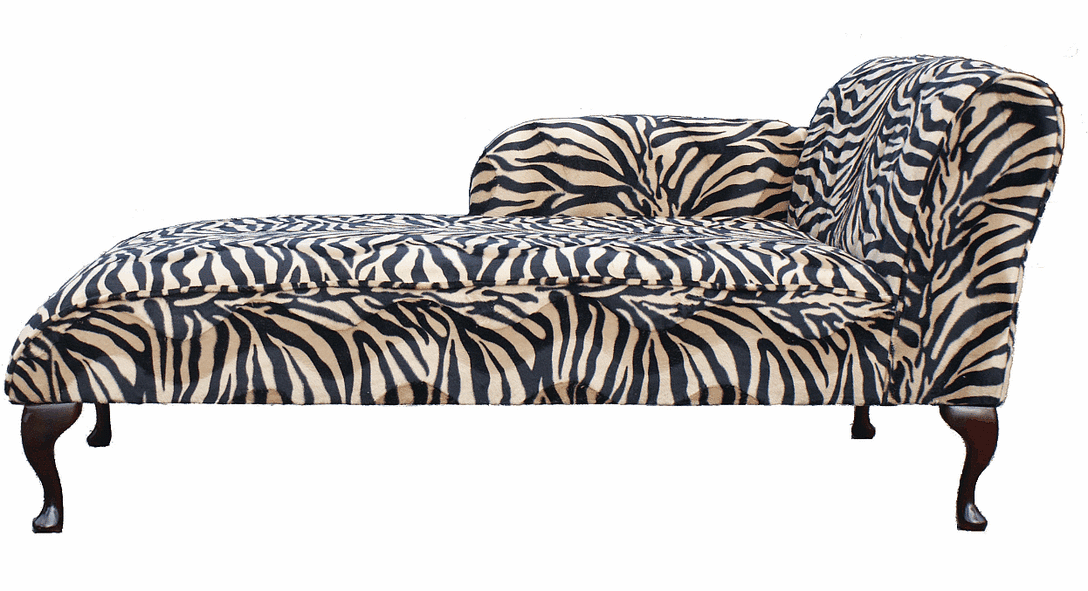
![2224c8482e2e204212a64f1dc4e62ce6[1]](https://www.KOTHEA.com/wp-content/uploads/2013/12/2224c8482e2e204212a64f1dc4e62ce61.jpg) I need one as well. Will we get a discount for 2? These look pretty good. Even better with our velvets on 😉 A nice bit of kid mohair perhaps.
I need one as well. Will we get a discount for 2? These look pretty good. Even better with our velvets on 😉 A nice bit of kid mohair perhaps.