Sofa and couch – faux leather or real leather

Dishevelled sofa
Dishevelled sofa

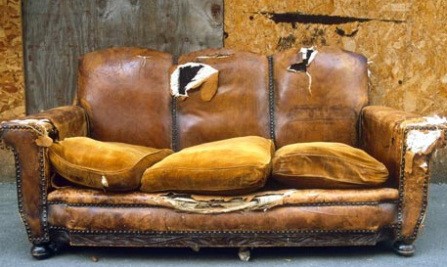
Chic, shabby chic or a bit of a mess?

Leather upholstery is limited by the size of the hide. Probably not that much of an issue on smaller sofas.

Faux leather can have very high abrasion resistance and both can be treated for fire resistance.

Care and maintenance is easier with faux leather. Repairs and colour matching are easier with faux leather, which is important if you under-order/under-specify or just need to buy some more if the project scope increases.

Fire Treating Faux Leather and Vinyls For Contract Upholstery Crib 5

Cell Leather
Cell Leather (Photo credit: Filter Forge)

Faux Leather and, indeed, vinyls in general have widely varying compositions. So it is very difficult to generalise about FR treatment.

However, as interior designers know, they are great for contract projects because of the excellent abrasion properties and the excellent ease of ongoing care and maintenance. IE they maintain their appearance relatively easily for extended periods.

Contract projects of course pose flammability requirements for the interior designer to determine and specify.

Typically CRIB5 is required for contract upholstery.

Some faux leathers come pre-treated; perhaps containing silicon/Teflon or other substances within the vinyl that limits or excludes the spread of flame required in a crib 5 test.

However some faux leathers require treating. That’s to be expected to a degree as faux leather is a relatively versatile fabric and can be used for a variety of end uses – but hence the required FR treatment will vary.

We recently treated some black faux leather to pass FR for contract curtains. In that case it was possible to treat the back of the fabric (it had a thin absorbent layer on the back) and that was sufficient to stop the spread of flame.

Another brown faux leather that we make has a speciality foam backing, slightly thicker than normal. Whilst this will take the same kind of chemical as the one for curtains the CRIB5 test has a more tricky flame to deal with. Also of consideration is the adhesive required to fix the backing and vinyl together. This adhesive may not be fire resistant again adding to the difficulty of treatment.

The thicker the backer the more luxurious the feel, perhaps. But the more difficult the treatment can be. Some sort of liner / interliner to the rear may well work to stop the flame spreading in a FR test. However, the thicker the foam backing the further away that interliner might be.

We have some specialist backing layers that themselves once set alight release gases (carbon dioxide) that reduce the spread of flame elsewhere. These backing layers do not noticeably add to the thickness of the faux leather.


&n

Contract Curtains – BS 5867: part2: 1980: Type B

New black curtains shading for the sun. (Photo credit: Wikipedia)

One of the specifications for the flame retardancy for contract curtains in the UK is Contract Curtains – BS 5867: part2: 1980: Type B.

Q: Is this the right one for you to use?
A: Maybe.

It is normally the responsibility of the interior desinger to determine what specification is required and to agree that with the local fire officer. Sometimes there might not be an interior designer. In that situation it is the responsibility of someone like, for example, the hotel owner. It is NOT THE RESPONSIBILITY OF THE FABRIC COMPANY nor is it the responsibility of the CURTAIN MAKER.

You should also tread carefully. If from your research you decide that the correct specification is BS 5867: part2: 1980: Type B then you are still not all the way there. If you plan to use other materials with your curtain or hang them in a novel way or with some sort of coating then all those ‘extra bits’ are relevant. The fire officer needs to be consulted to see if your method of making and hanging the curtains is OK.

Also note that if you are having your fabric treated by someone like Essex Flameproofing or TEK or Textiles FR then once they have treated the fabric they may well perform an indicative test. However if you are then going on to do unusual things to the fabric whilst making and hanging the curtains then you may have to have the curtain material tested by a testing house – such as TFT Ilkley. IE they test the retardancy and compliance of the made up curtain and not just the raw fabric in laboratory conditions.

If you are unsure of these opinions then please consult your local fire officer for correct guidance.

Faux Leather Martindale Test – What does it look like

Ever wondered what a Martindale rub test looks like?

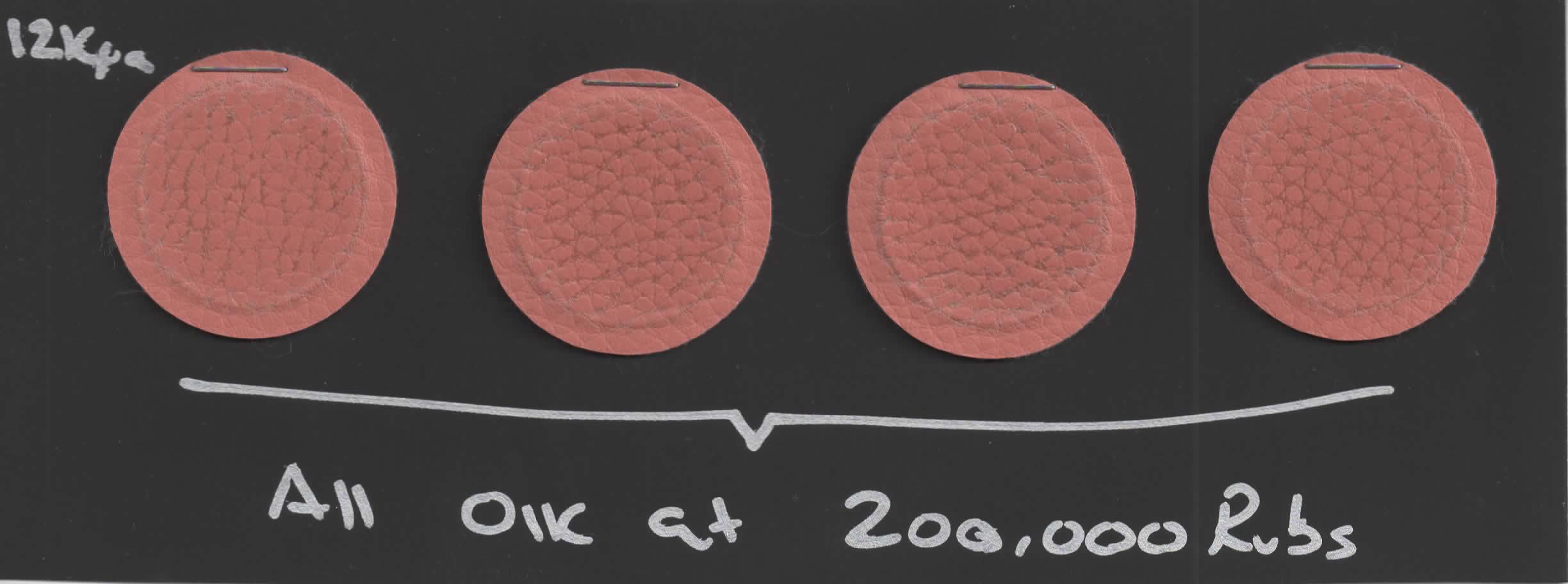
We have already shown a video of the machine in action here. Of some additional interest are the following faux leather samples that recently came back to us from the Martindale testing laboratory.

Faux Leather After Martindale Rub Test

The image above shows the circular cuttings taken of the fabric after being rubbed 200,000 times. As you can see, this faux leather lasted well above the industry standard of 100,000 rubs.

Leatherettes & Fine Faux Leather – More Collections

Leather (Photo credit: orebokech)

Faux Leathers are otherwise knows as leatherette, fake leather and artificial leather. We have a short article on their many benefits for interior designer <here>.

KOTHEA® are the UK’s leading producer of fine, performance faux leathers for the contract market.

We have some of the very highest performance faux leather fabrics with Martindale Rub Test results in excess of 200,000…some of the highest in Europe. You can specify this quality of product knowing that you can totally trust its abrasion resistance characteristics.

We have a broad range of collections covering the varied environmental needs of hospitality (spas, restaurants, hotels), marine (yachts), office and household (apartment, villa) usage. Our technical innovation gives the best fabrics and our designers the best patterns and extensive colour palettes.

Related articles

What is faux leather? When should an interior designer use it?

For a full comparison of PVC, PU and silicone faux leather types across Martindale rub count, fire rating, cleaning compatibility and environmental profile, see our faux leather types compared guide.

English: Leather tanning, Fes, Morocco Français : Tannage du cuir, Fès, Maroc (Photo credit: Wikipedia)

Faux leather looks like leather. It is a fabric made out of materials other than leather. Faux is the French for ‘fake’. So it is fake leather. It is cheaper than natural leather and much easier to work with in many cases. As well as a fabric for interiors it is used in many industries: it could be in your car or could make the case covering your iPAD. In the interior design world you would use it for: upholstery and wall-covering but also to cover, doors, table-tops, bar stools, bars, etc.

Types of Faux Leather

There are two main chemical types of faux leather:  polyvinyl chloride (PVC) and polyurethane (PU). Both types are used in making clothing, upholstery, and product covers; typically KOTHEA use PVC For our faux leathers. We are able to obtain fine faux leathers with amazing properties as a fabric including extremely high Martindale Rub test scores in excess of 200,000 and extremely accurate animal hide pattern copies.

Compared to Real Leather

Sometimes you can’t tell the difference unless you know what to look for. Most obviously natural leather will not have any kind of repeatable pattern. Faux leather will have a degree of ‘repeat’ but might be sufficiently subtle that you do not notice it. Natural leather has visible and irregular pores and rough edges.

Natural leather tends to have a smoother feel whereas some faux leather may well feel like plastic BUT other faux leathers will feel very similar to the natural leather. The ‘smell’ may be chemically but this could be either the chemicals that have been used to treat the natural leather or the chemicals in the faux leather. A VERY chemically smell that sticks to your hand is probably a faux leather – although most faux leathers will not have this property.

Pros and Cons

Faux leather can generally be made to have very good consistency of colour across batches and in theory can be made to any required colour (in sufficient quantity). Similarly texture and pattern can be varied and/or reproduced much more easily than with a natural product.

Care and maintenance of faux leather is greatly superior to natural leather which requires conditioning. Faux leather can be bought by the metre whereas natural leather must necessarily be bought by ‘the hide’ and hence has join, length and width constraints not necessarily found in the faux alternative. Faux leather generally has superior light fastness and durability.

The animal lover will appreciate that faux leather does not require animals to die. But then again many animals die each year to support the meat industry and leather is an abundant by-product that, if used, you might argue avoids waste. KOTHEA do not sell natural leather.

When should I specify FAUX LEATHER for interior design?

There is certainly a kudos surrounding natural leather. It IS viewed a s a more desirable product. However I’m really not sure why; especially when you look at it logically.

Faux leather is much easier to work with; it is much better suited for any kind of long term interior design use – looking at durability and care & maintenance; it can look and feel the same as natural leather. It is made of chemicals but chemicals (often environmentally damaging ones) are used in the natural leather treatment process.

Whilst I might buy natural leather shoes I would only specify faux leather in a contract interior design situation and would probably also specify faux leather in my house with the possible exception of a statement sofa.

Related articles

Fine Faux Leather Upholstery – New Contract Fabrics With High Abrasion Martindale

Fine Faux Leather Blue Upholstery Contract UsageUpholstery faux leathers are one of our many collections being revamped in 2013. We have introduced a new faux leather with a Martindale rub test score exceeding 200,000. This is one of the highest available in the UK.

It still looks great and also has the added comfort factor of the interior designer knowing that it can be a worry-free product to specify for even demanding contract environments. Providing that it is correctly upholstered and specified it will withstand very significant amounts of abrasion.

More Black Faux Leather Upholstery

Faux Leather is great for upholstery. Here is a time lapse video of the full process if you want to know how it is done. We would be happy to point you to a local upholsterer but please remember that we only sell the faux leather upholstery fabric. If you would like samples please drop us an email request <here> (trade only). We have several collections of faux leather in most colourways including base colours (black, brown, green, blue, red, yellow, gold) muted neutrals and metallic finishes.

[youtube=https://youtu.be/E333E2nRke4]

Faux leather Upholstery

Pinterest Picks
Pinterest Picks (Photo credit: CieraHolzenthal)

Recently we have had some detailed enquiries about how to upholster with the fine upholstery faux leather that we sell. KOTHEA are certainly NOT expert upholsterers and those questions should be aimed at your professional upholsterer.

Having said that here is a video (below) by Christopher Nejman showing some techniques for faux leather upholstery.

For more information about our faux leather products and colours click <here> or use the links on the right.

[youtube=https://www.youtube.com/watch?v=gcQfbojcY0w]

Tatami and Raffia Wallcoverings and Fabrics For Interior Designers

Tatami Wallcovering And Upholstery Fabric TextileRaffia and Tatami are often terms that are used synonymously these days by some interior designers.

Tatami are woven Japanese floor mats. Originally they were made from (rice-) straw but now they are made from a variety of materials with better properties for fire resistance, warmth and general comfort. Typically Tatami mats are made to be twice as long as they are wide and they are usually about 2m long.

Raffia (often Raphia in the USA) refers to fibres made from a tropical tree. Specifically raffia is made from the leaves of a specific palm tree called “Raphia ruffia”, which is usually found in Madagascar and more generally in Africa. A different variety in South America is “Raffia taedigera”.

Raffia that is more suited to top market interior design projects will probably often be made from other materials – one of the particular note would be made from high quality cellulose pulp.

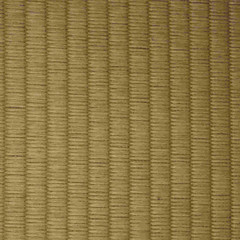
So, often when clients ask for Tatami or Raffia they are really often asking for a straightforward, grass-like, woven fabric similar to that shown in the main image accompanying this article.

Click To Read More Interior Design Articles

Such raffia and tatami fabrics are usually available by the meter and have additional properties making them more superior to traditional variants. For example having high martindale test scores making them suitable for upholstery and coming pre-treated for fire retardancy.

Click <here> to request samples.

Tatami and Raffia by the meter may also be quite flexible allowing it to be fastened around wooden frames and then used as a textured finish for walls and ceiling.

With Wyzenbeek rubs of 40,000 KOTHEA’s 2011 Raffia (Raphia) are also eminently suitable for a wide range of upholstery uses.

Raffias can usually be fire treated to meet a wide range of contract requirements including hotels and marine installations.

This type of raffia weave has been used for thousands of years perhaps most famously as Japanese Tatami mats. They are of course one of today’s modern day design staples for a clean, modern look.

Links: