
blog-tweet?
Stunning in white
blog-tweet?
Drop cloth seats in white
blog-tweet?
Great Spiral Staircases
blog-tweet?
CEMENT FINISHES – part 2
having carefully calculated the amount of cement for our new studio exterior render I was nervous about all the bags that were left over. Needless to say almost pure sand does not stay attached to blockwork for very long. 🙁
11 Most Hilarious Interior Design Ideas
hose or house ! I love lists especially ones that are not a round number. I’m off to read your 11.
Add a Layer to Your Decor

Good comments about layering, many thanks.
Request Sample Swatches

Leather sofa repair – car upholstery
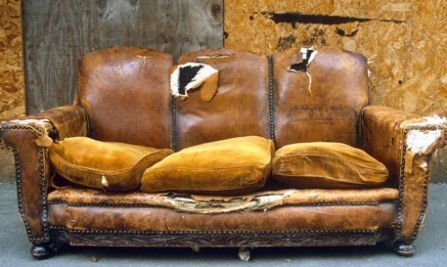
We have seen many instances of clients re-upholstering sofas and chairs when really it was not needed.
In the specific example of leather what has often happened (ignoring cuts) is that the surface or finish has been damaged; scuffed, if you like.
Leather is well able to last the test of time if cleaned and maintained well, however even the best-kept sofa is prone to the occasional accident – the rogue popper on trousers, a buckle on a dog collar or perhaps over zealous friends of your children, not your children of course!
The image above shows a sofa definitely in need of re-upholstering. This one has most certainly seen very much better days. However an errant scuff to your beloved sofa could perhaps often be completely repaired simply by applying a dye. Other noticeable issues that you could have with your sofa could include patchy areas of fading, a degree of cracking or perhaps even burn marks. All of these types of visual damage are potentially able to be repaired with a little love and care.
A professional upholsterer will be able to undertake leather sofa repair quite easily. However the option also exists for the DIY homeowner to use professional materials to perform a, hopefully, similar standard of work.
Such materials would include dye but also chemicals that can remove any grease/oils and then add a pigment and other chemicals that can ‘fix’ the pigment in place.
A similar scenario applies to car leather repair in your beloved automotive friend. Perhaps as a prelude to selling a car you want to rejuvenate the leather or, again, make some minor repairs. Whilst a home sofa might get more use than your car leather the rigours of twisting around and getting in and out of the car may, in fact, make it more liable to get damaged and sometimes we all might be guilty of possibly not taking as much care with our cars as we do with our homes.
Leather vs Faux Leather for upholstery

I’ve covered the leather vs. Faux Leather debate before on this blog. Today we received this interesting newsletter (reproduced below) from one of our suppliers who tests fabric. HSTTS. Whilst the detail will probably wash over most of our heads it is VERY enlightening to see all the stuff that is in leather (below). You assume that leather is natural as it comes from an animal but look at all the chemicals that can be used in the treatment/curing process for leather production. Sobering stuff.
EU amends REACH on hexavalent chromium On 25th March 2014 the EU published REgulation 301/2014 concerning the presence of hexavalent chromium in leather articles and leather components of other articles. Under the new Regulations the amount of Chromium VI present in leather articles or leather parts of articles shall not exceed 3 mg/kg (0.0003 % by weight). The method of test for Chrmium VI is BS EN ISO 17075. The new Regulation has a 12 month transitional period until 1st May 2015 to allow the sale of existing stocks of leather articles and leather goods into the EU market. After this date, leather components or articles must comply with the new restriction limit. |
EU adds 11 new CMR substances to Annex XVII On 27th March 2014, the EU issued Regulation 317/2014 amending REACH (Regulation 1907/2006) concerning the classification of carcinogenic, mutagenic and reprotoxic substances (CMR). Under the new amendment, indium phosphide (CAS No 22398-80-7) has been added to Annex XVII Appendix 2 “List of carcinogens – category 2”. Indium phosphide is used in the semi-cocnducter industry and is unlikely to be found in most textile products. Trixylyl phosphate (CAS No 25155-23-1) and 4-tert-butylbenzoic acid (PTBBA)(CAS No 98-73-7) have been added to the list of toxic for reproduction chemicals in appendix 6. Trixylyl phosphate may be found in some flame retardents and plasticisers in plastics and is often combined with phthalates, some of which are also controlled under REACH Regulations. PTBBA is sometimes used as a thermal stabiliser for PVC and in the production of polyester and alkyd resins. The restrictions on these 3 substances come into immediate effect as from 1st April 2014. A further 8 substances (1 carcinogen and 7 reprotoxic substances) have also been added to the Appendices of Annex XVII. These include:
Of these, APFO and PFOA (also sometimes known as C8) used to be employed in the manufacture of Teflon® and Gore-Tex® and may still be used in the manufacture of similar textile coatings and treatments. Similarly DHP may be found in flexible PVC, PU and rubber coatings included the expanded coating layer of leathers and textiles, PVA adhesives and paints. The restrictions on these substances will take effect from 1st January 2015. In addition “pitch, coal tar high temp” has been reclassified as a carcinogen (category 1), mutagen and reprotoxic substance. |