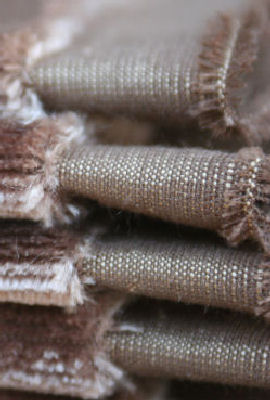
Designer Fabrics & Luxury Wallcoverings 2012 – Latest Collections of Faux Leather & Raffia

British Institute of Interior Design

Interior Design 101. Back to basics.

Minimally patterned, plain and simple patterns matter when you choose designer fabrics for your interior design scheme. It’s not just the ‘important’ stuff you have to worry about; it’s all the stuff.

Design after design. Pattern after pattern. Squashed into corners. Covered ceilings. Hung on walls. Something here, something there… OK you might have certain pieces that take centre stage in your grand design but you also have to set the stage with the backdrops, the reflected light, the subtle blend of auxiliary textures.

To a certain degree, if you must, you can compromise on the backdrops. It’s great having a silk panelled wall, relatively inexpensive and good to the touch. Not so good when it fades at differing rates in the exposed sun-lit areas of the room.

So when you choose designer fabrics yes you should be wowed by the colours, designs and textures BUT you should also be wowed and interested in the technical properties. Your clients might initially thank you for a great looking job. They won’t thank you if it starts to fall apart. they may well have already paid you at that point (so you’re OK right?) but will you then get recommended to their friends…probably not. It is so, so easy to make this kind of mistake.

So try faux silk rather than silk. It looks and feels pretty much the same but can be excellent in terms of non-fading.

So try faux leather. A wide variety of finishes and qualities are available and many are great for wall covering (!) as well as upholstery. Great to cover chairs or a bar in a restaurant but also in your kitchen as they can relatively easily be cared for and cleaned. If you love leather you might find that your upholsterer might not love that choice as you are working with hides of varying sizes, whereas with faux leather you are working with a fabric available by the metre.

Click for faux leather or faux silk designer fabric samples.

Fabric Awards 2011 – Homes & Gardens

Image via Wikipedia

23 September 2011, Decorex and Homes & Garden Magazine will be looking for the most inspirational fabrics and wallpapers that are launched in Spring or Autumn 2011.

There are several awards that may interest readers including

Here is a link to the 2010 winners. See if  you are inspired. On the whole we weren’t.

Wyzenbeek – Martindale – Abrasion Testing

If you were given one pound for every time an interior designer asks which upholstery fabric is most durable, you would retire quickly. The answer is more complicated than a single test result can convey, and understanding why is useful when specifying fabric for a client.

What Abrasion Tests Actually Measure

Martindale and Wyzenbeek are abrasion tests. They measure one specific property: how many times a fabric can be rubbed against a standard surface before showing visible wear. They do not measure fibre strength, yarn construction, weave complexity, resistance to soiling, light fastness, or how well the fabric performs when cleaned. All of these variables also affect how long an upholstery fabric lasts in use.

There is a close relationship between fibre strength and yarn strength. Yarns are twisted to add strength, and a tighter twist generally produces a stronger yarn. This is measured in twists per inch or per metre. Tightly twisted yarns tend to be smooth and dense. Weave design adds another layer of complexity. The same fibre in different weave constructions can produce very different abrasion results. A fabric’s rub count is the outcome of fibre, yarn, and weave working together, which is why a single figure cannot tell the whole story.

The Two Tests

Martindale is the standard used in the UK and Europe. Wyzenbeek is the standard used in the United States. The two tests use different motions, different abradants, and different specimen orientations. There is no reliable correlation between them, and a result on one test cannot be used to predict a result on the other.

With Wyzenbeek, tested to ASTM D4157, a piece of cotton duck fabric or wire mesh is rubbed in a straight back-and-forth motion across the fabric until noticeable wear or thread break occurs. Each back-and-forth motion is one double rub.

With Martindale, tested to BS EN ISO 12947, the abradant is worsted wool or wire mesh and the fabric specimen is circular. The rubbing follows a Lissajous figure-of-eight pattern rather than a straight line. Each complete figure of eight is one cycle.

Specification Thresholds

The following figures represent standard guidance for specifying by application. For heavy duty contract use, the recommended minimum is 30,000 Wyzenbeek double rubs or 40,000 Martindale cycles. For general contract use the minimum is 15,000 Wyzenbeek double rubs or 20,000 Martindale cycles. For heavy domestic use the minimum is typically 15,000 Martindale cycles. For general domestic use, 15,000 to 25,000 Martindale cycles covers most applications. For light domestic or occasional use, 10,000 to 15,000 Martindale cycles is generally acceptable.

At results above 100,000, the practical difference in longevity becomes less meaningful for most residential applications. The cleaning and maintenance regime applied to a fabric will have more influence on its service life than the difference between a 100,000 and a 200,000 rub count.

On the Validity of Test Results

Some commentators question the reliability of abrasion test results. In the UK, test houses are independent and operate under British Standards monitoring. No individual fabric company is large enough to influence results, and it is in no supplier’s interest to undermine the authority of the independent bodies that regulate the industry. UK Martindale figures can generally be taken at face value when supplied with a third party test certificate from an accredited laboratory.

For the full technical methodology of the Martindale test, rub count classifications by application, and a detailed Martindale versus Wyzenbeek comparison, see: The Martindale Rub Test: A Complete Guide for Interior Designers and Specifiers.

For a direct side-by-side comparison of the two test methods, see: Martindale vs Wyzenbeek: Rub Test by Abrasion Explained.

Request Samples

Order cutting samples of any fabric from our current collections. Trade accounts only.

Order Cuttings

Mohair Velvet & Other Velvets

For a complete comparison of all velvet types including full specification data, see: Velvet Types Compared: A Complete Specifier’s Guide for Interior Designers and Architects.

Silk Velvet Upholstery Fabric TextileMohair Velvet is a type of fabric made from Mohair Wool. It is usually used for upholstery. A velvet is a fabric that is made in a certain way usually ending up with a pile; importantly it can be made from many different fibres including mixtures of fibres.

Mohair Velvet – A velvet made from natural Mohair Wool. Typically durable with high Martindale rub test results. Natural fibres give a degree of inherent fire retardancy.

Cotton velvet – A velvet made from natural cotton

Linen Velvet – a velvet made from natural linen typically an excellent domestic upholstery velvet.

Silk Velvet – Potentially beautiful and amazing velvet fabric made from silk but a high degree of quality variation across manufacturers.

CS Trevira – Made from synthetic Trevira. Excellent contract velvet.

Cashmere Silk Velvet – Extremely high quality luxury fabric. Mix of two natural fibres ie Cashmere Wool and Silk. Combines beauty with durability.

Vicuna Silk Velvet – Extremely high quality and rare luxury fabric. Rarely available as an interiors fabric.

Cotton & Silk Velvet – A less expensive way to strengthen the beauty of the silk with the strength of cotton. Cotton being cheaper than Cashmere wool for example!

Note also that a velvet is made with a back cloth material. It is not unusual for an extremely fine top market velvet to have a 100% cotton back cloth.

Contract Upholstery Fabric – How to Specify It

For a comprehensive guide to specifying fabric for hotel and hospitality projects, including Martindale thresholds by room type, BS 7176 fire certification, cleaning regime compatibility, and dye lot strategy, see: How to Specify Fabric for Hotel and Hospitality Projects.

A quick guide to specifying contract upholstery fabrics. The main areas to consider are as follows.

1. Determine Use

Is it panelling or seating? For seating you will need to consider flammability (cigarette, match, and Crib 5) and abrasion (Martindale).

2. Fabric Composition

The composition of the fabric including the yarn and weave will affect long-term wear, appearance, and technical performance. Natural fabrics such as wool can be more expensive but generally offer good handle and technical characteristics including natural flame retardancy. Man-made fabrics are usually easier to maintain but require careful selection to achieve the right aesthetic.

3. Flammability

The standard for contract seating acceptable throughout the EU is EN 1021 Parts 1 and 2 (cigarette and match). Higher-level standards in the UK are BS 5852 Crib 5 and BS 7176. The standard for vertical surface fabrics is BS 476 Part 7. For a full explanation see our complete guide to BS 5852 Crib 5.

4. Abrasion

Check the Martindale rub count for the fabric. For contract seating in hotels, restaurants, and offices, a minimum of 40,000 Martindale rubs is the standard threshold.

5. Environmental Considerations

Natural fibres such as wool generally have better environmental credentials than synthetic alternatives. Nylon in particular has a high environmental impact.

6. Care and Maintenance

Contract fabrics typically deteriorate from dirt accumulation rather than abrasion. Follow the manufacturer’s cleaning instructions. Remove stains promptly and vacuum regularly.

Request Samples

Order cutting samples of any fabric from our current collections. Trade accounts only.

Order Cuttings

Black Velvet – Even Better Italian Silk Velvet In Black

Black Velvet – only to be enjoyed by those who appreciate that black is the new black! KOTHEA have a range of velvets with shades of black colourways in most of those velvet collections.

“Black Diamond” is the colourway name for the Italian Silk Velvet (100% Silk Pile) with the code 777-108-900.

You can get black silk velvet samples here from KOTHEA if you are a trade professional. Just click the link.

KOTHEA velvets are the best in the market. We only sell top market fabrics, mostly to top European Interior Designers and Architects. Here are some more bits of technical information on our black Italian Silk velvet fabric:

Width: 140cm

Composition: 100% Silk Pile

No repeat, plain.

Abrasion: Martindale 20,000.

Available from stock, normal delivery within 5 days.

Minimum Order length: 2m

Dye Lot Samples vs. Stock Cuttings

What is the difference between a dye lot sample and a stock cutting?

In the UK those phrases are taken to mean the same thing. But that is not universally true so I will explain.

When you as an interior designer are about to place an order you need to get a cutting which you keep in your records stating exactly what colour the fabric will be. So you need a cutting from the exact roll of fabric which is going to be cut for you by the supplier. Once you have a this “dye lot sample” or “stock cutting” the onus is then on the supplier to supply you with the exact fabric.

Is this always important?

This is particularly important as the colour of many fabrics vary slightly between different batches of production. This is common across all suppliers.

Usually, however, it will not matter if your ENTIRE order comes from a roll that was different from the original sampling. The difference will be trivial and not noticed.

But if you are being supplied with more than one piece then it often DOES matter. The different rolls of fabric when made-up side-by-side can be noticeably different.

Sometimes even if the fabrics are different; the way they are made up, the lighting or where they are in a room can make the difference not noticeable.

Various technical reasons explain all of this, such as the variability of colour in man-made dyes, however designers need only know that it can and often does happen that fabrics vary slightly in their colour.

If in doubt obtain a dye lot sample/stock cutting.

Facebook – Advanced Pages For Interior Designers

Once you have set up your Facebook (FB) Fan Page for your business so that it looks and feels ‘right ‘ then it’s time to take it to the next level. So if you are at that point, read on. If not go <here>.

Note: Before you start make sure you will be working on your business page (fan page) and not your personal page. You really should be using a business page (fan page), be sure what one is before continuing as lots of people go down the wrong route and then have to start all over again, FB is not very forgiving in that respect.

OK I’m going to look at Branding, Promoting, Enhanced Navigation & Content. These are the main areas to add a bit of spice to your FB Fan Page/Business Page.

1. BRANDING.

a. You need a 200 pixels wide x 600 pixels high image of your brand. Maybe you have a logo, if so use that. Upload this to the area to the left of where it says “Wall”.
b. Header. This goes above where it says “Wall”. Change the text here so that it has your company name. What if you get the name wrong? Well if you get the name wrong you cannot change it, so you have to delete the page and start again (as at Feb 2010). So please get it right first time.

c. The same applies to the category of your page, that cannot be changed either. So when you create your page get the category right.
d. If your company is called XYZDesigns then you need https://facebook.com/XYZDesigns as your url. This article <here> tells you how to do that.

2. PROMOTING


a. You probably already understand groups on LinkedIn. Well Facebook (FB) has them as well. Start one or use existing ones like Interior Design Lovers (requires you to be logged in to FB). Promote your page in groups. BUT DO NOT SELL, SELL, SELL. Let people know about the information your FB page will provide them with. Remember further that few people are interested in your business per se, they are more interested in what it can do for them. So talk about solving problems and NOT saying how great you/your services are. The sell-sell way does not usually work.

b. User comments. Engage with your fans, reply to them. Promote yourself to these people and remember that they are already on your page and are taking the time to write something, probably to find out something, so they have more than a passing interest in what you do. Again soft-sell not a hard sell. Try to help them.

c. Facebook Advertising.

You may have tried Google AdWords advertising or the Yahoo and Microsoft equivalents (they are each very similar to one another). Maybe they have worked for you, maybe not. Facebook also allows you to advertise your services. They take a slightly different approach to the other 3 by targeting the FB user base. I particularly like how you can be much more specific about the region and demographics of the person you are targeting; FB also tell you how many people are in the demographics you specify. Worth a look especially for Interior Designers who are targeting the general public rather than other businesses. I will not go into this area in any more depth yet as it really comes under ‘advertising’ rather than building a better FB page for your business.

d. Make sure the information about your business on the left-hand side really stands out. Get some good, engaging and genuine words about your company there.

3. ENHANCED NAVIGATION


a. You can administer your FB business page (fan page) <here>. You need to be an administrator of your business fan page.

b. Go to the wall. At the top of the left-hand column you will see ‘edit page’. Go there and then choose “Wall Settings: Edit”. Change the default view to the correct page that you want a user to land on, could be your wall, could be your info page. This can be changed later if you make a mistake.

4. CONTENT


This is what will make people come back to your site. It’s really, really important! So you will need to have some new ‘stuff’ on your FB page to make it worth their while to return. That ‘stuff’ could be new videos, articles or whatever. it could also be the content of communication and engagement with like-minded design professionals working together to solve problems online…

The most obvious route is through your blog. You can display your blog as the ‘wall’ for your business page. You have a few options for example:

  • Write your blog (the original content) in FB and post it everywhere else automatically from FB. You can even write your blog by accessing Facebook from your blackberry.
  • Get your external blog synchronised into FB automatically (I use a free FB application called Social RSS and my blog is on WordPress)
  • I prefer the second approach as WordPress also automatically publishes my blog posts to other sources such as Twitter. Apparently there is a FB Fan Page-to-Twitter application but I do not use that, sorry!
  • Encourage your fans to add content (photos, etc.). That makes your job easier and makes your site content-rich for others.

Designers: What to Twitter / Tweet About

It's Me Again
It’s Me Again (Photo credit: Wikipedia)

Really, I’m not interested in what you had for breakfast, nor what the weather is. If you want to be followed by people who are not decision makers then ‘your breakfast’ or ‘which train you are currently on’ is a great thing to Tweet about. But that’s not what you want is it?

So…

1. Automatically Tweet your blog posts once a week – that’s a great way to start. If  you use a WordPress hosted blog (like this one) it’s just a case of ticking a box and you are done.

Or

2. Every day just go through your suppliers. As a designer you have lots of them. Tweet a compliment about a DESIGN RELATED supplier &/or one of their products/services.

Or

3. Maybe tweet a promotion

Remember

4. Tweets are eventually deleted from the net. So you don’t have to worry about keywords too much. If you are writing a blog post then that post will be permanent and the keywords in it are important. So with your Tweets just keep it simple, interesting and professional. Think “interesting narrative”.

But would you…

5. Tweet about your competitors? Sure if you want to help publicize their work (??) and sure if they reciprocate and Tweet back.